


Humidity Conditioning Before Paper Carrier Tape Punching: Process Checks
Paper carrier tape punching quality depends on more than die accuracy and machine settings. The moisture condition of the paper can influence its dimensional stability, cutting response, edge cleanliness, and behavior during processing. If paper rolls enter production under inconsistent environmental conditions, punching results may vary even when the same tooling and machine setup are used.
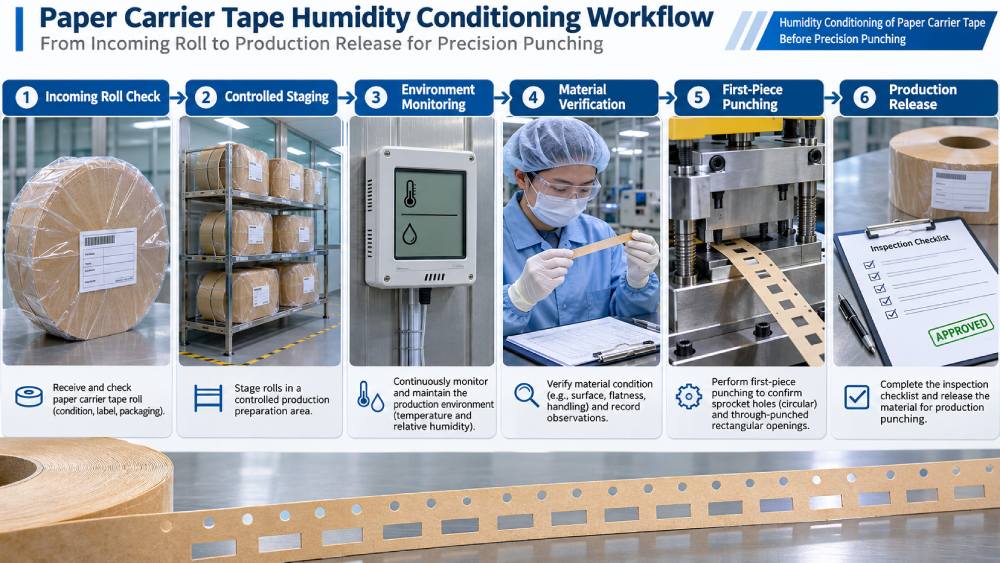
Before punching paper carrier tape, operators should verify the material identity, storage and exposure history, conditioning environment, moisture condition, and physical stability of the roll. A first-piece punching inspection should then confirm that the material meets the approved dimensional and edge-quality requirements.
This article explains how to organize humidity conditioning before punching, what to inspect, how to recognize possible moisture-related problems, and how to document material release for repeatable production.
1. Why Does Paper Moisture Matter Before Punching?
Paper is a hygroscopic material, meaning it can absorb or release moisture in response to the surrounding environment. Changes in its moisture condition may affect stiffness, dimensions, flatness, and mechanical behavior during cutting.
For paper carrier tape, these properties matter because the punching process must produce consistent component openings and sprocket holes. The material must withstand cutting without unacceptable tearing, fiber separation, or deformation.
Moisture-related variation can contribute to several production concerns:
-
Dimensional instability: Changes in paper moisture may cause expansion or contraction, affecting alignment with the punching tool.
-
Cutting inconsistency: Changes in material stiffness and deformation behavior can influence the appearance of punched edges.
-
Edge damage: Certain moisture and material conditions may contribute to cracking, fiber pull-out, or rough edges.
-
Curl and waviness: Uneven moisture distribution may affect flatness and handling during punching.
-
Feeding variation: Material distortion may interfere with controlled movement through the punching equipment.
These effects are not caused by moisture alone. Paper composition, thickness, fiber structure, coating, tooling condition, and machine tension also influence the final result.
Relative Humidity Is Not the Same as Paper Moisture Content
Relative humidity (RH) describes the amount of water vapor in the air relative to the amount the air can hold at a given temperature.
Paper moisture content describes the amount of water present in the paper itself, usually expressed as a percentage of its mass.
Although the two are related, they are not interchangeable.
A production room may have a stable RH reading while a recently delivered paper roll is still adjusting to the environment. Similarly, a roll that has been stored under different conditions may retain a different moisture state from material already held in the production area.
Paper also exhibits moisture sorption hysteresis: its moisture condition at a particular RH can depend partly on whether it previously absorbed or released moisture.
Therefore, checking ambient humidity is useful, but it does not by itself establish that a paper roll is ready for punching.
2. What Should Be Checked When a Paper Roll Enters Production?
Humidity conditioning begins with material identification and incoming-roll inspection.
Before transferring a roll to the punching machine, operators should verify that it matches the approved material specification and that its storage history does not indicate an unresolved moisture-related risk.
Verify Material and Roll Identification
The incoming inspection should confirm:
-
Paper grade and approved material specification.
-
Supplier lot number and roll identification.
-
Nominal thickness and width.
-
Surface treatment, coating, or laminated construction, where applicable.
-
Packaging integrity and visible material condition.
-
Available supplier inspection or moisture-related records.
Different paper grades may respond differently to environmental changes. A conditioning method validated for one construction should not automatically be applied to another.
For example, a treated or laminated paper may require different measurement or handling considerations from an untreated paper substrate.
Review Storage and Exposure History
The receiving or production team should determine whether the roll has remained protected during storage and transportation.
Relevant questions include:
-
Was the roll delivered in intact protective packaging?
-
Has it already been opened?
-
Was the material exposed to an uncontrolled environment?
-
Is there evidence of condensation, water contact, or damaged packaging?
-
Has the roll been transferred between areas with substantially different environmental conditions?
A roll with incomplete records does not necessarily have to be rejected. However, missing information should be addressed through the approved inspection or qualification procedure before release.
Visible waviness, edge damage, delamination, or unusual winding condition should also be recorded. These observations may indicate handling or material problems that cannot be resolved through humidity conditioning alone.
For a broader description of the manufacturing sequence, see Paper Carrier Tape Manufacturing Process.
3. How Should Paper Carrier Tape Rolls Be Conditioned Before Punching?
Humidity conditioning is intended to establish a sufficiently stable and reproducible material condition before precision processing.
The correct procedure depends on the paper grade, roll construction, initial condition, production environment, and validated manufacturing requirements.
There is no single conditioning time or RH setting that should be assumed suitable for every paper carrier tape.
Prepare a Controlled Conditioning Area
Where conditioning is required, the designated area should provide environmental control and records appropriate to the approved process.
Before placing material in the area, operators should check:
-
The temperature and RH are within the approved operating limits.
-
Monitoring instruments are functioning and have valid calibration or verification status.
-
The material can be identified and traced throughout conditioning.
-
The roll will be protected from water, condensation, and localized heat.
-
Any required packaging-removal or exposure procedure is documented.
Environmental sensors should be positioned according to the monitoring plan so that their readings represent relevant storage or processing conditions.
A reading taken near a doorway, heating outlet, or localized humidification source may not accurately represent the conditions experienced by the material.
Control Unpacking and Roll Exposure
The timing of packaging removal can influence how a roll interacts with its environment.
A tightly wound roll does not necessarily reach a uniform moisture condition at the same rate as a freely exposed paper sample. Outer layers may respond to environmental changes before material near the roll core.
Operators should follow the approved procedure for sealed rolls, partially used rolls, and material that has already been exposed to the workshop.
Important handling practices include:
-
Keeping roll identification attached throughout the process.
-
Avoiding unnecessary changes in storage conditions.
-
Preventing direct contact with water or wet surfaces.
-
Avoiding unapproved heating, forced drying, or direct humidification.
-
Using an approved sampling method when material verification is required.
If the production process requires a minimum conditioning duration, that duration should be based on validated material behavior rather than an arbitrary waiting period.
Control Transfer to the Punching Machine
Conditioning does not end with removing the roll from the controlled area.
The material may encounter different temperature and humidity conditions during transport, machine loading, or production delays.
The production record should identify when conditioning was completed and when the material was transferred to the punching station.
If an environmental excursion, prolonged exposure, or extended shutdown occurs, operators should follow the established criteria for reassessment.
The objective is not simply to expose paper to controlled air. It is to confirm that the material condition remains suitable when punching begins.
4. How Can Operators Verify the Paper‘s Conditioning State?
A useful conditioning verification procedure combines environmental records, material measurements, and physical inspection.
These checks answer different questions. None should automatically be treated as a substitute for the others.
Check Temperature and Relative Humidity Records
Record the conditions associated with material staging or conditioning, including:
-
Measured temperature.
-
Measured RH.
-
Measurement date and time.
-
Monitoring location.
-
Instrument identification.
-
Relevant environmental excursions.
A single acceptable RH reading should not replace the required conditioning history.
ISO 187:2022 describes standard atmospheres and procedures for conditioning and testing paper, board, and pulps. It provides a useful technical reference for understanding controlled sample conditioning.
However, laboratory sample-conditioning requirements are not automatically the correct operating conditions for every paper carrier tape punching line.
Measure Paper Moisture When Required
Material moisture may be verified using an approved laboratory or production measurement method.
ISO 287:2017 describes an oven-drying method for determining the moisture content of a lot of paper or board, subject to its stated applicability conditions.
In a suitable gravimetric method, moisture content is determined from the mass lost during controlled drying. The method must account for sampling and any material constituents that could affect the result.
Portable moisture meters may also be used for production screening when they have been appropriately qualified for the substrate.
However, meter readings can be influenced by:
-
Paper grade and density.
-
Material thickness.
-
Coatings or laminated layers.
-
Electrode or sensor contact.
-
Measurement depth and instrument principle.
-
Calibration and measurement conditions.
A reading from a device calibrated for another paper construction should not be assumed to represent the actual moisture content of carrier tape material.
Where moisture measurement is part of the release procedure, the sampling method, acceptance limits, and decision rules should be documented.
Inspect Physical and Dimensional Stability
Moisture measurements should be considered alongside the physical condition of the material.
Before punching, operators can inspect the paper for visible curl, waviness, edge distortion, surface irregularities, or delamination.
Tape width and thickness may also be measured against the approved material drawing or specification.
Where practical, measurements can be compared with qualified reference material or previous approved production records.
An apparently flat roll does not prove that moisture equilibrium has been reached. Likewise, an abnormal dimensional result does not automatically demonstrate a moisture problem.
Physical inspection is supporting evidence that must be interpreted together with material and process records.
5. What Is the Pre-Punching Conditioning Release Checklist?
A structured release checklist helps prevent material from entering production with unresolved conditioning or identification problems.
The checklist should cover material status, environmental history, relevant measurements, and authorization for the first-piece trial.
| Inspection Item | Verification Method | Release Requirement |
|---|---|---|
| Material identification | Check roll label and material records | Matches approved material specification |
| Packaging condition | Visual inspection | No unresolved damage or exposure concern |
| Conditioning history | Review staging records | Meets applicable approved procedure |
| Temperature and RH | Review monitored readings | Within approved limits, with excursions addressed |
| Material moisture | Approved test, if required | Meets material-specific acceptance criteria |
| Physical condition | Visual inspection | No unacceptable curl, damage, or delamination |
| Width and thickness | Approved measurement method | Within material specification |
| Release authorization | Review inspection record | Required checks completed and approved |
This table is a process-control framework. Actual numerical limits must come from the qualified material specification and manufacturing procedure.
Ready, Hold, or Reject?
Material disposition should be based on the inspection evidence.
Ready for Trial
The required conditioning and material checks have been completed, the results meet approved criteria, and there are no unresolved concerns.
The roll may proceed to first-piece punching.
Hold for Review
One or more required records are missing, a measurement is questionable, or a condition falls outside the approved process.
The roll should remain on hold until the responsible personnel complete the required evaluation.
Reject or Escalate
The material fails an approved requirement, has unacceptable physical damage, or cannot be released through the authorized corrective process.
Rejection, concession, or other disposition should follow the established quality procedure.
Importantly, passing the conditioning checklist does not mean that the resulting punched tape automatically meets its final product requirements. The first-piece punching inspection is a separate release stage.
6. What Should the First-Piece Punching Trial Confirm?
The first-piece punching trial verifies that the conditioned paper performs acceptably with the approved tooling and machine setup.
This step is particularly important when processing a new material lot, changing substrate grades, restarting after a relevant interruption, or investigating recurring punching defects.
Inspect Pocket and Sprocket-Hole Edges
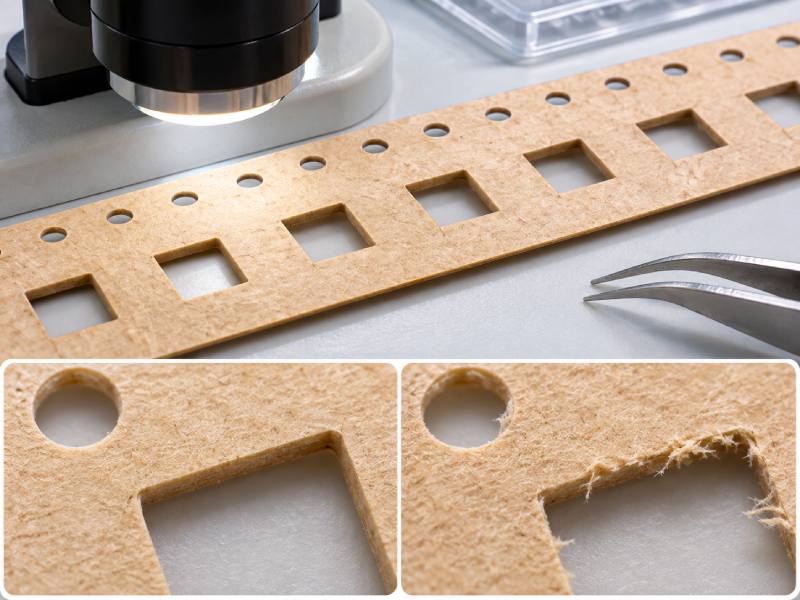
The first punched samples should be examined using the approved visual inspection or magnification method.
Inspect the component openings and sprocket holes for:
-
Rough or irregular cut edges.
-
Loose paper fibers.
-
Edge cracks or tears.
-
Raised material or incomplete cuts.
-
Layer separation.
-
Excessive debris or particles.
Inspection should cover the locations specified by the quality plan, including both component openings and sprocket holes where applicable.
The purpose is to determine whether the cutting result meets the approved acceptance criteria, not simply whether a hole has been formed.
For further technical context, see Punched Carrier Tape for SMT Packaging.
Verify Dimensions and Registration
Dimensional inspection should use the approved drawing for the specific tape design.
Relevant checks may include:
-
Tape width.
-
Sprocket-hole diameter and spacing.
-
Pocket opening dimensions.
-
Pocket-to-sprocket positional relationship.
-
Hole and cavity pitch.
-
Tape flatness and tracking.
Where applicable, A0 and B0 refer to defined pocket dimensions in carrier tape drawings. K0 or another depth-related dimension should only be checked when applicable to the actual punched-tape construction.
Not every embossed-carrier-tape dimension can be applied directly to a flat or laminated paper carrier tape.
For applicable formats, EIA-481 provides relevant carrier taping requirements. The current drawing, customer specification, and approved inspection plan determine which features must be checked.
Compare Results Under Controlled Conditions
If the first-piece result differs from previously approved production, engineers should consider more than moisture.
A meaningful comparison should account for the material grade and lot, die condition, punch-to-die clearance, tool alignment, feeding tension, and relevant machine settings.
When investigating conditioning effects, avoid changing several variables simultaneously without recording those changes.
For example, if cutting quality improves after both material reconditioning and die replacement, the improvement cannot reliably be attributed to moisture alone.
Where differences are significant, a documented comparison using consistent tooling and inspection conditions provides stronger evidence.
7. Which Punching Defects May Indicate a Humidity-Conditioning Problem?
Moisture-related variation can affect paper behavior during punching, but individual defects are rarely unique to humidity.
The practical approach is to treat moisture as one possible contributing factor and verify it against other material and tooling causes.
Possible Symptoms Under Dry Conditions
Depending on the paper construction, a relatively dry or brittle material may be more susceptible to edge cracking, fiber fragmentation, or tearing during cutting.
However, similar symptoms may appear when the substrate has insufficient mechanical strength or the punching tool is worn, misaligned, or incorrectly configured.
Moisture measurements and material history should be reviewed before assigning the cause to excessive dryness.
Possible Symptoms Under High or Uneven Moisture Conditions
A different or uneven moisture state may influence dimensional stability and cutting response.
Possible observations include increased curl, local deformation, irregular cut edges, or changes in tape registration.
Certain paper constructions may also show changes in fiber separation behavior or dimensional consistency.
The direction and severity of these changes depend on the material. High moisture should not automatically be treated as the cause of every fuzzy or distorted punched edge.
Moisture Problems vs. Tooling Problems
| Observed Problem | Possible Moisture Contribution | Other Possible Causes | Recommended Check |
|---|---|---|---|
| Edge cracking | Changed brittleness or mechanical response | Weak substrate, worn die, incorrect clearance | Review moisture state and cutting-tool condition |
| Fuzzy punched edges | Changed fiber-cutting behavior | Blunt punch, poor die clearance, paper fiber structure | Inspect tool edges and compare qualified material |
| Irregular hole shape | Dimensional or local deformation | Tool misalignment, die wear, unstable feeding | Measure hole geometry and review process settings |
| Tape curl | Uneven moisture distribution | Winding stress, laminated-layer imbalance, storage damage | Review exposure history and roll condition |
| Inconsistent registration | Dimensional variation during processing | Tension changes, feed-system error, indexing problems | Check material dimensions and feed registration |
| Layer separation | Moisture-related interface changes in susceptible material | Bonding defect, cutting stress, previous damage | Inspect layer integrity and material records |
This table identifies diagnostic possibilities, not universal cause-and-effect relationships.
A defect should be attributed to moisture only when the available evidence supports that conclusion.
When Should the Punching Tool Be Investigated First?
Tooling deserves particular attention when defects repeatedly occur at the same position, follow a specific punch element, or persist across different material lots.
Likewise, progressive deterioration during a production run may indicate tool wear or process instability rather than a change in paper moisture.
Checking the defect pattern, die condition, material measurements, and environmental history together helps narrow the investigation.
For additional defect categories, see Common Paper Carrier Tape Defects.
8. What Should Be Done When a Roll Fails the Conditioning Check?
A failed conditioning check should trigger a controlled material review rather than an immediate machine adjustment.
Changing punching pressure, tension, or tooling settings before identifying the material condition can introduce additional variation and make the problem more difficult to diagnose.
Step 1: Hold and Identify the Material
If a required conditioning criterion is not met, prevent the affected roll from entering routine production until its status is resolved.
Record the roll ID, material lot, reason for the hold, environmental history, and relevant measurement results.
If the problem is discovered during punching, determine the potentially affected production interval according to the traceability records.
Step 2: Investigate the Cause
Review the available evidence in a consistent order:
-
Confirm the material specification and identification.
-
Review conditioning and storage records.
-
Verify the measurement method and instrument status.
-
Inspect the paper for physical damage.
-
Review die condition and relevant machine settings.
-
Determine whether additional testing is needed.
This sequence helps separate incomplete conditioning, material variation, measurement problems, and equipment-related defects.
Step 3: Recondition or Apply an Approved Corrective Action
Reconditioning may be considered if the material specification and validated process allow it.
The material should not be exposed to improvised heating, direct water application, uncontrolled drying, or unapproved humidity treatment.
Reconditioning is not a guaranteed repair method. Paper that has already suffered unacceptable tearing, delamination, or other permanent damage may remain unsuitable for production.
Step 4: Retest Before Release
After an approved corrective action, repeat the applicable material measurements and inspections.
Where required, conduct another first-piece punching trial and confirm that both material condition and punching results meet the approved criteria.
Document the outcome and the responsible release authorization.
If the material continues to fail, escalate it through the nonconforming-material process rather than repeatedly adjusting the conditioning procedure without technical justification.
9. What Conditioning Records Are Needed for Production Traceability?
Consistent records help engineers investigate punching defects that appear intermittently or across different production lots.
They also make it possible to determine whether a problem follows a material batch, conditioning history, tooling change, or machine setup.
Conditioning and Material Records
A practical record should identify the roll and document how it was prepared for production.
Useful fields include:
-
Material grade and supplier lot.
-
Roll identification.
-
Material specification revision.
-
Storage and packaging condition.
-
Conditioning start and completion times, where applicable.
-
Temperature and RH monitoring reference.
-
Moisture measurement results, if required.
-
Physical inspection findings.
-
Any environmental deviations or additional checks.
Punching Trial and Production Release Records
The corresponding punching record should identify:
-
Machine and tooling reference.
-
Material roll used for the trial.
-
Approved setup or process revision.
-
First-piece inspection results.
-
Dimensional and edge-quality observations.
-
Corrective actions, if any.
-
Inspection and release authorization.
These records should be linked through the roll ID or production lot reference.
For example, if multiple reels from one material lot show a similar defect, engineers can compare the conditioning records and first-piece results with those from unaffected production.
A useful traceability record does not require an unnecessarily complex form. It needs consistent identifiers, meaningful measurements, and clear disposition decisions.
For a wider perspective on inspection planning, refer to Quality Control in Paper Carrier Tape Packaging.
10. Frequently Asked Questions
Can a Sealed Paper Carrier Tape Roll Be Punched Immediately After Delivery?
Not necessarily. The decision depends on the paper grade, packaging condition, transport and storage history, and approved production requirements.
Some materials may be suitable for processing without a separate conditioning period when their incoming condition has been verified. Others may require controlled staging or additional testing.
An intact package alone does not confirm that the roll is at the required processing moisture condition.
Is a Stable Room RH Reading Enough to Release a Paper Roll?
No. Ambient RH is only one part of the conditioning assessment.
Paper can retain a moisture state influenced by earlier environmental exposure, and a wound roll may not respond uniformly to changes in the surrounding air.
Where material moisture or stabilization verification is required, operators should use the approved method and release criteria instead of relying solely on the current room RH reading.
Can the Same Moisture Meter Be Used for Coated and Uncoated Paper Carrier Tape?
Only if the measurement method has been verified as suitable for both constructions.
Coatings, laminations, thickness, density, and other material properties may influence indirect moisture-meter readings.
A device calibrated for an untreated paper grade may not produce equivalent results on a treated substrate. Appropriate calibration, correlation, or an alternative laboratory method may be needed.
Should Conditioning Be Rechecked After a Production-Line Shutdown?
The need for rechecking depends on the duration and conditions of the interruption, the material‘s exposure history, and the approved production procedure.
If the material remains protected and its condition is covered by validated process rules, a new moisture test may not be necessary.
However, an environmental excursion, prolonged open-roll exposure, or unresolved material concern may require additional verification before restarting.
Can Humidity Conditioning Repair Paper That Has Already Delaminated?
Humidity conditioning should not be regarded as a repair process for permanently damaged paper.
Although environmental changes can affect certain material properties, they do not necessarily restore damaged fiber structures, failed bonds, or unacceptable layer separation.
Material showing delamination should be inspected against the approved acceptance criteria. If the damage is unacceptable, the roll requires authorized disposition rather than routine release.
11. What Should Be Confirmed Before the Next Production Run?
Reliable paper carrier tape punching begins with a verified material condition.
Before the next production run, operators should confirm the approved paper grade, review the roll‘s storage and conditioning history, complete the required environmental and material checks, and inspect the first punched samples.
If edge defects, dimensional variation, or feeding problems appear, moisture should be evaluated alongside tooling condition, material construction, and machine settings.
The most effective approach is to treat humidity conditioning as a documented material-control step, followed by first-piece verification—not as a substitute for punching-process quality control.
A consistent sequence of material identification, conditioning verification, first-piece inspection, and production authorization helps establish repeatable results while making future defect investigations more reliable.



 Emial
 John Mr