
Eco-Friendly Paper Carrier Tape Solutions for Sustainable SMT Packaging
As electronics manufacturers place more attention on sustainable packaging, eco-friendly paper carrier tape is becoming a practical option for many small electronic components. It helps reduce plastic use while still supporting the tape-and-reel format required for automated SMT assembly. For buyers, the key question is not only whether the material is more environmentally friendly, but whether it can also protect components, maintain stable positioning, and feed smoothly during production.
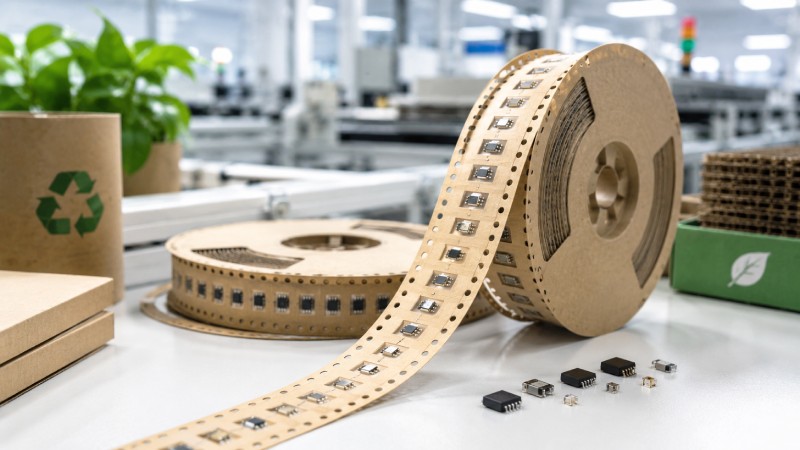
For suitable components, paper carrier tape can offer a balanced solution between sustainability, packaging efficiency, and SMT compatibility. The right design should match the component size, tape width, pocket structure, cover tape, reel format, and feeding requirements.
Why Sustainability Matters in Electronic Component Packaging
Electronic component packaging is used in large quantities across the SMT supply chain. Small components such as resistors, capacitors, diodes, and other SMD parts are often packed in long continuous tapes and shipped on reels. When production volume is high, packaging material consumption can become significant.
This is why more OEMs, component manufacturers, and distributors are reviewing packaging from a sustainability perspective. They want to reduce unnecessary plastic use, improve packaging efficiency, and support greener procurement goals. At the same time, they cannot accept packaging that creates feeding errors, component loss, contamination, or unstable production.
In other words, sustainable packaging must still be practical packaging.
For electronics buyers, an eco-friendly carrier tape solution should answer several questions: Can it hold the component securely? Can it run smoothly in SMT feeders? Can it work with the required cover tape? Can it be supplied consistently? Can it support plastic reduction goals without increasing production risk?
Paper carrier tape is relevant because it can help address these needs for many suitable component types.
What Is Eco-Friendly Paper Carrier Tape?
Eco-friendly paper carrier tape is a paper-based tape used to hold electronic components in continuous pockets for tape-and-reel packaging. Components are placed into the pockets, sealed with cover tape, wound onto reels, and then used in automated SMT placement processes.
Compared with plastic carrier tape, paper carrier tape uses a paper-based structure, which can help reduce dependence on plastic materials. Depending on the material design, coating, adhesive residue, local recycling systems, and post-use condition, paper carrier tape may also support easier recycling or disposal management.
However, it is important not to treat all paper carrier tape as automatically “green” in every situation. The actual environmental value depends on the complete packaging system, including the paper base, surface treatment, cover tape, reel, outer packaging, and how the used material is handled after production.
A reliable supplier should help buyers evaluate both environmental and production requirements, instead of simply promoting paper as a universal replacement for all carrier tape applications.
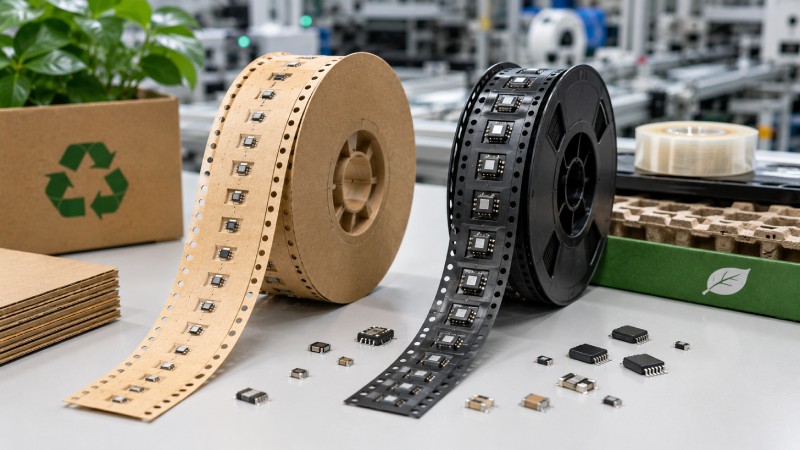
Paper Carrier Tape vs Plastic Carrier Tape
Paper carrier tape and plastic carrier tape serve similar packaging purposes, but they are not identical in material behavior, component suitability, or design flexibility.
Paper carrier tape is often a good choice for small, flat, lightweight electronic components. It can provide stable packaging for many passive components and simple SMD parts when the pocket dimensions and tape format are correctly designed. Its main sustainability advantage is reduced plastic material use.
Plastic carrier tape, especially embossed carrier tape, is usually better suited for components that require deeper pockets, stronger cavity protection, or more complex shapes. IC chips, LEDs, sensors, MEMS devices, connectors, and taller components may need embossed pockets to prevent movement, tilting, or damage.
The choice should not be based on material alone. It should be based on component size, height, shape, fragility, ESD requirements, feeder compatibility, packaging quantity, and production environment.
For simple high-volume parts, paper carrier tape can be a sustainable and cost-effective option. For complex or sensitive parts, plastic embossed carrier tape may still be the safer packaging choice.
Key Benefits of Eco-Friendly Paper Carrier Tape
Reduced Plastic Use
One of the strongest advantages of paper carrier tape is its ability to reduce plastic consumption in tape-and-reel packaging. For manufacturers packing millions of small components, even small material changes can have a meaningful impact on total packaging waste.
This makes paper carrier tape attractive for companies with internal sustainability goals, customer packaging requirements, or green procurement policies.
Suitable for High-Volume SMT Packaging
Paper carrier tape is especially useful for high-volume electronic components that have stable dimensions and simple shapes. When designed correctly, it can support consistent pocket positioning, smooth reel winding, and reliable feeding during SMT assembly.
This makes it a practical choice for many standard SMD components where deep cavity protection is not required.
Efficient Reel Packaging
Paper carrier tape can be supplied in standard tape widths and reel formats, helping buyers maintain compatibility with existing tape-and-reel workflows. Correct tape width selection and packaging quantity planning can also improve storage, shipping, and production efficiency.
For buyers managing large component inventories, reel consistency is an important part of packaging performance.
Stable Feeding Performance
Sustainability should not come at the cost of production stability. A well-designed paper carrier tape must still support accurate indexing, stable pocket holding, consistent cover tape peeling, and smooth SMT feeder operation.
This is why tape design, dimensional control, and sample testing are essential before mass production.
Support for ESG and Green Procurement Goals
Many electronics supply chains are under pressure to document and improve packaging choices. Offering an eco-friendly paper carrier tape option can help suppliers respond to customer expectations around plastic reduction and responsible packaging.
For buyers, this can also become a useful point when evaluating packaging suppliers.
Which Components Are Suitable for Paper Carrier Tape?
Paper carrier tape is commonly considered for small and lightweight SMD components that do not require deep pocket protection. Suitable examples may include chip resistors, chip capacitors, small inductors, small diodes, simple passive components, and other compact electronic parts with stable shapes.
These components usually require accurate positioning, clean packaging, and smooth feeding, but they may not need the deeper cavities provided by embossed plastic tape.
However, paper carrier tape is not the best solution for every component. Taller components, irregularly shaped parts, fragile sensors, MEMS components, complex IC packages, lens-type LEDs, and connectors with pins may require custom embossed tape.
For example, if your product is a semiconductor package, you may need a dedicated carrier tape for IC chips. If your component is a light-emitting product, carrier tape for LED packaging may require better lens protection and orientation control. For sensitive devices, carrier tape for sensors and MEMS components should consider contamination control, ESD protection, and pocket stability.
The best approach is to send component drawings or samples to the supplier for packaging evaluation.
What Makes Paper Carrier Tape Truly Eco-Friendly?
An eco-friendly paper carrier tape solution should be evaluated as a full packaging system, not just a single material.
First, the paper material should be suitable for electronic component packaging. It must provide enough strength, dimensional stability, and clean processing performance. If the tape deforms easily or creates feeding problems, the sustainability benefit is reduced.
Second, recyclability should be considered carefully. Paper-based materials may be easier to recycle than plastic in some systems, but coatings, adhesives, contamination, and mixed materials can affect the actual recycling result. Buyers should confirm material structure and disposal expectations with the supplier.
Third, efficient design matters. Using the correct tape width, pocket layout, reel size, and packaging quantity can reduce unnecessary material use. Overpackaging is not sustainable, even if the main material is paper.
Fourth, production yield is part of sustainability. If poor tape design causes component misfeeds, rejects, or production downtime, the environmental and economic costs increase. A truly sustainable solution must reduce waste while maintaining reliable production.
Eco-friendly carrier tape should therefore be evaluated by material, function, waste reduction, and production reliability together.
Design Factors for Reliable Paper Carrier Tape Packaging
To make paper carrier tape work properly, buyers should confirm several design details before ordering.
Tape width is one of the first factors. The width must match the component size, feeder requirements, and packaging standard. Pocket size is equally important because the component should sit securely without excessive movement or tight contact that may cause loading issues.
Pocket depth and clearance must also be checked. Even small components need enough space for stable placement and removal during pick-and-place operation. If the pocket is too loose, the component may shift. If it is too tight, feeding or pickup may become unstable.
Cover tape compatibility is another key point. The cover tape must seal properly and peel consistently. Peel force should be stable enough to protect the components during handling but not so strong that it causes feeding problems during production.
Other important factors include sprocket hole accuracy, component orientation, reel size, packaging quantity per reel, storage conditions, humidity control, and SMT feeder compatibility.
Before requesting a quote, buyers should prepare the component drawing, length, width, height, packaging quantity, tape width preference if available, cover tape requirement, and any ESD or moisture sensitivity concerns.
For more detailed packaging planning, buyers can also review paper carrier tape dimensions before confirming the final design.
Eco-Friendly Does Not Mean One-Size-Fits-All
Paper carrier tape can be a strong sustainable packaging choice, but it should not be selected only because it sounds environmentally friendly. The wrong tape material or pocket design can create more problems than it solves.
If a component is too tall, fragile, irregular, static-sensitive, or difficult to orient, a paper-based solution may not provide enough protection or stability. In these cases, custom embossed carrier tape may be more reliable.
A responsible packaging supplier should not push one material for every project. Instead, the supplier should evaluate the component and recommend the most suitable tape type. Sometimes paper carrier tape is the best choice. Sometimes embossed plastic carrier tape is necessary. In other cases, sample testing is needed before making the decision.
This practical approach helps buyers reduce packaging risk while still supporting sustainability goals where possible.
How Jiushuo Supports Eco-Friendly Paper Carrier Tape Solutions
Jiushuo helps electronics manufacturers and component suppliers evaluate suitable paper carrier tape solutions based on real packaging requirements. Instead of offering a one-size-fits-all tape, Jiushuo focuses on component size, tape design, cover tape matching, reel packaging, and SMT feeding stability.
For suitable small components, Jiushuo can support custom paper carrier tape design to help reduce plastic use while maintaining reliable tape-and-reel performance. The team can assist with tape width selection, pocket matching, packaging quantity planning, cover tape compatibility, and sample evaluation.
When a component is not suitable for paper tape, Jiushuo can also recommend custom carrier tape or embossed carrier tape options to improve protection and feeding reliability.
This makes the packaging decision more practical for buyers. You do not need to choose between sustainability and production stability without guidance. Jiushuo can help evaluate both sides and recommend a packaging solution that fits your component and production process.
How to Request a Quote for Eco-Friendly Paper Carrier Tape
To request a quote, prepare as much component and packaging information as possible. This helps the supplier evaluate feasibility quickly and provide a more accurate recommendation.
Useful information includes component name, component type, drawing or datasheet, length, width, height, required packaging quantity, monthly or annual demand, reel size, tape width if known, cover tape requirement, destination country, and any special packaging concerns.
If your company has sustainability requirements, you should also mention them during the quotation stage. For example, you may need reduced plastic use, paper-based packaging, specific documentation, or a packaging design that supports internal green procurement policies.
Sample testing is recommended before mass production, especially if this is the first time using paper carrier tape for a specific component.
FAQ About Eco-Friendly Paper Carrier Tape
Is paper carrier tape recyclable?
Paper carrier tape may be recyclable depending on its material structure, coating, adhesive residue, contamination level, and local recycling system. Buyers should confirm material details and disposal requirements before making environmental claims.
Can paper carrier tape replace plastic embossed carrier tape?
Not always. Paper carrier tape is suitable for many small and lightweight components, while plastic embossed carrier tape is often better for tall, fragile, or irregularly shaped parts.
Does paper carrier tape work with SMT feeders?
Yes, when the tape is designed correctly. Tape width, sprocket holes, pocket dimensions, cover tape matching, and peel force all affect SMT feeding performance.
What components are best suited for paper carrier tape?
Small passive components, chip resistors, chip capacitors, small diodes, inductors, and other lightweight SMD components are common candidates.
Does paper carrier tape need special storage?
Paper-based materials should be stored in controlled conditions. Excessive humidity or poor storage may affect tape stability and feeding performance.
How do I know whether paper carrier tape is suitable for my component?
The best way is to provide a component drawing, dimensions, and packaging quantity to the supplier. A sample test can help confirm whether paper carrier tape is suitable before mass production.
Choose a Practical Eco-Friendly Carrier Tape Solution
Eco-friendly paper carrier tape can help electronics manufacturers reduce plastic use while maintaining efficient tape-and-reel packaging for suitable components. The key is to choose the right material, tape design, pocket structure, cover tape, and supplier support.
If you are looking for a sustainable paper carrier tape solution for your electronic components, contact Jiushuo with your component details and packaging requirements. Our team can help evaluate feasibility, recommend a suitable design, and support stable SMT packaging from sample testing to mass production.



 Emial
Emial John Mr