
Why SMT Factories Are Switching to Paper Carrier Tape
Surface-mount technology manufacturers are under increasing pressure to reduce packaging waste, control production costs, and improve material efficiency without creating new risks on the assembly line. As a result, more component manufacturers, packaging companies, and SMT factories are evaluating paper carrier tape for suitable applications.
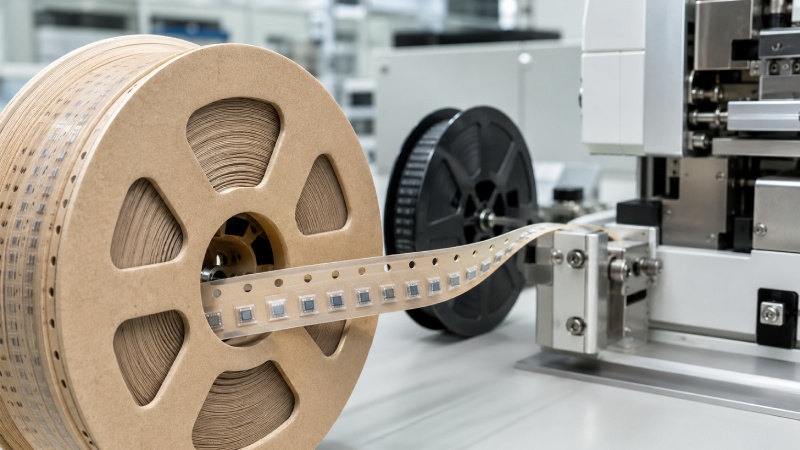
The change does not mean that paper is replacing plastic carrier tape everywhere. Embossed plastic tape remains essential for many tall, fragile, irregular, or electrostatic-sensitive components. Instead, manufacturers are becoming more selective about packaging materials. Paper carrier tape is being adopted where it can provide reliable component protection, stable feeder performance, and a lower-material packaging solution.
Quick Answer
More SMT factories are using paper carrier tape because it can reduce plastic consumption, support cost control, and efficiently package high-volume passive components. However, successful use depends on component geometry, pocket accuracy, ESD requirements, cover tape compatibility, cleanliness, storage conditions, and validation on actual SMT feeders.
What Does Switching to Paper Carrier Tape Mean?
A factory rarely replaces every plastic carrier tape specification at once. Most conversions begin with a limited group of components that are already suitable for punched paper cavities.
Small resistors, capacitors, inductors, and other low-profile passive components are common candidates. These components are usually mechanically robust, regular in shape, and capable of being held securely without a deep embossed pocket.
Some manufacturers qualify paper carrier tape when launching a new component program. Others review existing plastic-tape applications and identify products that may be converted without affecting performance.
Many factories ultimately use both materials. Paper carrier tape handles suitable passive components, while embossed plastic carrier tape remains in use for semiconductor packages, connectors, sensitive devices, and components requiring deeper or more complex pockets.
The objective is therefore not complete material replacement. It is better material selection for each packaging application.
Why SMT Factories Are Considering Paper Carrier Tape
Reduced Dependence on Plastic Packaging
Carrier tape is continuously consumed in high-volume electronics manufacturing. Even a small component may require thousands of meters of tape across its production life.
When paper can replace plastic without reducing packaging reliability, manufacturers may lower the amount of plastic used in component delivery. This can support internal packaging-reduction programs and customer requests for more resource-efficient supply chains.
However, paper-based construction should not automatically be described as recyclable, biodegradable, or environmentally harmless. Anti-static coatings, adhesives, laminated bottom layers, contamination, and local recycling infrastructure can all affect disposal.
Responsible suppliers should provide clear material information rather than relying on general environmental claims.
Potential Packaging Cost Control
Paper carrier tape is frequently considered for high-volume passive components because the base material and punched-pocket construction can be cost-effective.
The real financial benefit should not be measured by tape price alone. A lower price per meter provides little value if it leads to feeder interruptions, damaged components, cover tape problems, or higher rejection rates.
Factories should compare total packaging cost, including:
-
Carrier and cover tape prices
-
Reel and packaging quantities
-
Rework and rejected reels
-
Feeder jams and mis-picks
-
Operator intervention
-
Component loss
-
Inspection requirements
-
Waste handling
-
Production downtime
A technically stable paper tape can provide meaningful savings. An unqualified tape can create costs far greater than the original material difference.
Efficient Packaging for Small Passive Components
Punched paper carrier tape is particularly suitable for small, flat, and mechanically strong components with simple pocket requirements.
Instead of thermoforming a deep pocket into plastic film, manufacturers punch cavities through a controlled paper structure. A bottom support layer closes the pocket and holds the component in place.
This construction can work well when the component does not require complex pocket walls or extensive mechanical protection. The cavity dimensions, paper thickness, bottom-layer strength, and component clearance must still be carefully controlled.
Paper suitability should always be based on the actual component drawing. Two components with similar external dimensions may behave differently because of weight distribution, surface finish, edge geometry, or orientation requirements.
More Components per Reel
Small passive components are frequently packaged with narrow tape and short pocket pitches. This may allow a large number of components to be loaded onto one reel.
Higher reel quantities can reduce:
-
Reel replacement frequency
-
Feeder replenishment
-
Operator handling
-
Line interruptions
-
Packaging changes during long production runs
These benefits do not come from paper alone. Component size, pocket pitch, tape width, reel diameter, winding quality, and machine configuration all influence reel capacity.
Nevertheless, paper carrier tape is commonly associated with the compact formats used for high-volume passive components, making it attractive for automated manufacturing.
Support for Customer Sustainability Requirements
Electronics buyers increasingly ask suppliers to disclose packaging materials and identify opportunities to reduce unnecessary plastic.
For component manufacturers, adopting paper carrier tape for qualified products can demonstrate a practical response. It provides a more credible sustainability action than making broad environmental promises without changing packaging design.
The strongest approach is to document:
-
Which components were converted
-
Which plastic materials were replaced
-
Whether additional coatings or laminations are used
-
How packaging performance was validated
-
What disposal limitations apply
This gives customers useful evidence while preventing misleading claims.
Better Paper-Tape Manufacturing Control
Modern paper carrier tape can be produced with improved dimensional and process control. Depending on the supplier and construction, improvements may include more consistent thickness, cleaner punched cavities, stronger bottom support, better edge quality, and anti-static treatment.
These features can improve tape movement and component stability, but they should never be assumed.
Buyers should request specifications, inspection reports, test methods, and production samples. Terms such as “anti-static,” “low dust,” or “high precision” are meaningful only when supported by measurable requirements.
Where Paper Carrier Tape Works Best
Paper carrier tape is generally most appropriate when the component is low profile, regular in shape, mechanically robust, and compatible with a punched cavity.
| Evaluation Factor | More Suitable for Paper Tape | May Require Plastic Tape |
|---|---|---|
| Component profile | Low and flat | Tall or irregular |
| Mechanical strength | Rugged | Fragile or lead-sensitive |
| Pocket geometry | Simple cavity | Deep or complex pocket |
| ESD requirements | Compatible with qualified treatment | Highly ESD-sensitive |
| Physical protection | Moderate protection sufficient | Strong pocket protection needed |
| Cleanliness | Validated low-debris process | Critical particle-control environment |
| Storage conditions | Controlled storage | High humidity or demanding exposure |
This table is only a starting point. Final approval requires dimensional review and production testing.
When Plastic Carrier Tape Is Still the Better Choice
Plastic carrier tape remains the more reliable option for many advanced or demanding components.
Embossed plastic can form deeper pockets, complex shapes, supporting features, and tighter three-dimensional geometries. It may also offer stronger moisture resistance and more consistent protection during transportation and handling.
Plastic should still be considered for:
-
Tall components
-
Fragile packages
-
Devices with sensitive leads
-
Irregular component shapes
-
Deep pocket requirements
-
Advanced semiconductor packages
-
Components requiring tight movement control
-
Highly ESD-sensitive devices
-
Demanding storage environments
-
Applications with strict particle limits
Paper can also generate fibers or debris when material quality, punching, slitting, or edge control is poor. Accumulated particles may interfere with small nozzles, feeders, or optical inspection systems.
Choosing plastic for these applications is not a failure to improve sustainability. It is a necessary decision to protect components and maintain assembly reliability.
Does Paper Carrier Tape Improve SMT Line Performance?
Paper carrier tape can perform reliably on high-speed SMT lines, but the base material is only one part of the packaging system.
Stable feeding depends on:
-
Tape width and camber
-
Sprocket-hole accuracy
-
Pocket pitch
-
Pocket dimensions
-
Bottom-layer strength
-
Component clearance
-
Cover tape alignment
-
Peel consistency
-
Static behavior
-
Reel winding quality
-
Debris control
A tape that meets basic dimensional requirements may still perform poorly if the component moves excessively, the cover tape peels inconsistently, or the reel is wound with uneven tension.
Factories should measure real production results rather than relying only on supplier claims. Important indicators include mis-pick rate, feeder-jam frequency, component flipping, cover tape breakage, pocket damage, dust accumulation, line stoppages, and rejected reels.
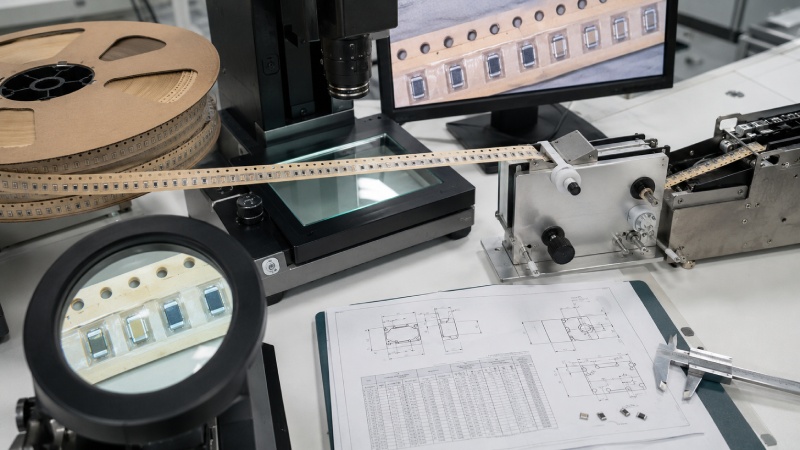
How to Qualify Paper Carrier Tape Before Switching
A controlled qualification process reduces the risk of production disruption.
1. Select a Suitable Component Family
Begin with stable, high-volume, low-profile passive components. Avoid starting with the most fragile or sensitive devices.
2. Review Component and Pocket Dimensions
Compare the component length, width, height, weight, and orientation with the proposed pocket dimensions. Confirm tape width, pocket pitch, paper thickness, sprocket-hole position, and component clearance.
3. Check Applicable Tape-and-Reel Requirements
Review the applicable dimensional, orientation, leader, trailer, and reel requirements used by the customer and assembly equipment.
4. Validate Cover Tape Compatibility
Test the carrier tape together with the intended cover tape. Evaluate sealing consistency, peel behavior, tracking, adhesive transfer, component movement, and residue.
5. Run an Actual Feeder Trial
Laboratory measurements are not enough. Test the sample reel on the intended feeder model, machine speed, nozzle, and production settings.
6. Evaluate Storage and Transportation
Paper responds differently to humidity and environmental exposure than plastic. Test dimensional stability, pocket integrity, seal performance, and feeding after realistic storage and transportation conditions.
7. Compare Total Cost and Risk
Approve the conversion only when the expected material benefit does not create higher downtime, rejection, inspection, or component-loss costs.
Paper Carrier Tape Conversion Checklist
| Qualification Item | Required Evidence |
|---|---|
| Component suitability | Drawing and dimensional review |
| Pocket fit | Loading and movement test |
| Tape dimensions | Inspection report |
| ESD behavior | Test method and results |
| Cover tape compatibility | Seal and peel testing |
| Feeder performance | Production trial |
| Cleanliness | Fiber and debris inspection |
| Storage stability | Environmental testing |
| Cost benefit | Total-cost comparison |
| Supplier control | Traceability and change-control records |
What to Ask a Paper Carrier Tape Supplier
Before approving a supplier, ask practical engineering questions:
-
Which component types have been validated with this paper construction?
-
What dimensional tolerances are controlled?
-
How are paper thickness and pocket accuracy inspected?
-
What ESD treatments are available?
-
How is fiber or debris generation evaluated?
-
Which cover tapes have been tested?
-
Can sample reels be provided for feeder trials?
-
What inspection records are supplied with each lot?
-
How are material and process changes communicated?
-
Can the supplier support custom pocket design and pilot production?
A capable supplier should help validate the application rather than simply sell tape by width and pitch.
The Future Is Application-Specific Material Selection
Paper carrier tape is becoming a valuable option for SMT packaging because it can reduce plastic use, support cost control, and efficiently package suitable high-volume components.
Its advantages are real, but they are not universal. Paper must be matched to the component, cover tape, feeder, storage environment, and quality requirements. Plastic carrier tape should remain in use wherever deeper pockets, stronger protection, tighter control, or advanced ESD performance are required.
The most successful factories will not choose paper or plastic based on marketing claims. They will use engineering data to select the lowest-impact packaging material that still delivers stable feeding and reliable component protection.
For manufacturers considering a conversion, the best starting point is a component drawing, the current tape specification, and a sample-reel trial under actual production conditions.



 Emial
Emial John Mr