

Best Applications for Paper Carrier Tape in SMT Packaging
Paper carrier tape is widely used to package small electronic components for automated surface-mount assembly. However, not every component is suitable for a punched paper pocket. The correct carrier tape depends on the component’s dimensions, weight, shape, mechanical strength, electrostatic sensitivity, and behavior inside an SMT feeder.
In general, paper carrier tape performs best with small, lightweight, low-profile components that have simple and consistent geometry. Typical applications include chip resistors, multilayer ceramic capacitors, ferrite beads, chip filters, resistor arrays, and selected compact inductors.
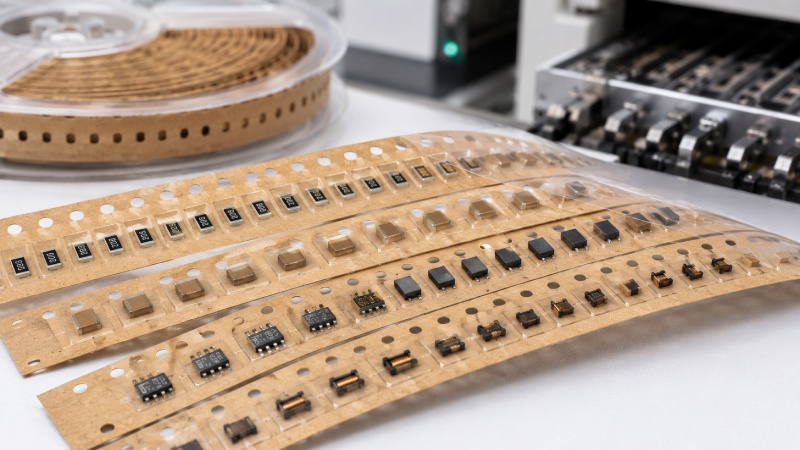
Understanding where paper tape works well—and where embossed plastic tape may be safer—helps component manufacturers reduce packaging failures, feeder interruptions, component movement, and unnecessary material costs.
What Makes a Component Suitable for Paper Carrier Tape?
Paper carrier tape is produced by punching or compressing pockets into a paper-based material. These pockets hold components in a fixed position before a cover tape is applied and the finished tape is wound onto a reel.
Because the pocket structure is formed directly in the paper, the component must match several basic conditions.
Small and Lightweight Construction
Lightweight components place less stress on the pocket walls during loading, reel winding, storage, transportation, and feeder operation.
A component may have a small footprint but still be unsuitable if it is unusually dense or heavy. Excessive weight can increase pocket deformation, component movement, or tape damage, particularly during high-speed feeding.
There is no single universal weight limit for paper carrier tape. Suitability should be determined through component evaluation and trial packaging.
Simple and Consistent Geometry
The strongest candidates normally have flat, rectangular, or square bodies with repeatable dimensions.
Components with protruding leads, delicate terminals, uneven surfaces, or irregular shapes may be difficult to retain in a shallow paper pocket. Dimensional consistency is also important because excessive variation can cause some components to fit too tightly while others rotate or move.
Low Component Height
Paper carrier tape is generally most practical for low-profile parts that can be retained inside shallow punched pockets.
Taller components require greater pocket depth and stronger sidewall support. In these cases, embossed plastic carrier tape may provide better dimensional control and component protection.
Sufficient Mechanical Strength
Components must tolerate loading, sealing, winding, shipping, cover-tape peeling, and high-speed pick-and-place handling.
Fragile ceramic parts, exposed structures, or easily damaged terminations require careful pocket design. Even when the component category is commonly packed in paper tape, its specific construction must still be reviewed.
Best Components for Paper Carrier Tape
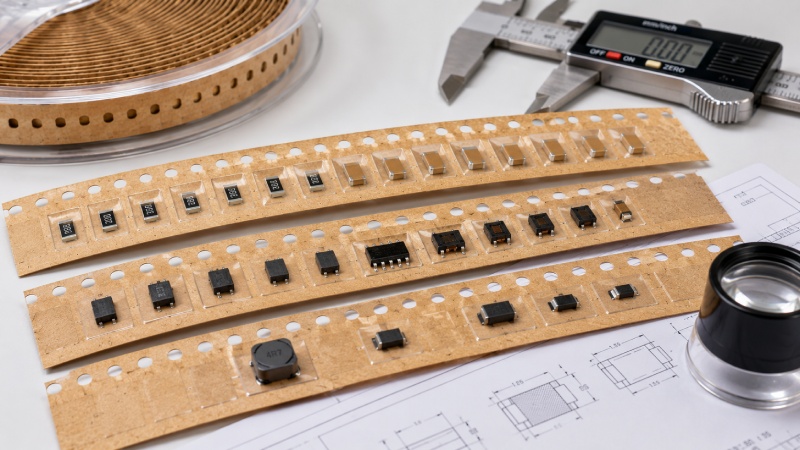
1. Chip Resistors
Chip resistors are one of the most common applications for paper carrier tape.
Their compact rectangular bodies, low weight, uniform dimensions, and limited height make them well suited to shallow punched pockets. They are also produced in extremely high volumes, making packaging efficiency and reel capacity important considerations.
Paper tape is frequently used for small resistor formats because it can support compact pocket pitches and reliable presentation to automated assembly equipment.
However, the packaging supplier should still confirm:
-
Component length, width, and thickness
-
Maximum dimensional tolerances
-
Termination condition
-
Required component orientation
-
Pocket clearance
-
Quantity per reel
-
Feeder compatibility
Larger, thicker, or specially constructed resistors may use embossed plastic tape instead. The packaging material should therefore be selected according to the exact product series rather than the component name alone.
2. Multilayer Ceramic Capacitors
Multilayer ceramic capacitors, commonly known as MLCCs, are another major paper carrier tape application.
Many small MLCCs have characteristics similar to chip resistors: compact geometry, low weight, consistent dimensions, and high production volumes. These properties make them suitable for narrow-pitch tape-and-reel packaging.
Paper tape can be particularly effective for miniature capacitor sizes where increasing the number of components per reel helps reduce reel changes and packaging-material consumption.
Nevertheless, not every MLCC should use paper tape. Suitability can be affected by:
-
Component thickness
-
Capacitance and voltage series
-
Ceramic body strength
-
Flexible termination construction
-
Surface condition
-
Pocket clearance
-
Risk of cracking during transportation
-
Customer packaging specifications
Larger, thicker, or special-purpose capacitors may require the stronger pocket definition provided by embossed plastic tape.
3. Ferrite Beads and Chip Filters
Ferrite beads and compact chip filters can also be good candidates for paper carrier tape.
Many of these components have rectangular bodies and low-profile designs that fit well inside punched pockets. Their consistent external dimensions can support reliable orientation and pickup during automated assembly.
However, ferrite materials may be denser than standard resistors or capacitors. The tape supplier should therefore evaluate both component weight and height.
A suitable pocket must prevent the component from rotating, tilting, or moving excessively without gripping it so tightly that pickup becomes difficult.
4. Resistor Arrays and Chip Networks
Selected resistor arrays and chip networks may be packaged in paper carrier tape when their bodies are flat, stable, and mechanically robust.
Compared with individual chip resistors, arrays are often longer and may include several terminals. This makes orientation control and pocket support more important.
The supplier should review:
-
Overall body length
-
Terminal layout
-
Component thickness
-
Center of gravity
-
Pocket support area
-
Risk of rotation
-
Tape width
-
Pocket pitch
A low-profile array with consistent dimensions may perform well in paper tape. A longer, heavier, or more delicate network may be better suited to an embossed carrier.
5. Selected Small Inductors
Paper carrier tape can be used for certain low-profile chip inductors, but this application requires more careful evaluation.
Suitable candidates generally have compact rectangular bodies, limited height, stable weight distribution, and mechanically durable construction.
Paper tape may be less appropriate for:
-
Tall molded inductors
-
Heavy power inductors
-
Wire-wound components
-
Components with exposed winding structures
-
Irregular body shapes
-
Parts requiring deep pockets
For these products, embossed plastic carrier tape usually provides stronger sidewalls and better vertical support.
6. Other Lightweight SMT Components
Selected thermistors, varistors, chip diodes, and similar SMT parts may also be packaged in paper carrier tape.
The decision should not be based only on the component category. Polarity, terminal protection, electrostatic sensitivity, body strength, orientation, and pickup requirements must all be considered.
Semiconductor-related components may also require verified static-dissipative or conductive packaging performance. Standard paper material should not automatically be assumed to provide sufficient ESD protection.
Best Production Scenarios for Paper Carrier Tape
Paper carrier tape provides the greatest value when it is matched with the right production environment.
High-Volume Passive Component Manufacturing
Paper tape is especially suitable for factories producing large quantities of uniform passive components.
When millions of components must be loaded, sealed, reeled, shipped, and fed into SMT equipment, consistent pocket formation and stable feeding become essential.
A well-designed paper tape can support efficient production without using a deeper or more complex pocket than the component actually requires.
Narrow-Pitch Packaging
Small components can often be packed at compact pocket pitches, allowing more parts to fit on each reel.
Higher reel capacity can reduce:
-
Reel replacement frequency
-
Packaging-material consumption
-
Warehouse space
-
Handling requirements
-
Machine downtime caused by reel changes
The selected pitch must remain compatible with the component dimensions, sprocket-hole pattern, loading equipment, and customer feeder.
Standardized SMT Feeding
Paper carrier tape is well suited to automated assembly environments where tape dimensions, sprocket holes, pocket position, cover-tape width, winding tension, and peel behavior are tightly controlled.
Reliable feeder performance depends on the complete packaging system. A good pocket alone cannot compensate for poor tape camber, inconsistent cover-tape sealing, incorrect winding, or unstable peel force.
Cost- and Material-Efficient Programs
For appropriate components, paper tape can provide an efficient alternative to embossed plastic tape.
However, material price should not be the only selection factor. The lowest-priced tape may create higher total costs if it causes damaged components, feeder interruptions, pickup errors, or rejected reels.
Paper Carrier Tape Application Suitability
| Component or Requirement | General Suitability | Main Consideration |
|---|---|---|
| Chip resistors | High | Dimensions, orientation and pocket clearance |
| Small MLCCs | High | Thickness, ceramic strength and product series |
| Ferrite beads | Medium to high | Weight, height and rotation |
| Chip filters | Medium to high | Body consistency and terminal protection |
| Resistor arrays | Medium | Length, terminals and pocket support |
| Small chip inductors | Conditional | Weight, height and construction |
| Small diodes | Conditional | Polarity, ESD and terminal protection |
| Tall or heavy components | Low | Deeper and stronger pockets may be required |
| Fragile or irregular components | Low | Higher risk of movement or damage |
| Highly ESD-sensitive components | Conditional | Verified protective performance is required |
These ratings are intended for initial screening. Final approval should always be based on component drawings, physical samples, packaging tests, and feeder trials.
When Paper Carrier Tape Is Not the Best Option
Embossed plastic carrier tape may be a better choice when the component is tall, heavy, fragile, irregularly shaped, or dependent on a deep custom pocket.
Plastic tape may also be preferable when the application requires:
-
Stronger pocket sidewalls
-
Greater pocket-depth control
-
High transparency
-
Improved moisture resistance
-
Engineered conductive or static-dissipative performance
-
Additional support for delicate terminals
-
Better retention of components with uneven geometry
A component that moves, tilts, or rotates inside a paper pocket may create orientation problems during pickup. A pocket that is too tight can also cause loading defects or prevent the vacuum nozzle from removing the component cleanly.
The goal is not to force every small component into paper tape. It is to select the carrier structure that provides the most reliable total packaging performance.
How to Confirm Component Suitability
Before selecting paper carrier tape, provide the supplier with the component drawing and basic packaging requirements.
The most important information includes:
-
Component length, width, and height
-
Dimensional tolerances
-
Component weight
-
Required orientation
-
ESD requirements
-
Tape width and reel size
-
Quantity per reel
Physical samples are also helpful because they allow the supplier to check the actual pocket fit and component movement.
Before mass production, a trial reel should be tested for loading, sealing, winding, cover-tape peeling, feeder movement, and pick-and-place pickup. This helps confirm that the complete packaging system works reliably.
Questions to Ask a Paper Carrier Tape Supplier
Before selecting a supplier, ask whether it has packaged components with similar dimensions and construction.
The supplier should be able to explain how it will control pocket dimensions, sprocket-hole accuracy, tape camber, paper thickness, winding quality, and cover-tape compatibility.
It should also be able to review drawings, inspect samples, prepare trial tape, and support feeder testing where required.
Other useful questions include:
-
Can the pocket be adjusted for component tolerances?
-
Which cover tape is recommended?
-
How is seal and peel performance evaluated?
-
Can the supplier support narrow-pitch packaging?
-
How are production lots inspected and traced?
-
What data must be approved before mass production?
Choose Paper Tape Based on Application Performance
Paper carrier tape is best suited for small, lightweight, mechanically robust components with simple geometry and consistent dimensions. Chip resistors, small MLCCs, ferrite beads, chip filters, resistor arrays, and selected low-profile inductors are among its most common applications.
However, the component category provides only an initial indication. Reliable tape-and-reel packaging depends on pocket fit, component movement, cover-tape performance, reel construction, transportation conditions, and SMT feeder compatibility.
The safest selection process is to provide the component drawing, physical samples, expected volume, ESD requirements, and feeder information to the tape supplier. A properly designed and tested packaging system can reduce component damage, improve feeding stability, and support efficient high-volume SMT production.



 Emial
Emial John Mr