




Reel Winding Tension: Pocket Crushing & Telescoping
Carrier tape pockets may become crushed after reel winding, while the wound tape layers may shift sideways and form an uneven pack. Both problems can affect packaging quality and SMT feeder performance, but they do not always have the same cause.
Reel winding tension is an important factor, but it should not be adjusted without first checking the condition of the carrier tape, the winding machine, and the plastic reel. Excessive or unstable tension may increase pressure on embossed pockets. Insufficient winding stability, poor tape tracking, or reel misalignment may contribute to telescoping.
An effective diagnosis starts by identifying the defect, determining when it first appeared, and checking the relevant process conditions. This guide explains how to distinguish pocket crushing from reel telescoping, investigate their possible causes, and verify corrective actions before releasing affected reels.
What Do Pocket Crushing and Telescoping Look Like?
Pocket crushing and telescoping are different defects. One affects the geometry of the embossed carrier tape; the other affects the position of tape layers on the reel.
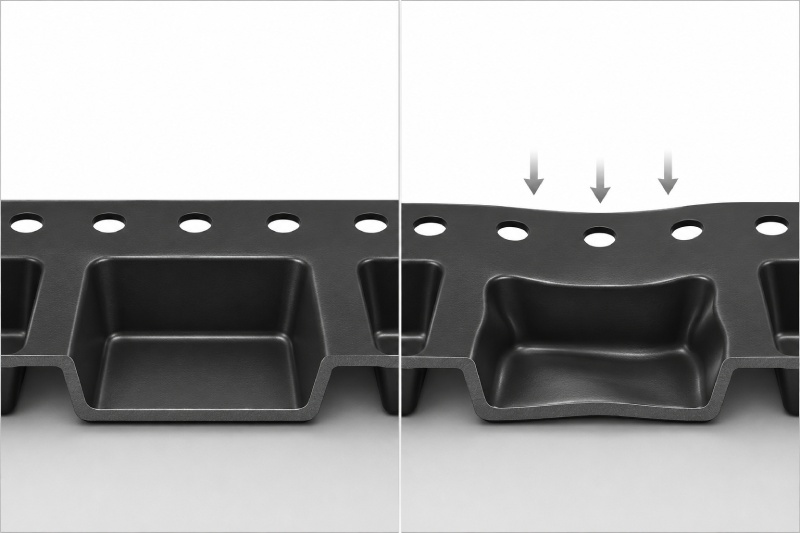
Signs of Pocket Crushing
Pocket crushing occurs when the embossed cavities become deformed under mechanical loading. The damage may affect the pocket bottom, sidewalls, corners, or the overall cavity shape.
Common signs include:
-
Flattened or partially collapsed pocket bottoms.
-
Reduced pocket depth compared with the approved drawing.
-
Bent, distorted, or damaged pocket walls.
-
Local whitening or stress marks around pocket corners.
-
Components sitting incorrectly or becoming restricted inside the cavities.
Pocket damage may appear throughout a reel or only in certain winding layers. In some cases, the damage is more noticeable near the reel hub, where the inner layers have experienced the subsequent winding process.
However, a crushed pocket found on a finished reel does not automatically prove that winding tension caused the problem. The cavity may already have been weakened during thermoforming or damaged by a guide, roller, or sealing operation.
Signs of Reel Telescoping
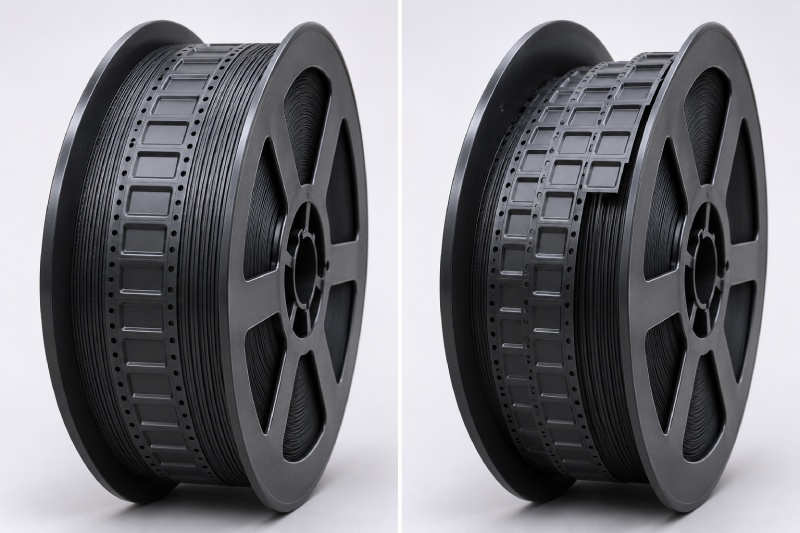
Telescoping occurs when wound tape layers move axially relative to one another, creating a stepped or displaced tape pack.
Typical symptoms include:
-
Tape layers extending unevenly toward one reel flange.
-
A visible stepped profile along the side of the wound tape.
-
Local rubbing between the tape edge and reel flange.
-
Uneven resistance during unwinding.
-
Increased risk of tape tracking problems during feeder operation.
Telescoping should not be confused with an irregular winding edge that does not involve actual layer displacement.
The distinction matters because reel alignment, tape tracking, interlayer friction, and tension behavior may all contribute to the final appearance.
| Inspection point | Pocket crushing | Reel telescoping |
|---|---|---|
| Main defect | Embossed pocket deformation | Axial displacement of wound layers |
| Visible location | Pocket walls, corners, or bottoms | Side profile of the tape pack |
| Possible process factor | Excessive compression or weak pocket structure | Tracking error, unstable winding, or layer movement |
| Potential SMT impact | Component interference or pickup problems | Uneven unwinding or feeder tracking problems |
| Primary verification | Pocket measurement before and after winding | Tape-pack alignment and winding-condition inspection |
A reel showing both defects should be investigated for multiple interacting causes rather than treated as a single tension problem.
How Does Reel Winding Tension Cause These Defects?
Winding tension is the pulling force applied to the carrier tape as it enters the reel. It helps maintain stable winding, but the force must be appropriate for the tape construction, reel configuration, and packaging process.
Winding tension is different from motor torque. Torque produces the rotational force used to drive the reel, while tape tension is the force acting along the moving tape.
The relationship between them changes as the wound reel diameter increases. Consequently, a constant motor torque does not necessarily produce constant tape tension throughout winding.
Excessive Tension and Pocket Compression
As carrier tape is wound into successive layers, tension in the outer turns can contribute to compressive loading within the tape pack.
Embossed carrier tape differs from flat film because the formed cavities introduce raised structures, thin walls, and localized load-bearing areas.
If the resulting compression exceeds what the pocket structure can tolerate, possible consequences include:
-
Permanent pocket deformation.
-
Reduced cavity depth.
-
Local wall buckling.
-
Stress concentration around corners.
-
Loss of clearance between the pocket and the packaged component.
The risk depends on several interacting factors, including pocket geometry, material properties, winding diameter, and the orientation of the embossed structures within the wound pack.
Deep pockets or locally thin walls may be particularly sensitive to unfavorable loading conditions, although pocket depth alone is not sufficient to predict failure.
Increasing tension should therefore not be used as a general solution for loose or uneven reels without checking pocket integrity.
Insufficient or Unstable Tension and Layer Movement
Insufficient winding stability may allow tape layers to move relative to one another during winding, handling, transportation, or unwinding.
However, telescoping is not exclusively a low-tension defect.
It can also occur when:
-
Tape tracking is inconsistent.
-
Winding tension fluctuates during speed changes.
-
The reel is mounted incorrectly.
-
Reel flanges or the hub are distorted.
-
Interlayer friction is insufficient for the winding conditions.
-
The wound pack develops uneven internal stresses.
A reel can therefore telescope even when the displayed tension setting appears normal.
Why Winding Diameter and Control Method Matter
As the reel fills, its effective winding radius increases.
For an idealized center-driven reel, the torque required to produce a particular tape tension increases with winding radius, although actual equipment must also account for friction, acceleration, and other mechanical effects.
Different machines may use torque control, dancer mechanisms, load-cell feedback, or combinations of these methods.
A tension profile describes how the target tension changes during winding. Some winding systems also use taper tension, which intentionally reduces the target tension as the roll diameter increases.
These methods can help control wound-pack behavior in suitable applications, but there is no single tension profile that can be applied to every embossed carrier tape.
The correct settings must be validated for the actual material, pocket design, reel, and equipment.
Was the Pocket Damage Present Before Winding?
Before changing the winding process, engineers should determine the earliest stage at which the defect can be observed.
A finished reel may contain damaged pockets even when the winding system is operating correctly.
The most reliable approach is to compare the tape condition at several inspection points.
Inspect the Carrier Tape Before Reeling
Start with an unwound sample from the same production lot.
Check the pocket shape and compare the relevant dimensions with the approved carrier tape drawing.
Important dimensions include:
-
A0: Pocket dimension associated with the component width.
-
B0: Pocket dimension associated with the component length.
-
K0: Pocket depth.
-
P1: Pocket pitch.
-
W: Overall carrier tape width.
The applicable drawing and measurement convention should determine how each dimension is verified.
Inspect pocket corners, sidewalls, and bottoms for whitening, thinning, collapse, cracks, or inconsistent forming.
Also check tape curl, camber, and edge condition. These may influence tape tracking even when the pocket dimensions are acceptable.
If the incoming carrier tape already shows the same deformation, the investigation should move upstream to material selection, forming conditions, tooling, or handling.
Compare Conditions Before and After Cover Tape Sealing
For loaded Tape & Reel packaging, inspect the carrier tape before and after the component-loading and cover-tape-sealing stages, where safe and accessible.
Check for:
-
Damage caused by guide rollers or contact surfaces.
-
Pocket deformation near the sealing area.
-
Wrinkled or displaced cover tape.
-
Components pressing against the cover tape or cavity walls.
-
Changes in tape flatness after sealing and cooling.
Cover tape peel force and reel winding tension are separate process characteristics. A reel winding problem cannot be confirmed through peel-force measurement alone.
If pocket damage is present before the tape reaches the winding reel, changing the winding tension will not eliminate the original source of the damage.
Locate the First Damaged Section on the Reel
When the defect appears only after winding, document its position.
Compare samples from the inner, middle, and outer portions of the reel, using a controlled inspection or unwinding procedure.
Record whether the damage:
-
Appears near the hub.
-
Increases toward the outer winding layers.
-
Occurs repeatedly at particular positions.
-
Appears only after handling or shipment.
This information helps engineers determine whether the defect is related to cumulative pack compression, intermittent machine contact, or another process condition.
How to Troubleshoot Reel Winding Tension Step by Step
A structured troubleshooting procedure is more reliable than repeatedly increasing or decreasing the winding tension setting.
The following sequence can be applied to empty carrier tape reels or loaded Tape & Reel packaging, with inspection methods adjusted to protect components and sealed packages.
Step 1: Isolate the Affected Reel and Record the Defect
Place the affected reel on hold according to the applicable quality procedure.
Record:
-
Carrier tape part number and lot number.
-
Plastic reel identification.
-
Packaging machine and production shift.
-
Empty or component-loaded packaging condition.
-
Location and appearance of the defect.
-
Whether the problem appeared during winding, after handling, or during unwinding.
Photograph the wound reel before moving the tape layers or attempting to correct their position.
For pocket crushing, collect close-up images showing the damaged cavity alongside an acceptable reference.
For telescoping, photograph the side profile of the tape pack and its relationship to the reel flanges.
These records help preserve evidence that might disappear during rewinding or further handling.
Step 2: Check the Actual Winding Conditions
Review the machine settings and available process records.
Important checks include:
-
Winding tension setpoint.
-
Actual measured tension, if the equipment provides a calibrated measurement.
-
Motor torque or drive setting.
-
Winding speed.
-
Acceleration and deceleration behavior.
-
Reel diameter or winding stage at which the defect occurs.
-
Machine alarms or unusual tension fluctuations.
Do not assume that a displayed motor setting represents actual tape tension.
A machine may maintain the same displayed setting while the mechanical loading on the carrier tape changes.
Pay particular attention to startup, stopping, and speed transitions. Short tension spikes can be missed if inspectors review only steady-state operation.
Step 3: Inspect Reel Geometry and Tape Tracking
Check that the plastic reel is suitable for the carrier tape and correctly installed.
Inspect:
-
Reel seating on the winding shaft.
-
Hub condition and concentricity.
-
Flange deformation or visible wobble.
-
Available clearance around the wound tape pack.
-
Tape guide alignment.
-
Evidence of tape-edge contact.
-
Winding direction and tape path.
Where appropriate, measure reel flange runout using a validated method rather than judging it only by eye.
If the tape consistently moves toward one side, examine the winding path and reel alignment before concluding that tension is insufficient.
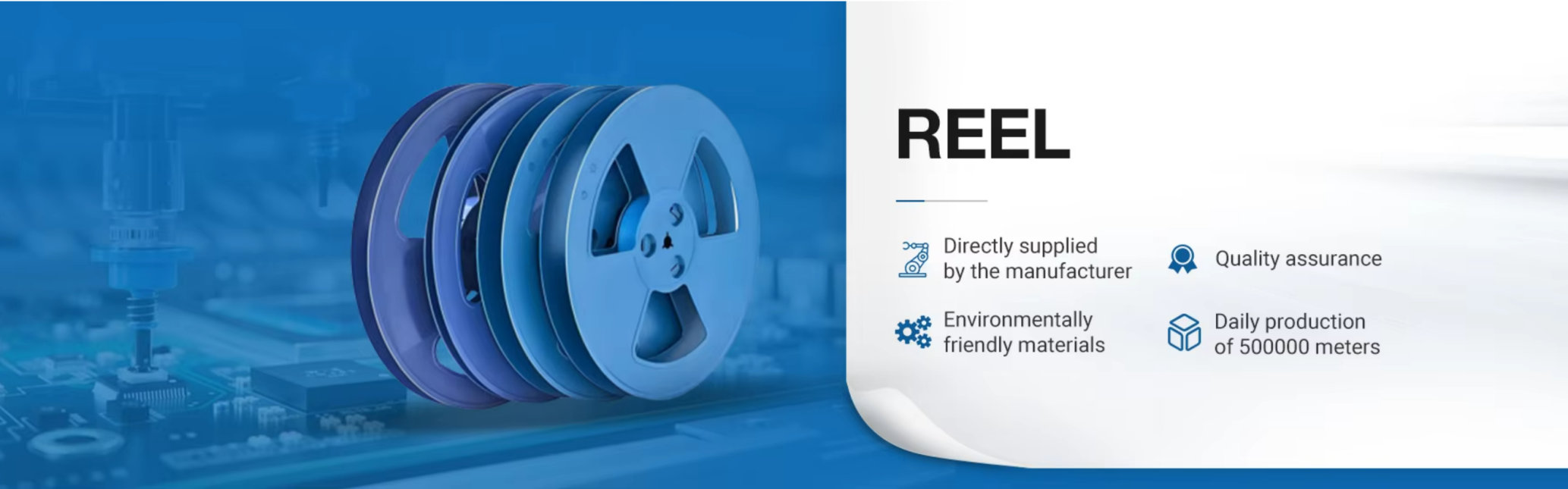
The available plastic reel configurations should be evaluated against the approved tape width and packaging requirements.
Step 4: Inspect Pocket Geometry and Material Condition
If pocket crushing is present, compare damaged pockets with approved unwound samples.
Check whether the damage is associated with:
-
Pocket depth and shape.
-
Thin or unsupported pocket walls.
-
Corner geometry.
-
Material stiffness and forming quality.
-
Local contact between adjacent wound layers.
-
Contact with packaged components.
Materials such as PS, PET, and PC can have different mechanical responses depending on formulation, construction, processing history, and temperature.
Material names alone cannot establish how much winding tension a carrier tape can tolerate.
A design using deeper cavities or more delicate pocket structures may require a separate winding validation.
Step 5: Perform a Controlled Adjustment Trial
Once the likely causes have been narrowed down, change only one approved process variable at a time.
For example, if pocket damage appears after winding and no upstream damage is found, engineers may evaluate a controlled reduction in winding tension.
If tape layers are shifting sideways, they should first confirm that reel alignment and tape tracking are correct before changing tension.
For each trial:
-
Record the original process conditions.
-
Document the single adjustment.
-
Use representative tape and reel samples.
-
Inspect pocket geometry after winding.
-
Check the tape-pack edge alignment.
-
Observe unwinding behavior.
-
Compare the results with the baseline.
If the adjustment improves one defect but produces another, it should not be accepted as a successful correction.
The final setting must provide acceptable pocket protection, pack stability, and unwinding performance together.
Root Causes of Pocket Crushing and Reel Telescoping
Winding defects often result from multiple interacting process conditions. A root-cause investigation should therefore match each suspected cause with observable evidence.
Tension-Related Root Causes
Potential tension-related problems include:
Excessive winding tension: May increase compressive loading and contribute to pocket deformation.
Unstable tension: May cause inconsistent winding pressure or allow localized layer movement.
Unsuitable tension profile: May create different winding conditions as the reel diameter increases.
Poor response during speed changes: May produce temporary tension deviations that are not visible during steady running.
Reel and Machine-Related Root Causes
Mechanical factors include:
Incorrect reel alignment: May cause the tape to track toward one side during winding.
Deformed reel flanges: May create local interference or contribute to inconsistent winding geometry.
Improper reel seating: May cause wobble or irregular rotation.
Incorrect tape guide positioning: May introduce lateral forces before the tape enters the reel.
Insufficient side clearance: May allow the wound tape pack to rub against the flange.
Carrier Tape and Packaging-Related Root Causes
Possible material and design factors include:
Weak pocket walls: May deform under loads that an otherwise suitable tape design would tolerate.
Pre-existing curl or camber: May affect tracking through the winding path.
Inconsistent forming quality: May create localized weak sections in the embossed cavities.
Unsuitable material construction: May provide insufficient dimensional stability for the actual winding process.
Damage before winding: May be incorrectly attributed to reel tension if earlier inspection records are unavailable.
Root-Cause Verification Matrix
| Observed defect | Possible cause | Verification method |
|---|---|---|
| Pocket depth decreases after winding | Excessive compression or weak pocket structure | Compare pocket profiles before and after winding |
| Damage occurs near the reel hub | Localized pack stress or hub-related contact | Inspect inner layers and reel geometry |
| Tape layers shift toward one flange | Tracking error, layer slip, or reel misalignment | Inspect guides, reel seating, and tension behavior |
| Tape edges rub against a flange | Inadequate clearance or flange distortion | Check tape-pack position and reel dimensions |
| Telescoping appears after transportation | Insufficient pack stability or handling effects | Compare pre-shipment and post-handling conditions |
| Wrinkled cover tape appears before winding | Sealing or tape-path problem | Inspect the tape before the winding stage |
The suspected causes in this table are diagnostic starting points, not confirmed explanations.
An observed defect should be linked to a root cause only after the available evidence supports the conclusion.
For a broader overview of related failures, see common tape and reel packaging defects.
How to Correct Winding Tension Without Creating New Defects
Correcting a winding problem requires balancing pocket protection with the stability of the wound tape pack.
Simply lowering tension may reduce compression but create a loose reel. Increasing tension may improve apparent winding tightness while worsening pocket deformation.
A successful correction must address the actual root cause and avoid introducing a new failure.
Establish a Validated Winding Window
A validated winding window defines the acceptable operating conditions for a particular tape and reel combination.
It should consider:
-
Carrier tape width and thickness.
-
Pocket geometry and depth.
-
Material construction.
-
Reel diameter and hub configuration.
-
Packaging speed.
-
Winding control method.
-
Empty or component-loaded condition.
Where the equipment supports a tension profile, engineers can evaluate whether the selected profile maintains acceptable winding conditions throughout the reel.
The final settings should be documented in the approved operating instructions.
Numerical limits should come from qualified process trials and applicable specifications rather than generic recommendations for unrelated film-winding equipment.
Correct Mechanical Alignment Before Compensating With Tension
If a reel telescopes because the tape enters at an angle, increasing winding tension may not correct the underlying problem.
Check the shaft, reel seating, guide rollers, tape path, and flange clearance.
Correct any confirmed alignment or mechanical issue before repeating the winding trial.
Where damaged or unsuitable reels are involved, replacement with an approved reel may be more appropriate than adjusting the machine.
Validate the Corrective Action
After implementing a correction, examine the finished reel under representative operating conditions.
Validation should include:
-
Pocket shape and dimensional inspection.
-
Tape-pack edge alignment.
-
Smooth and consistent unwinding.
-
Cover tape condition, where applicable.
-
Component position and integrity for loaded reels.
-
Functional feeder performance when required.
Additional handling or transportation testing may be appropriate if the original defect appeared after shipment rather than immediately after winding.
A correction is complete only when inspection results demonstrate that the reel meets the applicable acceptance requirements.
How to Inspect and Release Reels After a Winding Defect
A visually improved reel is not necessarily an acceptable reel.
Pocket damage may remain even after the tape has been rewound, and a telescoped reel may have experienced edge rubbing, local deformation, or irregular unwinding.
Quality personnel should evaluate the actual condition of the carrier tape before deciding whether the product can be released.
Inspect Pocket and Component Condition
For reels affected by suspected pocket crushing, inspect the relevant cavity geometry against the approved drawing.
Pay particular attention to pocket depth, walls, corners, and evidence of permanent deformation.
For loaded reels, confirm that the components remain correctly positioned and show no unacceptable contact damage.
Also inspect tape edges and sprocket holes where damage could affect feeding.
Verify Unwinding and Feeder Performance
A controlled unwinding check can reveal defects that are difficult to identify while the tape remains on the reel.
Look for:
-
Unusual release resistance.
-
Tape rubbing against a reel flange.
-
Irregular lateral tracking.
-
Local pocket deformation.
-
Cover tape lifting or abnormal behavior.
For component-loaded packaging, representative feeder testing may be necessary to verify reliable transport and pickup.
Inspection frequency, sampling plans, and acceptance limits should follow the approved quality requirements.
Decide Whether Rewinding Is Acceptable
Rewinding may correct the position of displaced tape layers in some circumstances, but it does not automatically restore damaged pocket geometry.
For loaded reels, rewinding can also introduce risks involving component orientation, cover tape integrity, part counting, and traceability.
Therefore, rewinding should be performed only under an approved rework procedure.
Reels containing permanently crushed pockets, damaged components, or other unacceptable defects must be held for engineering disposition.
Additional information on final packaging checks is available in Quality Control in Tape and Reel Packaging.
Preventing Winding Defects in Production
Preventing repeated winding defects requires stable machine setup, appropriate materials, and regular process inspection.
First-Piece and Reel-Change Verification
Before production starts, verify the reel specification, installation, tape path, and winding direction.
Inspect the first wound section for pocket deformation and tape alignment.
Repeat the relevant checks after changes in reel size, carrier tape design, material, or machine settings.
A setting approved for one carrier tape configuration should not automatically be applied to another.
Monitor Winding Throughout Production
During winding, operators should monitor the tape-pack edge profile and available process indicators.
Inspection points should cover representative stages of the winding cycle rather than only the finished reel.
Particular attention is needed after speed changes, reel replacement, and machine adjustments.
If a deviation is detected, the affected production range should be identified and evaluated.
Keep Useful Engineering Records
A practical winding inspection record should include the following information:
| Record item | Information to capture |
|---|---|
| Product identification | Carrier tape specification and lot |
| Reel identification | Reel type, dimensions, and lot if applicable |
| Machine information | Equipment identification and operating mode |
| Winding conditions | Approved settings and available measurements |
| Inspection stage | Before winding, during winding, or finished reel |
| Defect description | Pocket crushing, telescoping, or other observation |
| Supporting evidence | Photographs and measurement records |
| Disposition | Hold, accept, rework, or reject under approved criteria |
| Corrective action | Adjustment performed and verification result |
These records make it easier to identify recurring problems and distinguish process variation from material or tooling issues.
Frequently Asked Questions
Can a Carrier Tape Reel Telescope Even When Winding Tension Appears Normal?
Yes. A normal displayed tension setting does not rule out reel misalignment, tape tracking errors, flange deformation, or inadequate layer stability.
The displayed value may also be a control setting rather than a direct measurement of actual tape tension. Engineers should examine mechanical alignment and winding behavior before changing the setting.
Can Reducing Winding Tension Restore Crushed Carrier Tape Pockets?
Reducing tension may help prevent further deformation if excessive winding compression is confirmed as the cause.
However, it cannot be assumed to restore pockets that have already undergone permanent deformation. Damaged cavities must be inspected against the approved drawing, and affected reels should follow the applicable quality disposition procedure.
Is Cover Tape Peel Force the Same as Reel Winding Tension?
No. Cover tape peel force measures the force required to separate the cover tape from the carrier tape under specified test conditions.
Reel winding tension is the pulling force applied as the tape is wound.
Both affect Tape & Reel packaging performance, but they describe different mechanical processes and should be measured and controlled separately.
Should a Telescoped Carrier Tape Reel Be Rewound Before Shipment?
Not automatically.
Before rewinding, determine whether the tape, pockets, components, or cover tape have been damaged. Rewinding should be allowed only when an approved procedure exists and the resulting reel can be reinspected.
If damage cannot be ruled out, the reel should remain on hold for engineering review.
Does EIA-481 Specify One Winding Tension for All Carrier Tapes?
No universal winding tension should be assumed for all embossed carrier tape designs.
ANSI/EIA-481 addresses the taping requirements relevant to automatic handling of surface-mount components. Actual winding process settings must be established for the specific tape, reel, equipment, and applicable customer requirements.
The relevant standard edition and approved engineering specification should be consulted before defining acceptance criteria.
What Information Should Be Prepared for an Engineering Review?
When pocket crushing or telescoping persists after routine inspection, an engineering review should consider the carrier tape, plastic reel, and winding process as a complete system.
Prepare the following information:
-
Carrier tape drawing, including width, pitch, A0, B0, and K0.
-
Material specification and relevant forming details.
-
Plastic reel dimensions and configuration.
-
Photographs of the defective pockets or displaced tape layers.
-
Packaging machine identification and available winding settings.
-
The production stage when the problem first appeared.
-
Inspection records from before and after winding.
-
Results of any controlled adjustment trials.
This information helps engineers determine whether the problem is associated with winding conditions, reel compatibility, pocket construction, or an earlier manufacturing operation.
For applications with recurring winding problems, reviewing the carrier tape design and reel packaging equipment together may reveal interactions that cannot be corrected by adjusting tension alone.
Reliable reel winding depends on more than maintaining a particular tension setting. Pocket geometry, material behavior, reel alignment, machine control, and inspection results all need to be considered.
By identifying where damage begins, verifying suspected causes, and validating corrective actions, manufacturers can reduce pocket crushing, reel telescoping, and the feeding problems that may follow.
Technical References
-
ECIA — ANSI/EIA-481-F Standard Information. Industry requirements for carrier taping of surface-mount components.
-
Texas Instruments — Semiconductor Packing Methodology. Technical reference for carrier tape, embossed cavities, cover tape, and reel packaging.
-
Dover Flexo Electronics — Prevent Common Roll Winding Defects. Engineering reference for winding tension, telescoping, and roll stability.
-
Dover Flexo Electronics — Web Tension Control. Explanation of tension feedback, torque control, winding diameter, and control methods.
Note: General roll-winding guidance does not establish validated winding tension values for embossed carrier tape. Process settings and release criteria must be confirmed for each applicable packaging configuration.



 Emial
 John Mr