








Tape-and-Reel Lot Label Checklist for Traceability
A tape-and-reel lot label inspection verifies that a finished component reel is correctly identified and can be traced to its approved packaging and production records. Inspectors should check the part number, manufacturing lot, date code, reel identification, quantity, and applicable handling information. Barcode data must also match the printed label and the authoritative records.
A label that looks correct is not necessarily traceable. The information must remain consistent across the reel, protective bag, shipping carton, and associated documentation.
This guide provides a practical inspection procedure for SMT component packaging, including field verification, barcode checks, traceability records, and actions to take when labeling discrepancies are found.
1. What Must a Tape-and-Reel Lot Label Prove?
A tape-and-reel label connects the physical component reel to the information needed for receiving inspection, inventory control, SMT production, and quality investigations.
Before a reel is accepted, its identification should establish three essential facts:
-
Product identity: The reel contains the component specified by the approved order or packaging instruction.
-
Lot traceability: The component manufacturing lot can be identified through the applicable supplier or production records.
-
Packaging identity: The physical reel can be connected to its packaging operation, quantity, and shipment records at the required level of traceability.
A missing or incorrect identifier may cause receiving delays, wrong-part selection, inventory discrepancies, or uncertainty when identifying affected material during a quality investigation.
Product Identity vs. Lot Identity vs. Reel Identity
Several identifiers may appear on the same reel label, but they do not serve the same purpose.
Manufacturer Part Number (MPN) identifies the component manufacturer‘s product. The full ordering code may include package, finish, temperature grade, or tape-and-reel configuration information.
Customer Part Number identifies the component within the customer‘s purchasing or manufacturing system. It may differ from the manufacturer‘s part number.
Manufacturing Lot Code identifies the component manufacturing batch according to the manufacturer‘s traceability system.
Packaging Lot or Work Order identifies a packaging or repacking operation when a separate identifier is assigned.
Reel ID identifies an individual reel when the system uses reel-level identification.
For example, several reels may contain components from the same manufacturing lot while carrying different Reel IDs.
Inspectors should not treat these identifiers as interchangeable. Each must be compared with its corresponding source record.
2. Which Fields Should Be Checked on a Reel Label?
The required information depends on the component manufacturer, packaging specification, customer agreement, and applicable labeling standard.
A practical inspection starts with the approved label template rather than assuming that every reel must contain the same fields.
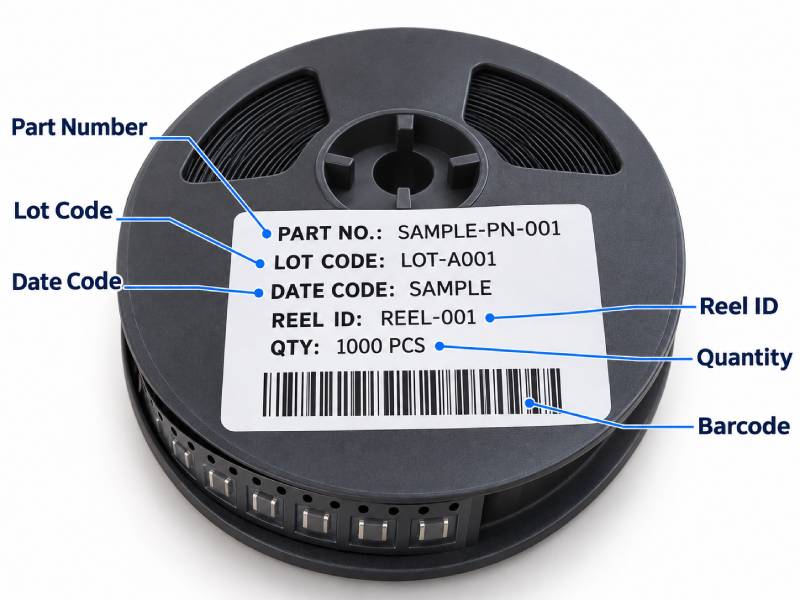
Part Identification and Packaging Configuration
First, verify the manufacturer name, part number, and applicable customer identification.
Pay particular attention to part-number suffixes. Two ordering codes may describe similar components but specify different packaging formats or product configurations.
For example, a component ordered in tape-and-reel format may have a different complete ordering code from the same component supplied in another packaging format.
The inspector should compare the full identification against the approved order, bill of materials, or packaging instruction.
Where the label contains packaging configuration information, confirm that it corresponds to the approved documentation.
Lot Code, Date Code, Reel ID, and Quantity
These fields are particularly important for material identification and traceability.
-
Lot Code: Verify that the manufacturing lot corresponds to the source material or approved production record.
-
Date Code: Check the code against the component manufacturer‘s documented date-code format.
-
Reel ID: Confirm that the identifier corresponds to the correct physical reel and is unique when required.
-
Quantity: Compare the labeled quantity with the approved packing or counting record, including the unit of measure.
A date code should not automatically be interpreted as a packaging date. Component manufacturing dates, packaging dates, and label printing dates can represent different events.
For partial reels, the quantity must reflect the applicable current inventory or packaging record rather than an assumed original full-reel quantity.
Conditional Handling and Customer-Specific Information
Depending on the product and order, additional label information may include:
-
ESD-sensitive handling identification.
-
Moisture Sensitivity Level (MSL) information.
-
Country of origin.
-
Customer purchase order.
-
Approved packaging revision.
-
Inspection or release status.
-
Barcode or 2D identification data.
These fields should be checked when required by the approved specification. They are not universally mandatory on every reel label.
Reel Label Field Verification Matrix
| Label field | Verification source | Typical discrepancy |
|---|---|---|
| Manufacturer part number | Approved order or BOM | Incorrect part or packaging suffix |
| Customer part number | Customer specification | Wrong internal identification |
| Manufacturing lot | Component production or receiving record | Lot mismatch |
| Date code | Manufacturer documentation | Incorrect or inconsistent date code |
| Reel ID | Packaging record | Duplicate or unregistered identifier |
| Quantity | Packaging or counting record | Quantity mismatch |
| Barcode data | Approved encoding specification | Incorrect or unreadable data |
| Handling information | Product and customer requirements | Missing required identification |
The inspection result should be based on agreement with the authoritative records, not simply on whether the printed text appears reasonable.
3. How Should Inspectors Perform a Step-by-Step Reel Label Check?
A consistent inspection sequence reduces the risk of overlooking errors when multiple reels, lots, or packaging orders are processed.
The following procedure can be adapted to an approved quality control plan.
Step 1 — Prepare the Approved Reference Information
Before examining the label, obtain the documents needed to determine what correct information should look like.
These may include:
-
Packaging work order.
-
Approved label template and revision.
-
Manufacturer or customer part number.
-
Manufacturing lot and date-code information.
-
Expected reel quantity.
-
Customer labeling requirements.
-
Packaging and shipment records.
Confirm that the documents apply to the current job. An outdated label template can produce apparently consistent labels that are incorrect for the actual order.
Step 2 — Inspect Label Presence and Physical Condition
Examine the applied label without damaging the reel or protective packaging.
Check whether the label is:
-
Present in the approved location.
-
Securely attached.
-
Legible and free from significant smearing.
-
Free from tears or damage affecting required information.
-
Not obscured by tape, straps, or other packaging materials.
-
Consistent with the approved label format.
Also check for multiple conflicting labels or signs of uncontrolled replacement.
For labels attached to plastic reels, the label should remain readable in its intended handling and storage condition. Placement requirements should follow the approved reel and packaging layout.
Step 3 — Compare Printed Information with Source Records
Read the human-readable data and compare each required field with its approved reference.
Do not rely on a quick visual impression.
Pay particular attention to:
-
Missing leading zeros.
-
Incorrect letters or digits.
-
Omitted part-number suffixes.
-
Inconsistent lot-code formatting.
-
Incorrect quantities.
-
Missing revision identifiers.
For example, LOT-0A12 and LOT-OA12 may look similar, but the zero and the letter O are different characters.
Any difference should be documented and resolved rather than assumed to be a harmless printing variation.
Step 4 — Scan and Verify the Barcode
Where machine-readable identification is required, scan the actual applied label using the intended scanning equipment.
Confirm that the barcode can be decoded and that the resulting data matches the approved source.
The verification should consider both the barcode‘s readable condition and the accuracy of its encoded content.
A successful scan alone does not establish that the data is correct.
If the decoded part number, lot code, quantity, or other required identifier differs from the printed or approved value, the discrepancy must be investigated.
Step 5 — Cross-Check Associated Packaging Labels
Compare the reel identification with the protective bag, inner box, carton, and packing records, where applicable.
Confirm that:
-
The reel belongs to the documented packaging unit.
-
The assigned part number is correct.
-
The reel‘s lot information is supported by the packaging records.
-
The quantity is consistent with the recorded allocation.
-
The relevant packaging identifiers provide the required traceability relationship.
The labels at different packaging levels do not always need identical identifiers. They must, however, provide a consistent and documented relationship.
Step 6 — Record Results and Determine Disposition
Document the inspection results according to the approved control plan.
For material that meets all applicable requirements, record the accepted status and any required authorization.
If an identity or traceability discrepancy remains unresolved, place the affected material on hold according to the quality procedure.
Do not release a reel merely because its label has been replaced. The corrected information must be verified against the appropriate records before release.
4. How Do You Verify Barcode Data Against Printed Label Information?
Barcodes support faster data capture, but their value depends on accurate encoding and reliable interpretation.
A barcode can be readable while still containing incorrect information.
Human-Readable Information vs. Machine-Readable Data
Human-readable information is the text printed for operators to read directly.
Machine-readable information is encoded into a barcode or 2D symbol for scanning.
Some labels use a linear barcode to represent a single identifier. Others use a 2D symbol capable of encoding multiple structured data fields.
Depending on the labeling specification, encoded information may include part number, lot code, date code, quantity, and other identifiers.
When structured data identifiers are used, the decoding system must correctly distinguish the meaning of each field.
The inspector should compare the decoded values with the authoritative records rather than checking only that the scanner produces an output.
Common Barcode Verification Failures
Several problems can occur during barcode printing or data preparation.
Unreadable barcode: Poor print quality, physical damage, or an unsuitable scanning setup prevents decoding.
Printed and encoded data mismatch: The visible part number is correct, but the barcode contains an older or incorrect value.
Incorrect lot information: A previous production lot remains in the label-generation system.
Missing characters: Leading zeros, suffixes, or separators are omitted or handled incorrectly.
Duplicate identification: Different reels receive the same identifier when unique reel-level identification is required.
Incorrect data mapping: The scanned value is interpreted as the wrong field in a warehouse or production system.
To investigate a failure, capture the actual decoded output, expected value, label photograph, reel identification, and relevant printer or scanner configuration.
Where formal barcode quality grading is required, use the approved verification method and equipment. A handheld scanner‘s successful read is not a substitute for a specified print-quality verification test.
5. How Should Reel, Bag, Carton, and Shipment Labels Match?
Electronic components may pass through several packaging levels before reaching an SMT assembly line.
Each level can have a separate identification label.
A typical structure may include:
Component Reel → Protective Bag → Inner Carton → Shipping Carton → Shipment Record
The purpose of a packaging-level traceability check is to verify that the physical material can be linked through this structure without losing its identity.
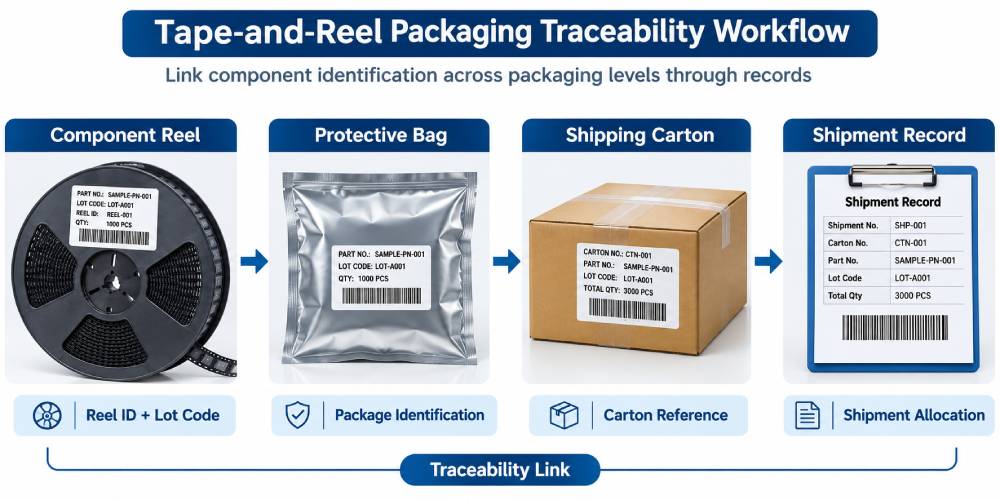
Check the Packaging Identification Hierarchy
Start with the individual reel.
Confirm its product identity, manufacturing lot, and quantity using the available records.
Next, verify the protective bag or inner package label, if present.
For moisture-sensitive components, a sealed moisture barrier bag may carry important identification and handling information. Inspectors should follow the approved procedure rather than opening protective packaging unnecessarily to inspect an internal reel.
At the carton level, verify the documented relationship between the enclosed reels and the carton identification.
Finally, compare the carton allocation with the packing list or shipment record.
The objective is consistency and documented association, not necessarily identical text on every label.
Check Quantity and Lot Consistency
When several reels are packed into a carton, the carton quantity should reconcile with the recorded reel quantities.
For example, if the packing record lists three reels, the inspector should confirm that those specific reels are present and correctly assigned.
An unexpected additional reel, missing reel, or quantity discrepancy should be investigated.
Mixed manufacturing lots may be permitted in some packaging systems but restricted by particular customer specifications.
Inspectors should verify the applicable segregation requirement rather than assuming that all cartons must contain only one manufacturing lot.
Special Cases: Partial Reels and Repacked Components
Additional care is needed when material is divided, transferred, or repacked.
For a partial reel, the remaining quantity and original source identity must be maintained through the approved records.
For a replacement reel, the new physical packaging identifier should be linked to the original component lot and relevant source reel.
If a repacking operation assigns a new packaging lot, that identifier should not erase the original component manufacturing information.
A traceable packaging process preserves the relationship between the original source material and the final physical reel.
6. How Can a Reel ID Be Traced Back to Production and Inspection Records?
An accurate reel label supports quality investigations only when the underlying records can be retrieved.
Depending on the manufacturer‘s system and agreed traceability requirements, a Reel ID may be linked to several levels of information.
Trace Backward from the Finished Reel
A typical record relationship may be:
Finished Reel ID → Packaging Work Order → Component Manufacturing Lot → Associated Material and Inspection Records
The available records may identify:
-
Original component manufacturing lot.
-
Packaging or repacking work order.
-
Packaging date and production period.
-
Carrier tape material batch.
-
Cover tape material batch.
-
Plastic reel material batch, where tracked.
-
Applicable packaging equipment or line.
-
In-process and final inspection results.
Not every organization records all these details at individual reel level.
The important requirement is that the actual traceability system provides the records specified by the approved quality and customer requirements.
For example, when investigating a packaging-related defect, records linking the affected reel to its carrier tape and cover tape batches may help identify whether other reels require inspection.
Trace Forward from a Manufacturing Lot
Trace-forward capability answers a different question:
Which reels, cartons, inventory locations, or shipments contain material associated with a particular lot?
A suitable search may begin with the component lot and identify its packaging operations, reel identifiers, carton allocations, and shipment references.
This supports material containment when a manufacturing or packaging issue is discovered after production.
Perform a Traceability Retrieval Test
A simple way to evaluate a traceability system is to select one recorded Reel ID and attempt to retrieve its associated information.
The reviewer should verify whether the system can identify the source component lot, packaging record, quantity, inspection status, and shipment association where required.
Any missing relationship should be recorded as a traceability gap and assessed against the applicable requirements.
The test should evaluate record completeness rather than merely confirming that the Reel ID exists in a database.
7. Which Reel Label Problems Require Hold, Correction, or Reinspection?
Reel label issues may include damaged printing, incorrect lot codes, unreadable barcodes, or differences between reel and carton information. Each issue should be evaluated against the approved packaging records.
Common Label Issues
-
Damaged label: Check whether the required information remains readable.
-
Incorrect lot code: Compare the code with the original production record.
-
Barcode error: Check the scanned data against the printed information.
-
Quantity mismatch: Review the reel quantity and packing record.
-
Carton mismatch: Verify that the reel belongs to the correct packaging group.
Correction and Reinspection
If the correct information is available, the label can be updated according to the approved procedure. The revised label should be checked for accuracy and readability.
Reels with unresolved identification differences should remain on hold until the necessary verification is completed.
8. What Evidence Should Be Recorded Before Releasing a Labeled Reel?
An inspection record should allow another qualified person to understand what was checked, what evidence was reviewed, and why the reel was accepted or placed on hold.
The required record format depends on the organization‘s control plan and customer requirements.
Essential Inspection Record Fields
A practical record may include:
-
Inspection date and inspector identification.
-
Part number and manufacturer.
-
Manufacturing lot and date code.
-
Reel ID or other applicable identifier.
-
Packaging work-order reference.
-
Label template revision.
-
Labeled quantity.
-
Barcode verification result.
-
Packaging-level traceability result.
-
Description of any discrepancy.
-
Corrective action and reinspection reference.
-
Final disposition and required approval.
Photographs or scan records can provide supporting evidence where they are useful and permitted.
Practical Tape-and-Reel Lot Label Inspection Checklist
The following checklist can be adapted for incoming inspection, finished-package inspection, or an outgoing quality check.
| Inspection item | Verification requirement | Result |
|---|---|---|
| Label presence | Required label is present | Pass / Fail / N/A |
| Label condition | Required information is legible | Pass / Fail / N/A |
| Part identification | Part number matches approved record | Pass / Fail / N/A |
| Lot identification | Lot code matches source record | Pass / Fail / N/A |
| Date code | Date code matches approved information | Pass / Fail / N/A |
| Reel identification | Reel ID is valid and unique where required | Pass / Fail / N/A |
| Quantity | Quantity matches approved packing record | Pass / Fail / N/A |
| Barcode | Required code is readable and accurate | Pass / Fail / N/A |
| Packaging hierarchy | Reel and carton relationships are verified | Pass / Fail / N/A |
| Handling information | Applicable warnings and identifiers are present | Pass / Fail / N/A |
| Documentation | Inspection and disposition are recorded | Pass / Fail / N/A |
For each failed item, the inspector should record an evidence reference or nonconformance number.
A failed or unresolved required field should not be converted into a passing result without documented justification and authorization.
Record Retention and Change Control
Traceability records must remain accessible for the period specified by the applicable customer agreement, quality system, or regulatory requirement.
When label information is corrected, the record should preserve the required change history.
This is particularly important when material has been repacked, partially consumed, or transferred between inventory locations.
A reliable record links the final disposition to the actual reel or lot rather than leaving the correction documented only in an unrelated email or handwritten note.
9. Which Standards and Customer Requirements Apply to Tape-and-Reel Labeling?
Tape-and-reel labeling should follow the applicable industry standards and customer packaging specifications. Requirements may vary depending on the component type and packaging method.
EIA-481 Packaging Requirements
EIA-481 provides technical requirements for carrier taping of surface-mount components. It is commonly referenced when reviewing tape-and-reel packaging configurations.
ECIA Labeling Guidelines
ECIA EIGP 114 covers product and shipment labeling for electronic components, including barcodes and identification information.
Customer-Specific Requirements
Customers may specify additional label fields, barcode formats, or traceability information. Inspectors should compare reel labels with the approved packaging instructions and customer requirements before acceptance.



 Emial
 John Mr