
PS Carrier Tape: Material Properties, Applications & Engineering Selection Guide
What Is PS Carrier Tape
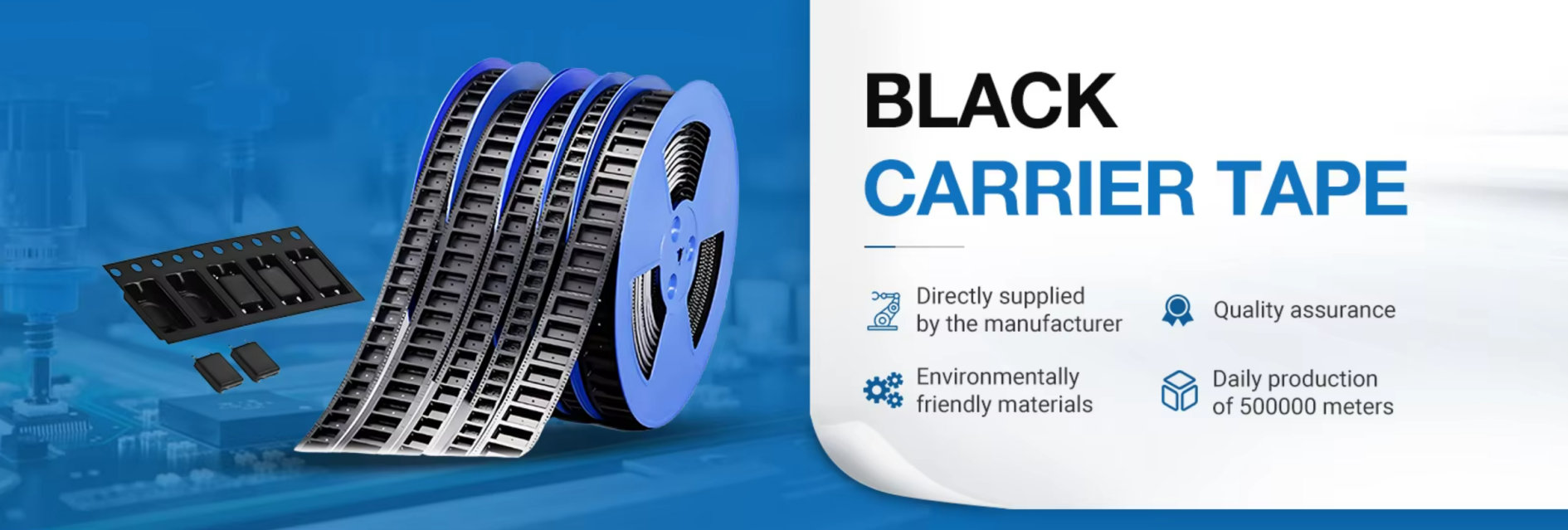
PS carrier tape refers to embossed carrier tape manufactured from polystyrene (PS), a thermoplastic material widely used in SMT component packaging. Within the overall carrier tape material system, PS occupies a very clear engineering position: it is a material optimized for stability, manufacturability, and cost efficiency under well-defined operating conditions.
In practical SMT applications, PS is one of the most commonly adopted materials because it offers a predictable forming window, reliable pocket geometry for standard components, and consistent performance in controlled production environments. For decades, it has served as the baseline material for tape-and-reel packaging, especially in high-volume electronics manufacturing where process repeatability matters more than extreme material performance.
From an engineering standpoint, PS is not chosen because it is the “strongest” or “most advanced” material, but because it delivers sufficient mechanical performance with excellent economic efficiency. When component geometry is simple and feeder conditions are stable, PS provides a highly optimized balance between function and cost.
One-sentence conclusion:
PS is a material that delivers exceptional cost-performance when used within the right engineering boundaries.
For a broader material context, see Carrier Tape Materials and the Carrier Tape Guide.
Material Properties of PS Carrier Tape (Engineering Perspective)
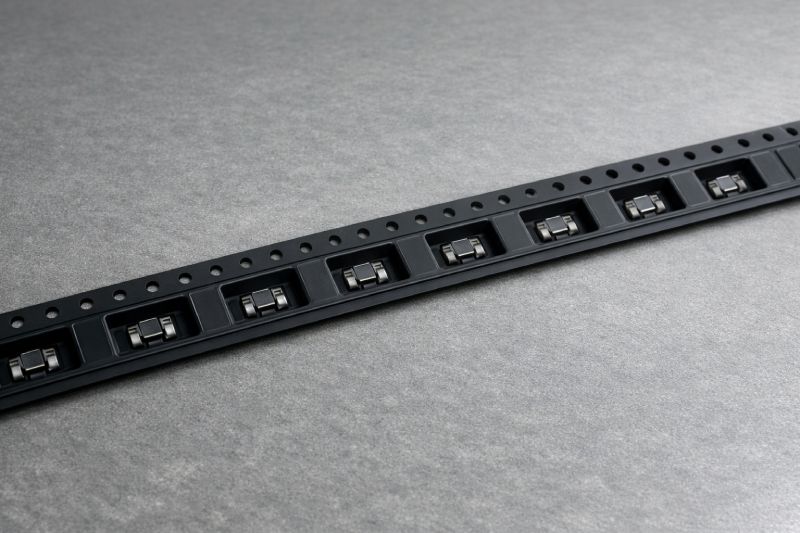
From an engineering perspective, the material properties of PS carrier tape are best understood through process behavior and production consistency, rather than isolated numerical parameters. PS has a well-defined and forgiving forming window, which makes it highly suitable for continuous embossing under stable thermal conditions. This predictability allows manufacturers to maintain consistent pocket geometry over long production runs with minimal adjustment.
In terms of structural behavior, PS exhibits moderate rigidity with low elastic recovery. This combination provides reliable pocket wall support for components with simple shapes, helping prevent deformation during tape handling, cover tape sealing, and feeder indexing. While it is not designed to absorb high mechanical stress, its stiffness is sufficient to maintain pocket integrity in standard SMT workflows.
Dimensional consistency is one of the strongest practical advantages of PS. In mass production environments, PS carrier tape properties support tight repeatability of pocket pitch, depth, and alignment, as long as design complexity remains controlled. This consistency reduces variation across reels and minimizes cumulative deviations that could otherwise affect feeder accuracy.
However, PS achieves this stability by operating within a relatively narrow structural margin. As pocket depth increases or geometry becomes more complex, material limitations begin to surface. Within its intended range, though, PS remains one of the most process-stable and predictable materials available for carrier tape manufacturing—an attribute that continues to make it a default choice in many SMT packaging programs.
Engineering Scenarios Where PS Carrier Tape Performs Best
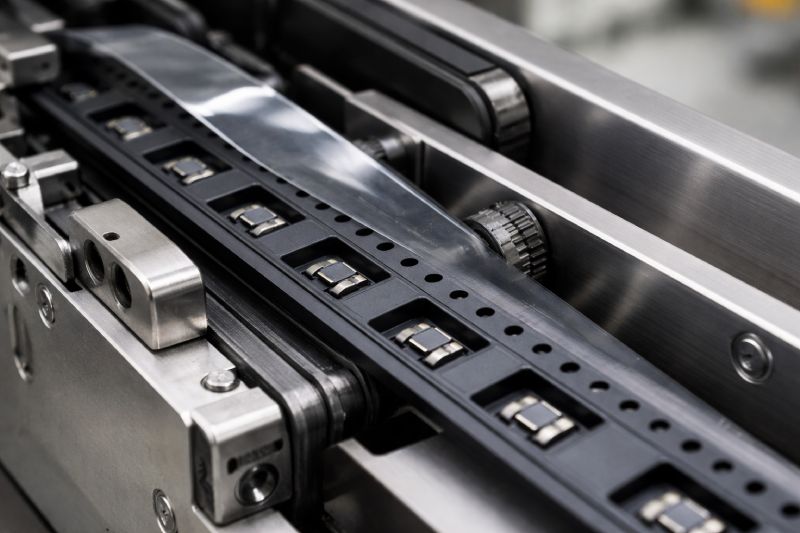
PS carrier tape performs best in engineering scenarios where process stability and cost control are prioritized over extreme mechanical tolerance. One of the most suitable environments is low-to-medium speed SMT lines, where feeder dynamics are predictable and mechanical stress on the tape remains within controlled limits. In these conditions, PS maintains pocket geometry and indexing accuracy without introducing unnecessary material rigidity.
High-volume, cost-sensitive production is another scenario where PS clearly excels. When millions of identical components are packaged and placed under repeatable conditions, the economic efficiency of PS becomes a decisive advantage. Its stable forming behavior allows manufacturers to run long embossing cycles with minimal variation, which directly supports yield consistency at scale.
PS carrier tape is also well suited for components with simple and symmetrical geometry, such as standard passive components, basic discrete devices, or ICs with shallow profiles. In these cases, pocket walls do not require excessive structural reinforcement, and PS provides adequate support without overengineering the design.
Finally, PS performs reliably in stable feeder environments—systems with controlled tension, accurate sprocket engagement, and minimal vibration. When cumulative mechanical stress is low, PS carrier tape properties align perfectly with the demands of the process, offering dependable feeding behavior and consistent pick-and-place performance across extended production runs.
Advantages of PS Carrier Tape in SMT Applications
One of the primary advantages of PS carrier tape in SMT applications is the process stability that comes with a mature, well-understood material. PS has been used in carrier tape manufacturing for decades, which means its forming behavior, sealing compatibility, and feeder interaction characteristics are highly predictable. This maturity reduces process uncertainty and simplifies engineering validation.
From a cost-structure perspective, PS offers a clear advantage in large-volume programs. Tooling efficiency, shorter setup times, and high forming yield translate into lower unit costs when production scales up. For projects where material cost directly impacts overall BOM competitiveness, PS remains one of the most economically efficient options available.
PS also provides a reasonable degree of design tolerance within defined limits. For standard pocket depths and uncomplicated geometries, minor design adjustments can often be accommodated without re-engineering the entire tape structure. This flexibility allows engineers to optimize pocket dimensions for component protection while maintaining manufacturability.
Importantly, these advantages are not rooted in marketing claims but in repeatable engineering outcomes. When applied to the right SMT conditions, PS carrier tape delivers consistent feeding performance, stable pocket geometry, and predictable production behavior—qualities that matter most in real-world assembly environments.
Why PS Carrier Tape Fails in Certain Applications
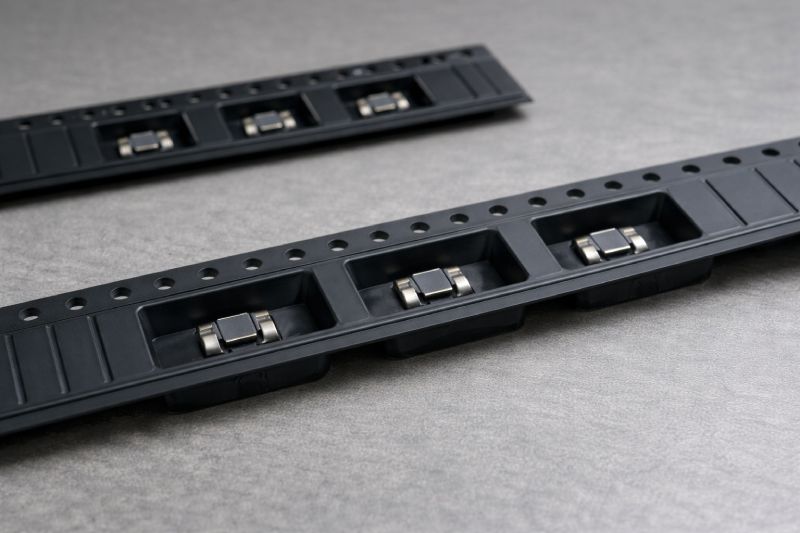
Despite its strengths, PS carrier tape has clear engineering limits, and performance issues typically arise when those limits are exceeded rather than from material inconsistency. One of the most common failure points appears in high-speed SMT operations. As placement speeds increase, dynamic forces on the tape grow significantly. PS, with its moderate rigidity, can reach a structural stability boundary where pocket deformation or edge flexing begins to affect feeder accuracy.
Deep pockets and complex component geometries introduce another critical limitation. As pocket depth increases, PS requires thicker walls to maintain shape, which narrows the effective forming window. In complex designs with undercuts, asymmetric cavities, or thin pocket features, PS may struggle to reproduce geometry consistently across long runs, leading to variability between reels.
Cumulative tolerance amplification is a less visible but equally important issue. In high-speed feeders, even small deviations in pocket pitch, depth, or sprocket alignment can compound over thousands of indexing cycles. PS carrier tape properties, while stable in moderate conditions, offer less resistance to this amplification effect compared to higher-rigidity materials. What appears acceptable at low speed can become problematic when mechanical margins tighten.
These failure modes do not indicate poor material quality; they reflect misalignment between material capability and application demands. Recognizing where PS reaches its engineering boundary is essential to maintaining yield, feeder reliability, and long-term process stability in SMT environments.
How to Decide If PS Carrier Tape Is Right for Your Application
Selecting PS carrier tape should be approached as an engineering decision, not a default material choice. The first and most decisive factor is component geometry. If the component shape is simple, symmetrical, and does not require deep or highly reinforced pockets, PS is usually sufficient to provide stable support and consistent feeding behavior.
SMT line speed is the next critical checkpoint. When placement speeds remain within low-to-medium ranges and feeder dynamics are well controlled, PS operates comfortably within its structural limits. If SMT speed exceeds certain thresholds or the process involves aggressive acceleration and deceleration, PS should be reconsidered in favor of materials with higher rigidity and tighter dimensional control.
Yield sensitivity also plays a key role. In applications where even minor feeding deviations result in significant scrap, rework, or downtime, the narrower mechanical margin of PS may become a risk factor. In such cases, the cost savings of PS can be quickly offset by yield loss.
In practical terms, PS is the right choice when the process window is stable and forgiving. If the application demands higher mechanical tolerance, deeper pockets, or maximum feeder precision, PS may no longer be the optimal solution—even if it appears cost-effective on paper.
PS vs PC vs PET Carrier Tape (Material Directional Comparison)
When comparing PS, PC, and PET carrier tape materials, the goal is not to identify a universally “better” option, but to understand directional suitability based on engineering priorities.
PS is defined by cost efficiency and material maturity. It performs reliably in stable processes with simple component requirements and remains the most economical choice for high-volume applications. Its advantages come from predictability and manufacturing familiarity rather than extreme mechanical capability.
PC (polycarbonate) moves the balance toward precision and structural rigidity. It is typically selected when pocket geometry becomes deeper or more complex, or when feeder accuracy must be maintained at higher SMT speeds. The trade-off is higher material and processing cost, along with a narrower manufacturing margin.
PET occupies a middle ground as a stability-oriented compromise. It offers better dimensional control and thermal stability than PS, while avoiding some of the cost and processing complexity associated with PC. PET is often chosen when PS approaches its performance limit but PC is not strictly required.
In directional terms:
-
PS prioritizes cost and proven stability
-
PC prioritizes precision and rigidity
-
PET prioritizes balance and consistency
PS Carrier Tape from a Manufacturing Perspective
From a manufacturing standpoint, PS carrier tape is valued less for peak performance and more for process controllability over long production cycles. In continuous embossing operations, PS responds predictably to thermal forming, allowing manufacturers to maintain stable pocket geometry without frequent parameter adjustments. This consistency is especially important in high-volume programs where even small process fluctuations can accumulate into measurable variation.
Batch-to-batch uniformity is another practical strength. When tooling, material grade, and forming conditions are properly matched, PS enables repeatable output across multiple production lots, reducing the risk of reel-to-reel variation. This level of controllability simplifies quality assurance and lowers the burden on incoming inspection for downstream assembly lines.
Importantly, PS is often “more stable rather than more advanced.” It does not push the limits of material capability, but it allows manufacturers to operate comfortably within a known and reliable window. This makes it easier to scale production, manage yield, and maintain predictable delivery timelines.
For certain projects, especially those with mature designs and fixed process conditions, PS carrier tape offers a manufacturing reality that is hard to replace: steady output, manageable risk, and consistent performance, even if higher-performance materials exist on paper.
Custom PS Carrier Tape: Design & Use Considerations
Although PS carrier tape is often associated with standard designs, custom PS solutions are still required in many real-world projects. Variations in component outline, thickness, or orientation frequently demand tailored pocket geometry, even when the overall application remains within PS’s performance range. Customization allows engineers to optimize component stability without changing material systems.
From a design perspective, pocket depth, wall angle, and corner radii must be evaluated carefully. PS tolerates customization best when pocket structures remain simple and avoid excessive depth or thin unsupported features. As designs approach these limits, forming stability and dimensional repeatability can degrade, increasing process risk.
Pitch and tolerance control are equally critical. While PS supports consistent pitch under controlled conditions, tighter tolerances reduce design margin. In custom projects, it is essential to align pocket design with realistic manufacturing capability rather than theoretical dimensions. This often means prioritizing process robustness over maximum compaction.
In practice, successful custom PS carrier tape projects balance design ambition with material behavior. When customization stays within PS’s natural forming and structural window, it delivers a cost-efficient and reliable solution. For design-driven applications that exceed these boundaries, alternative materials should be evaluated early.
For tailored solutions, see Custom Carrier Tape and Custom Embossed Carrier Tape.
Summary: When PS Carrier Tape Is the Right Engineering Choice
PS carrier tape is best understood as a material with clear strengths and equally clear boundaries. It excels when component geometry is simple, SMT conditions are stable, and production priorities emphasize consistency and cost efficiency over extreme mechanical margins. In these scenarios, PS delivers reliable pocket integrity, predictable feeding behavior, and excellent scalability in mass production.
Crucially, choosing PS does not mean settling for a low-end solution. When applied within the right engineering window, PS is often the most rational choice—not because it is cheap, but because it is stable, controllable, and well matched to the process. Correct material selection is not about maximizing specifications, but about aligning material behavior with real operating conditions.
Used correctly, PS carrier tape remains a proven and dependable engineering solution in modern SMT packaging—not a compromise, but a deliberate choice.



 Emial
Emial John Mr