
PET Carrier Tape: Material Characteristics, Applications & Selection Guide
What Is PET Carrier Tape
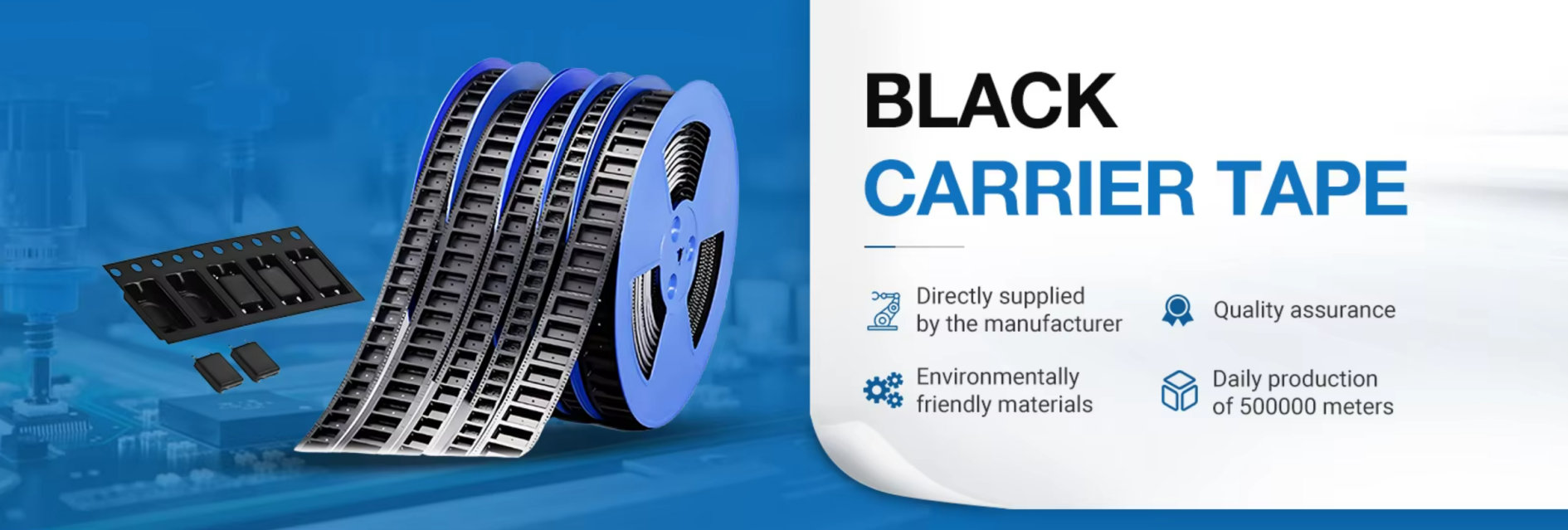
PET carrier tape is a component packaging solution manufactured from polyethylene terephthalate (PET), designed to securely hold electronic components during automated SMT handling, transport, and storage. In the carrier tape material landscape, PET sits between PS (polystyrene) and PC (polycarbonate), offering a carefully balanced set of mechanical and processing characteristics rather than extreme performance in a single dimension.
From a material engineering perspective, PET plays the role of a stability-oriented, application-flexible substrate. It delivers better dimensional control and environmental resistance than PS, while avoiding the higher cost and processing complexity typically associated with PC. This makes PET a frequent choice in projects where visual quality, handling reliability, and production consistency matter—but where ultra-high precision is not the primary constraint.
In one sentence from an engineering standpoint: PET is a compromise solution that balances stability, adaptability, and perceived quality, making it suitable for a wide range of mid-to-upper tier carrier tape applications.
Related reference: Carrier Tape Materials.
Material Characteristics of PET Carrier Tape
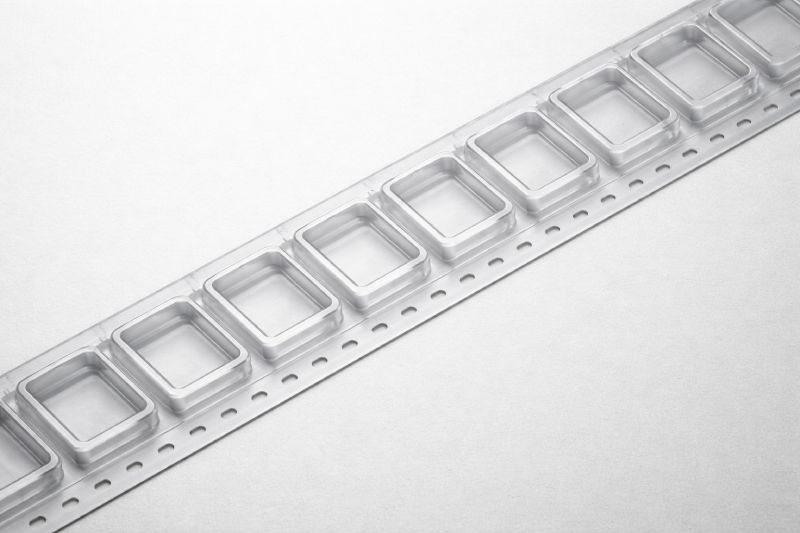
From an engineering standpoint, PET carrier tape is primarily valued for its dimensional stability and environmental robustness under real production conditions. Compared with PS, PET exhibits lower shrinkage variability during thermoforming and maintains more consistent pocket geometry across long production runs. This stability becomes especially important when pocket depth, component orientation, and pitch accuracy must remain uniform at scale.
PET also demonstrates strong adaptability to environmental changes. It is less sensitive to moderate temperature fluctuations and humidity variations than PS, which helps reduce deformation risks during storage, international transport, and extended feeder operation. While PET is not designed for extreme thermal or mechanical stress, its performance envelope comfortably covers the majority of standard SMT assembly environments.
Another key characteristic is forming consistency in mass production. PET offers a relatively wide and forgiving forming window, allowing manufacturers to achieve repeatable pocket shapes with controlled wall thickness and smooth contours. This consistency supports predictable feeding behavior and stable pick-up performance, particularly in medium-to-high speed SMT lines.
Visually and structurally, PET provides a clean, rigid appearance that aligns well with export-oriented and brand-sensitive electronics production. Although it does not match PC in absolute rigidity or micro-tolerance capability, PET delivers a dependable balance of form accuracy, process stability, and production efficiency—making it a practical material choice for projects that prioritize repeatability and controlled variation over absolute extremes.
Why PET Is Chosen Over PS or PC in Some Projects
In many engineering decisions, PET is selected not because it is the “best” material in absolute terms, but because alternative materials introduce unnecessary trade-offs for the specific project requirements. The choice often starts with a simple question: why not PS or PC?
When dimensional stability is more critical than minimizing material cost, PS quickly reaches its limits. PS carrier tape is economical and easy to form, but it is more sensitive to temperature, humidity, and long-run forming variation. In projects where pocket deformation, feeding inconsistency, or export handling risks are unacceptable, PET becomes the more reliable option without escalating to premium materials.
On the other end of the spectrum, PC offers exceptional rigidity and precision, but at a higher material cost and with tighter processing control requirements. For applications that demand good consistency but do not require ultra-fine tolerances, PC can be an over-engineered solution. PET fills this gap by delivering sufficient mechanical stability and forming accuracy at a more controlled cost and with better production efficiency.
There is also a market and customer preference dimension. Certain regions and OEMs associate PET with higher perceived quality, cleaner appearance, and better long-term stability during shipping and storage. In these cases, PET is chosen as a strategic material decision—aligning engineering performance with customer expectations and operational reality rather than chasing maximum specifications or minimum cost.
Engineering Scenarios Where PET Carrier Tape Performs Best
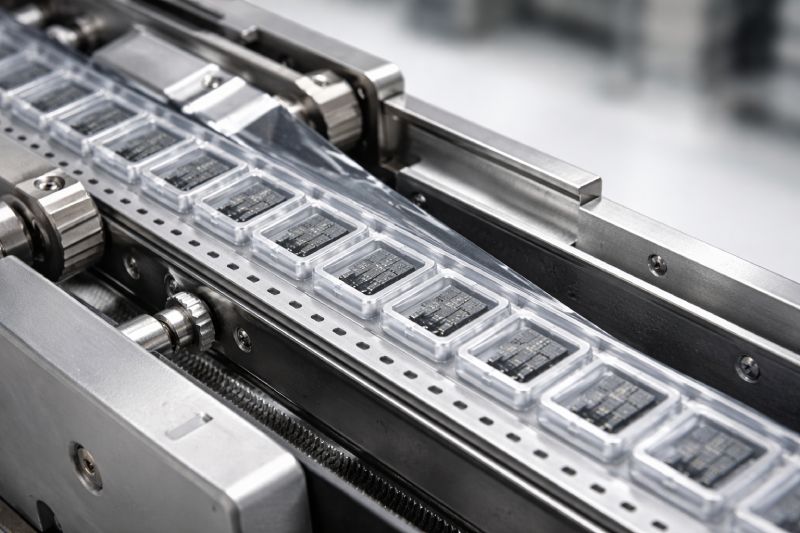
PET carrier tape performs best in engineering scenarios that demand consistency, reliability, and controlled cost, rather than extreme precision or lowest possible material pricing. Its balanced material profile makes it particularly suitable for production environments where stability across the entire process chain matters.
In medium-to-high speed SMT lines, PET offers reliable feeding behavior thanks to its dimensional stability and repeatable pocket geometry. Compared with PS, PET reduces the risk of pocket deformation under continuous feeder tension, helping maintain consistent component presentation at the pick-up point. This directly supports stable placement yields without requiring the tighter tolerances—and higher cost—associated with PC.
PET is also well suited for LED components and certain IC packages, especially where component protection, visual uniformity, and orientation stability are required. Many LED packages benefit from PET’s controlled rigidity, which helps protect lenses and leads during transport and automated handling. Similarly, a wide range of standard IC formats can be securely supported without the over-engineering of PC-based solutions.
See related applications: LED Carrier Tape and IC Carrier Tape.
For export-oriented electronics production, PET’s resistance to moderate environmental variation becomes a practical advantage. It tolerates temperature changes and humidity exposure better than PS, reducing deformation risks during long-distance shipping and extended storage.
Finally, PET is often chosen for yield-sensitive but cost-aware projects. When production stability, brand perception, and operational predictability are priorities—but budgets do not justify premium materials—PET provides a dependable middle ground that aligns engineering performance with real-world manufacturing and logistics conditions.
Advantages and Trade-offs of PET Carrier Tape
From an engineering perspective, PET carrier tape offers clear advantages in stability and consistency, but it also introduces trade-offs that must be acknowledged during material selection.
The primary advantage of PET lies in its dimensional stability and environmental tolerance. Compared with PS, PET maintains pocket geometry more reliably during forming, storage, and feeder operation. This stability supports consistent component orientation, smoother feeding behavior, and more predictable pick-and-place performance—especially in medium-to-high volume production. PET also presents a cleaner, more rigid appearance, which aligns well with quality-sensitive and export-focused electronics manufacturing.
However, these benefits come at a realistic cost and process trade-off. PET is more expensive than PS, both in raw material and in forming energy requirements. Thermoforming PET typically demands tighter temperature control and more refined tooling, which can increase setup time and production complexity. While these factors are manageable, they reduce PET’s suitability for highly cost-driven, low-margin projects.
There are also application boundaries to consider. PET does not offer the extreme rigidity or micro-tolerance capability of PC, making it less suitable for ultra-fine-pitch components or highly complex pocket geometries. In such cases, PET may reach its mechanical or forming limits before meeting engineering requirements.
In short, PET excels when stability and consistency outweigh absolute cost—but it is not a no-compromise solution. Understanding these trade-offs is essential to using PET effectively rather than assuming it is universally superior.
Why PET Carrier Tape Is Not a Universal Solution
Despite its balanced performance, PET carrier tape is not a one-size-fits-all material, and treating it as such often leads to over-engineering or unnecessary cost. Understanding where PET falls short is critical to building trust in material selection decisions.
For applications requiring ultra-high dimensional precision, PET cannot match the rigidity and micro-tolerance control of PC. When pocket geometry must remain extremely tight—such as with very fine-pitch ICs or complex multi-level pocket designs—PET may exhibit slight elastic recovery or forming variation that becomes unacceptable at the margins. In these cases, PC remains the more appropriate engineering choice.
At the opposite end of the spectrum, PET is often unjustified in extreme cost-driven projects. When component value is low, tolerances are forgiving, and production speed is moderate, PS can deliver acceptable performance at a significantly lower material and processing cost. Using PET in such scenarios increases BOM cost without delivering proportional functional benefits.
PET also presents manufacturing challenges under complex pocket conditions. Deep draws, sharp corner geometries, or thin wall requirements narrow PET’s forming window and raise the risk of inconsistency across large production volumes. While these challenges can be mitigated through tooling and process optimization, they increase technical complexity and reduce PET’s attractiveness for certain designs.
In short, PET is best understood as a deliberate engineering choice, not a default option. Knowing when not to use PET is just as important as recognizing where it performs well.
How to Decide If PET Carrier Tape Fits Your Application
Choosing PET carrier tape should be the result of a material judgment process, not a default assumption. The key question is whether your application requires balance—or pushes toward one extreme.
If your application needs a balance between stability, adaptability, and cost, PET is often the right fit. Projects that involve medium-to-high speed SMT lines, export shipping, or yield-sensitive production benefit from PET’s consistent pocket geometry and resistance to environmental variation. In these cases, PET provides measurable reliability gains without the complexity or cost escalation of PC.
If cost pressure dominates the decision, PET should be reconsidered. For high-volume, low-value components with relaxed tolerance requirements, PS can often meet functional needs at a significantly lower material and processing cost. Selecting PET in such scenarios typically adds cost without improving real-world performance.
When mechanical rigidity or micro-level precision is critical, PET may fall short. Applications involving fine-pitch components, complex pocket structures, or extremely tight tolerance windows should prompt an evaluation of PC instead. PC’s higher stiffness and dimensional control justify its use when failure risk or yield loss carries high consequences.
Viewed as a simple decision logic:
– If the application demands balance → PET is a strong candidate
– If cost is the primary driver → reconsider PET
– If rigidity and precision are non-negotiable → evaluate PC
This logic-driven approach helps engineers and procurement teams align material choice with actual performance requirements rather than assumptions or habits.
PET Carrier Tape from a Manufacturing Perspective
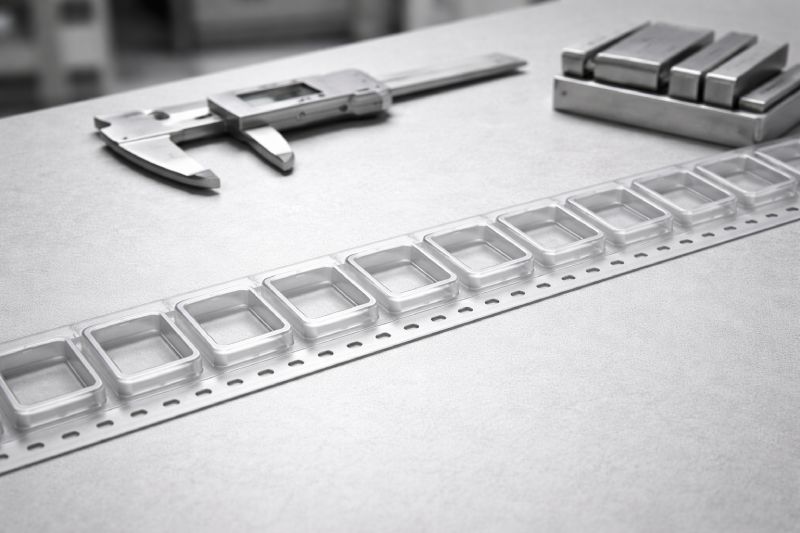
From a manufacturing standpoint, PET carrier tape is favored in projects where process stability and repeatability outweigh the need for extreme forming precision or lowest material cost. PET offers a workable balance between control and efficiency when the production environment is well managed.
One key factor is PET’s forming window and process control requirements. Compared with PS, PET requires more disciplined temperature management during thermoforming, as underheating can reduce definition while overheating may introduce thinning or stress marks. That said, PET’s forming window is still more forgiving than PC’s, making it easier to stabilize in high-volume production once parameters are established.
In terms of batch consistency and repeatability, PET performs reliably when tooling, material batches, and process settings are kept consistent. This makes PET suitable for long production runs where pocket geometry, pitch accuracy, and tape flatness must remain stable across multiple lots. Manufacturers often prefer PET in programs where requalification risk between batches needs to be minimized.
PET is also commonly selected in “stability-first” manufacturing programs. These are projects where feeder reliability, yield protection, and downstream process predictability carry more weight than aggressive cost optimization. In such cases, PET supports smoother production planning and fewer corrective interventions, making it a practical material choice from both an engineering and operational perspective.
Custom PET Carrier Tape Design Considerations
Custom PET carrier tape is typically required when standard tape formats cannot fully support component geometry, feeding behavior, or yield targets. This is common for non-standard LEDs, special IC outlines, or components with sensitive surfaces that demand tailored pocket support.
From an engineering perspective, customization begins with pocket design trade-offs. Pocket depth, corner radius, and wall angle must balance component protection with forming feasibility. PET handles moderate pocket complexity well, but aggressive geometries—such as deep draws or sharp transitions—can narrow the forming window and increase variability. Early design validation is critical to avoid pushing PET beyond its practical limits.
Pitch selection and tolerance control are equally important. While PET offers stable pitch repeatability, tighter tolerances increase tooling precision requirements and process sensitivity. Engineers often relax non-critical tolerances slightly when designing PET tape to improve manufacturability without affecting feeder performance.
Customization decisions should also account for volume and lifecycle expectations. For long-term, repeat-production programs, investing in optimized PET tooling delivers better consistency and lower risk over time. For short runs or rapidly changing designs, the added setup effort may outweigh the benefits.
Related references: Custom Carrier Tape and Carrier Tape Design Guide.
Well-executed PET customization is not about maximizing complexity—it is about aligning material capability, pocket design, and process control to achieve reliable, repeatable performance at scale.
Summary: PET Carrier Tape as a Balanced Engineering Choice
PET carrier tape occupies a clear middle position in the carrier tape material spectrum. It is neither the lowest-cost option nor the highest-precision solution, but a deliberate balance between stability, adaptability, and manufacturing practicality. For applications that demand consistent pocket geometry, reliable feeder performance, and controlled environmental resistance, PET delivers dependable results without unnecessary over-engineering.
At the same time, PET is most effective when selected with intent. It excels in stability-focused, yield-sensitive projects, but it should be avoided when extreme precision or aggressive cost targets dominate the decision. By understanding where PET fits—and where it does not—engineers and procurement teams can make material choices that align performance, cost, and operational reality rather than defaulting to assumptions.



 Emial
Emial John Mr