


Automotive Connector Carrier Tape: Packaging Solutions for Automotive Electronics
What Is Automotive Connector Carrier Tape?
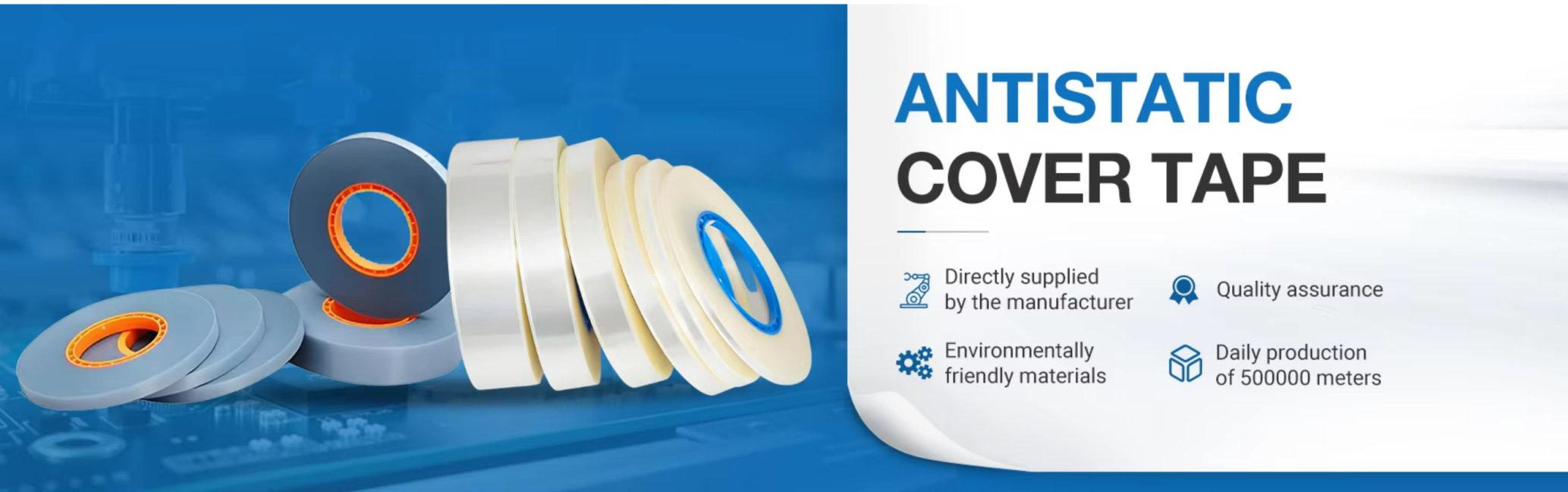
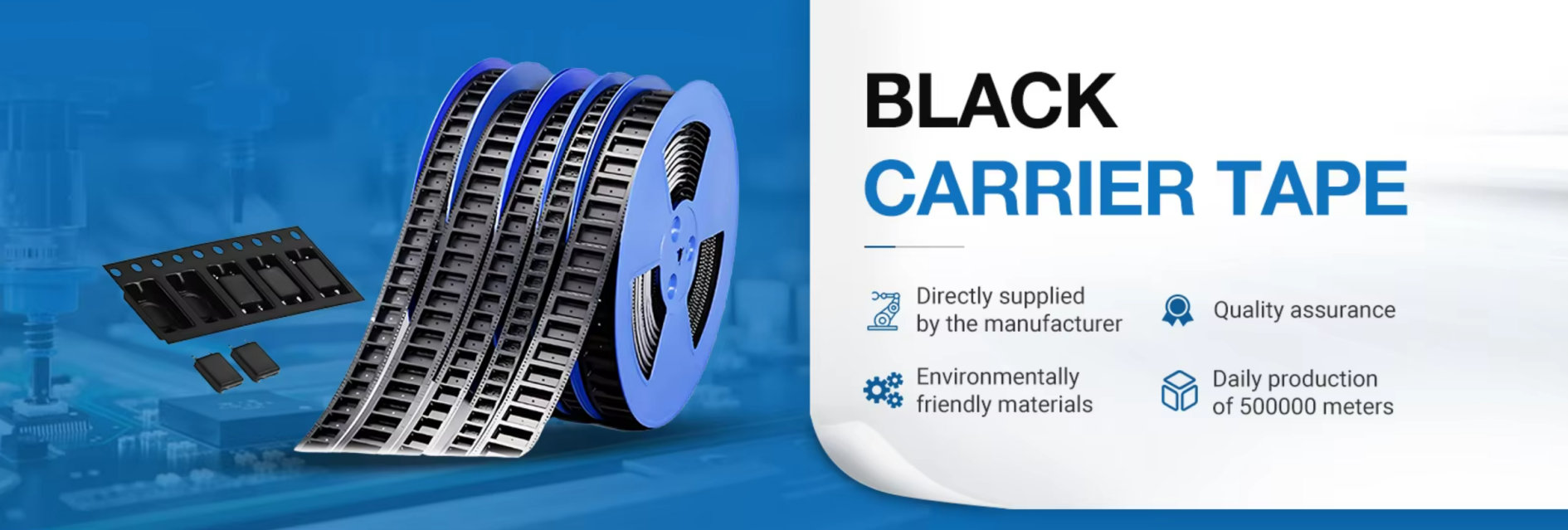
Automotive connector carrier tape is a specialized packaging solution used to transport, protect, and feed automotive connectors into automated assembly equipment. In modern automotive electronics manufacturing, connectors are often delivered to SMT or automated assembly lines using a tape-and-reel packaging system, which consists of three key components: carrier tape, cover tape, and plastic reel.
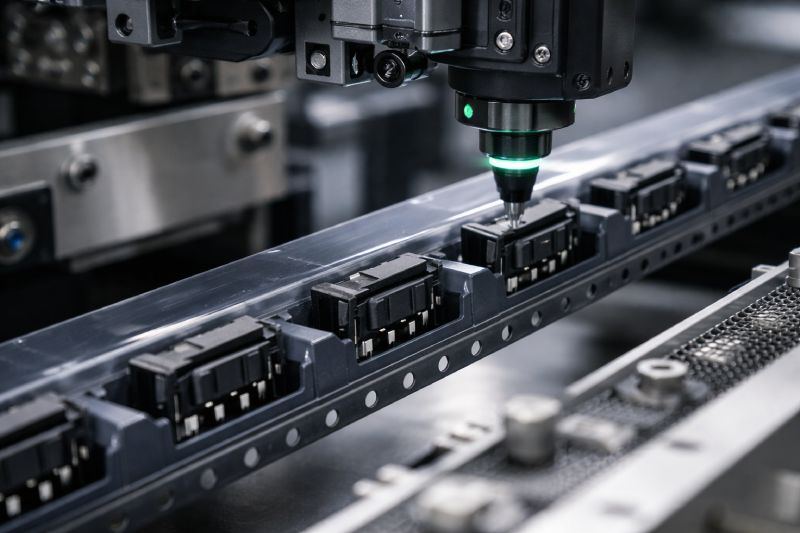
The carrier tape contains precisely formed pockets designed to hold each connector securely in place. A cover tape seals the pockets to prevent components from escaping during transportation, while the reel allows the packaged connectors to be handled efficiently by automated feeding systems. During production, the tape is loaded into a feeder, where connectors are sequentially presented to pick-and-place machines or robotic assembly systems.
Compared with standard SMT components such as resistors or capacitors, automotive connectors typically have larger sizes, irregular geometries, and higher mass, which makes their packaging significantly more complex. The carrier tape pockets must be carefully designed to maintain component orientation, prevent movement, and protect sensitive terminals.
Automotive connectors require higher packaging stability and dimensional control compared with standard SMT components. Because these components are often used in safety-critical automotive systems—such as engine control units, ADAS modules, and infotainment electronics—the reliability of the packaging system directly affects the stability of automated assembly processes.
Why Automotive Connectors Require Specialized Carrier Tape
Automotive electronics operate under far more demanding conditions than typical consumer electronics. As a result, the packaging systems used for automotive connectors must meet higher standards of stability, durability, and consistency throughout the manufacturing and logistics process. This is why automotive connectors often require specialized carrier tape designs rather than standard SMT packaging solutions.
One major factor is vibration resistance. Automotive connectors are usually larger and heavier than common SMT components, which means they are more susceptible to movement inside the tape pockets during transportation. If the pocket structure or retention design is insufficient, connectors may shift, rotate, or even jump out of the pocket under vibration. Specialized carrier tape designs incorporate deeper pockets, optimized geometry, and stronger retention features to maintain component stability.
Another critical requirement is the long supply chain associated with automotive production. Automotive components often travel through multiple stages—including packaging facilities, international shipping, component warehouses, and OEM assembly plants—before reaching the final production line. During this extended logistics cycle, packaging must ensure that connectors remain correctly positioned and protected from mechanical stress.
Automotive manufacturing also follows strict zero-defect quality standards. Many connectors are used in safety-related electronic systems such as braking control units, airbag modules, and vehicle communication networks. Any feeding error, orientation issue, or damaged terminal caused by unstable packaging can lead to production interruptions or costly defects.
In addition, automotive assembly lines rely heavily on high-reliability automated assembly systems. These systems require precise pocket dimensions, stable orientation control, and consistent pitch alignment to ensure smooth feeding in SMT or robotic assembly equipment.
Because of these factors, standard carrier tape designs developed for small SMT components are not always suitable for automotive connectors. Specialized carrier tape structures are often required to achieve the stability and precision needed for automotive electronics manufacturing.
Common Types of Automotive Connectors Packaged in Carrier Tape
Automotive electronics use a wide variety of connectors for power distribution, signal transmission, and module interconnection. Many of these connectors are supplied to assembly lines through carrier tape packaging, allowing them to be handled efficiently by automated feeding and pick-and-place systems.
However, automotive connectors differ significantly in size, shape, and pin structure, which means the carrier tape pocket design must be customized for each connector type. Below are several common categories of automotive connectors frequently packaged in carrier tape systems.
Board-to-Board Connectors
Board-to-board connectors are widely used in automotive electronic modules where two printed circuit boards must be connected directly. These connectors are commonly found in control units such as engine control modules (ECUs), ADAS systems, and infotainment boards.
Board-to-board connectors are often rectangular and relatively low-profile, but they may include delicate pin arrays or alignment posts. Carrier tape pockets for these components must provide stable support across the connector body while preventing pressure on the contact terminals. Precise pocket geometry is also required to maintain consistent orientation so that pick-and-place machines can place the connector correctly onto the PCB.
Wire-to-Board Connectors
Wire-to-board connectors are used to connect wiring harnesses to electronic circuit boards inside vehicles. These connectors are typically bulkier and taller than board-to-board connectors and may include plastic housings with multiple locking features.
Because of their larger size and irregular structure, packaging them in carrier tape requires deeper pockets and stronger retention control. The pocket must stabilize the connector without deforming the plastic housing, while still allowing smooth removal by automated assembly equipment.
Automotive Signal Connectors
Signal connectors are designed to transmit data or communication signals between electronic systems within a vehicle. These connectors are commonly used in automotive communication networks such as CAN, LIN, and Ethernet systems.
Signal connectors often have precise terminal arrangements and compact designs, which means orientation control is especially important. The carrier tape must ensure that every connector is presented in the correct direction so that automated assembly systems can place the component accurately during production.
Micro Automotive Connectors
As automotive electronics become more compact, micro connectors are increasingly used in applications such as sensors, cameras, and advanced driver-assistance systems. These connectors can be extremely small but still contain complex pin structures.
Packaging micro connectors presents unique challenges. The carrier tape pocket must be precisely engineered to prevent component rotation while maintaining tight dimensional tolerances. Even small deviations in pocket design can affect feeding stability or placement accuracy.
Because each connector category has different physical characteristics, carrier tape pocket design varies significantly depending on the connector type. Proper packaging design ensures stable transportation, consistent orientation, and reliable automated assembly throughout the automotive electronics manufacturing process.
Key Design Considerations for Automotive Connector Carrier Tape
Designing carrier tape for automotive connectors requires careful engineering to ensure stable transportation, consistent feeding, and reliable automated assembly. Unlike standard SMT components, connectors often have irregular shapes, larger mass, and sensitive terminal structures, which makes pocket design significantly more complex.
To meet the reliability requirements of automotive electronics manufacturing, several key design factors must be considered when developing automotive connector carrier tape.
Pocket Geometry
Pocket geometry is one of the most critical aspects of carrier tape design for automotive connectors. Unlike resistors or ICs that have relatively uniform shapes, connectors may include protruding housings, locking features, or pin structures that create complex outlines.
The pocket must be designed to support the connector body securely without applying pressure to fragile terminals or plastic locking structures. Engineers often optimize pocket depth, wall angles, and support surfaces to ensure that the connector sits stably inside the cavity while still allowing smooth removal by pick-and-place equipment.
Proper pocket geometry also helps prevent issues such as component tilting, rotation, or misalignment during transportation and feeding.
Retention Stability
Automotive connectors tend to be heavier than most SMT components, which increases the risk of movement during shipping and handling. If retention stability is insufficient, connectors may shift within the pocket or even escape the cavity under vibration.
To address this issue, carrier tape designs often incorporate precise pocket tolerances and controlled pocket depth to hold the connector firmly in place. In some cases, additional retention features—such as optimized pocket edges or structural support areas—are used to reduce internal movement.
Strong retention stability is essential to ensure that connectors remain properly positioned throughout long transportation routes and automated feeding processes.
Orientation Control
Maintaining consistent component orientation is essential for automated assembly. Automotive connectors must be presented to pick-and-place machines in a fixed and predictable orientation, allowing robotic systems to pick and place them accurately onto the PCB or assembly fixture.
Carrier tape pocket design typically includes orientation control features, such as asymmetric pocket shapes or support structures that prevent the connector from rotating inside the cavity. These design elements ensure that each connector enters the assembly process in the correct direction.
Without proper orientation control, automated systems may experience feeding errors, placement defects, or production interruptions.
Pitch and Feeder Compatibility
Another important consideration is compatibility with SMT feeder systems. Carrier tape pitch—the spacing between adjacent pockets—must match industry standards and feeder specifications to ensure smooth operation during high-speed assembly.
Automotive connector carrier tapes are typically designed to comply with EIA-481 standards, which define key parameters such as pocket pitch, tape width, and sprocket hole positioning. Ensuring feeder compatibility allows connectors to be integrated seamlessly into existing SMT production lines.
Stable pitch control and accurate dimensional tolerances help prevent feeding issues such as misalignment, tape slipping, or pick position errors during automated assembly.
By carefully optimizing pocket geometry, retention stability, orientation control, and feeder compatibility, engineers can design carrier tape packaging systems that meet the strict reliability requirements of automotive electronics manufacturing.
Material Selection for Automotive Connector Carrier Tape
Material selection plays a critical role in the performance of automotive connector carrier tape. Because automotive connectors are often larger, heavier, and used in high-reliability applications, the carrier tape material must provide sufficient rigidity, dimensional stability, and mechanical strength to maintain pocket accuracy throughout transportation and automated assembly.
Several thermoplastic materials are commonly used in carrier tape manufacturing, each offering different mechanical and electrostatic properties. The most widely used materials include PS (Polystyrene), PET (Polyethylene Terephthalate), and PC (Polycarbonate), along with conductive or anti-static variants designed for ESD-sensitive components.
PS carrier tape is widely used for standard electronic components because it is cost-effective and easy to form through thermoforming processes. However, while PS provides good pocket definition for lightweight parts, its rigidity and dimensional stability may not always be sufficient for heavier automotive connectors. In some cases, PS is still used when connector geometry allows stable retention.
PET carrier tape offers improved strength and dimensional stability compared with PS. It provides better resistance to deformation under mechanical stress, which makes it suitable for packaging connectors that require more robust pocket support. PET also performs well in environments where temperature variations or mechanical loads could affect packaging integrity.
For demanding automotive applications, PC carrier tape is often preferred due to its superior rigidity and structural stability. Polycarbonate maintains pocket shape more effectively during transportation and high-speed feeding, reducing the risk of connector movement or deformation. This makes PC particularly suitable for connectors with complex shapes or higher mass.
In addition to mechanical properties, ESD protection is also important for certain automotive electronics. Conductive or anti-static materials may be used to prevent electrostatic discharge that could damage sensitive electronic components.
Because automotive production emphasizes long-term reliability and process stability, packaging solutions for automotive connectors often favor materials with higher rigidity and better dimensional consistency than those used for standard SMT components. Proper material selection ensures that carrier tape maintains pocket integrity, protects connector terminals, and supports stable feeding throughout the assembly process.
Challenges in Packaging Automotive Connectors
Packaging automotive connectors in carrier tape presents several engineering challenges that are rarely encountered with standard SMT components. Because connectors often have complex structures, larger mass, and delicate terminal features, designing a stable and reliable packaging solution requires careful consideration of multiple factors.
One of the most common challenges is irregular component geometry. Automotive connectors often include plastic housings, locking tabs, guiding ribs, or terminal extensions that create asymmetrical shapes. Unlike simple rectangular components, these connectors cannot always be supported by standard pocket designs. The carrier tape pocket must be carefully shaped to stabilize the connector body while avoiding pressure on fragile structural features.
Another challenge is the higher weight of connectors compared with typical SMT parts. Heavier components increase the risk of movement during transportation or automated feeding. If the pocket depth or retention design is not properly optimized, connectors may tilt, rotate, or bounce inside the pocket when exposed to vibration during shipping. This instability can lead to orientation errors or feeding failures in automated assembly equipment.
Terminal protection is also a critical concern. Many automotive connectors contain exposed metal terminals or precision contact pins that must remain perfectly aligned to ensure reliable electrical connections. If these terminals are subjected to pressure from the pocket walls or cover tape during packaging, they may bend or deform. Carrier tape designs must therefore provide sufficient clearance and support to protect sensitive terminal structures.
Orientation errors present another potential issue. Because connectors may not be symmetrical, maintaining the correct orientation inside the pocket is essential for automated assembly. Without proper orientation control features, connectors can rotate within the cavity, causing pick-and-place machines to misidentify the component position or fail to pick the connector correctly.
Due to these challenges, standard carrier tape solutions are often insufficient for automotive connectors. Many connector designs require custom carrier tape packaging, where pocket geometry, depth, and retention structures are specifically engineered for the connector’s shape and assembly requirements. Custom designs help ensure stable transportation, consistent orientation, and reliable automated feeding throughout the production process.
How Automotive Connector Carrier Tape Works in SMT Assembly
In automotive electronics manufacturing, connectors are often integrated into production lines through automated SMT or robotic assembly systems. Carrier tape packaging enables connectors to be delivered to these systems in a stable, organized, and machine-readable format, ensuring smooth and consistent feeding during high-volume production.
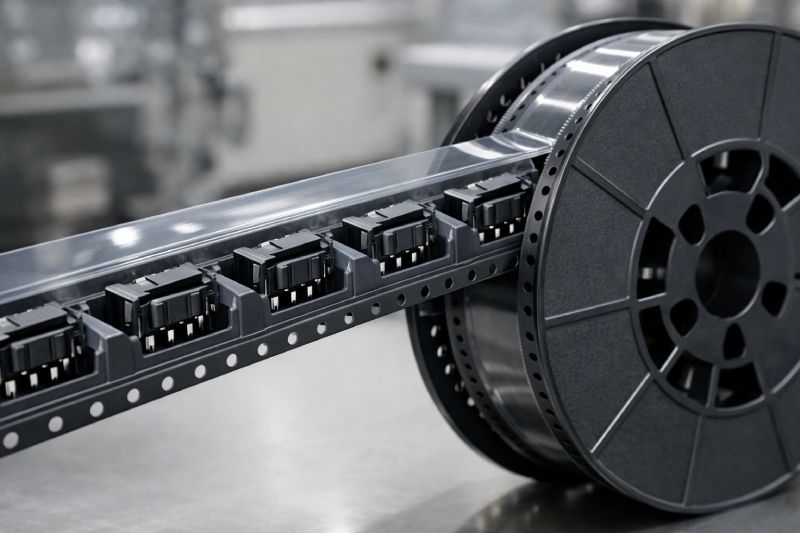
The typical workflow follows a tape-and-reel packaging process. First, connectors are placed into precisely formed pockets in the carrier tape during packaging. A cover tape is then applied over the pockets to secure the components and prevent them from moving or falling out during transportation. The packaged tape is wound onto reels, allowing it to be handled efficiently during storage, shipping, and production. This complete packaging format is commonly referred to as tape and reel packaging.
When the connectors arrive at the assembly facility, the reel is loaded into an automated SMT feeder. The feeder advances the carrier tape step by step according to the defined carrier tape pitch, positioning each connector at the pick-up location. As the tape moves forward, the cover tape is peeled away from the carrier tape, exposing the connector in the pocket.
At this point, a pick-and-place machine or robotic assembly system retrieves the connector from the pocket using a vacuum nozzle or mechanical gripper. The system then places the connector precisely onto the PCB or assembly fixture according to the programmed placement coordinates.
Because automotive connectors are often used in safety-critical electronic systems, stable feeding performance is essential. Any instability in carrier tape design—such as inconsistent pocket dimensions, poor orientation control, or weak retention—can lead to pick failures, misplacement, or production downtime.
For this reason, automotive connector carrier tape must maintain tight dimensional accuracy and reliable pocket stability to ensure that connectors are consistently presented to the assembly equipment in the correct position and orientation. A well-designed packaging system supports efficient automation and helps maintain the high reliability standards required in automotive electronics manufacturing.
Custom Carrier Tape for Automotive Connector Packaging
In many automotive electronics projects, standard carrier tape designs cannot fully meet the packaging requirements of connectors. Due to variations in connector geometry, size, and assembly conditions, manufacturers often require custom carrier tape solutions to ensure stable transportation and reliable automated feeding.
One common situation that requires customization is irregular connector shapes. Automotive connectors frequently include locking tabs, guide ribs, asymmetrical housings, or protruding terminal structures. These features make it difficult for standard pocket designs to stabilize the component properly. Custom carrier tape allows engineers to design pockets that match the exact contour of the connector body, ensuring secure positioning without applying pressure to sensitive structures.
Another factor is the need for deep or reinforced pockets. Some automotive connectors have a relatively tall housing or uneven weight distribution, which can cause instability if the pocket depth is insufficient. Custom embossed carrier tape can incorporate deeper cavities and optimized wall structures that provide better support and retention during transportation and feeding.
High-speed SMT production lines also increase the demand for custom packaging. Automotive electronics manufacturers often run automated assembly equipment at high speeds, where even minor instability in the carrier tape can lead to feeding errors or pick failures. Custom pocket design helps ensure that connectors remain stable and correctly oriented as the tape advances through the feeder.
In addition, automotive assembly processes may require tight dimensional tolerances to ensure compatibility with feeders, pick-and-place equipment, and inspection systems. Custom carrier tape designs allow manufacturers to control pocket geometry, pitch accuracy, and material properties to meet these requirements.
For these reasons, many automotive connector packaging solutions rely on custom carrier tape development rather than standard off-the-shelf tape formats. Customization enables engineers to adapt the packaging system to the connector’s structure and the specific requirements of the production line, ensuring consistent feeding performance and reliable assembly results.
Standards and Quality Requirements in Automotive Electronics
Automotive electronics manufacturing follows extremely strict quality and reliability standards. Because many electronic systems in vehicles perform safety-critical functions—such as braking control, power management, and driver assistance—every component involved in the assembly process must meet high consistency and stability requirements. This includes not only the connectors themselves but also the packaging systems used to transport and feed these components.
One key requirement is packaging consistency. Automotive production lines operate with highly automated equipment that relies on predictable component positioning. If carrier tape pockets vary in shape, depth, or spacing, automated feeders may experience misalignment or pick failures. Maintaining consistent pocket geometry across the entire reel is therefore essential for stable assembly operations.
Another important factor is dimensional control. Automotive connectors often require tight packaging tolerances to ensure correct orientation and feeding accuracy. Even small dimensional deviations in pocket size or pitch can affect how connectors sit inside the cavity or how they are presented to pick-and-place systems. High-precision forming processes are used to maintain these dimensional requirements.
In addition, packaging systems used for automated assembly must comply with industry standards, most notably the EIA-481 standard for tape-and-reel packaging. This standard defines critical parameters such as carrier tape width, pocket pitch, sprocket hole placement, and feeder compatibility. Following these specifications ensures that carrier tape can be reliably used across different SMT machines and feeder systems.
For automotive electronics manufacturers, maintaining packaging quality is not simply a logistics concern—it is an essential part of ensuring process stability and product reliability. By adhering to strict dimensional control and industry standards, automotive connector carrier tape helps support the high-quality manufacturing environment required by the automotive industry.
Summary: Why Automotive Connector Packaging Requires Specialized Carrier Tape
Automotive connectors differ significantly from standard SMT components in terms of size, geometry, and reliability requirements. These differences make packaging a critical factor in ensuring stable transportation and reliable automated assembly.
Unlike small passive components, automotive connectors often have irregular shapes, higher weight, and sensitive terminal structures. As a result, their packaging must provide strong retention, precise orientation control, and consistent dimensional accuracy to prevent feeding issues during automated production.
Automotive connectors require higher packaging stability and dimensional control compared with standard SMT components. Any instability in the carrier tape—such as pocket deformation, orientation errors, or inconsistent pitch—can lead to pick failures, assembly defects, or production downtime.
For many connector designs, custom carrier tape solutions are necessary to accommodate complex shapes and meet the strict quality standards of automotive electronics manufacturing.
By combining optimized pocket design, suitable material selection, and compliance with industry standards, specialized carrier tape helps ensure that automotive connectors are delivered to assembly lines in a stable, machine-ready format. This packaging stability ultimately supports the reliability and efficiency of automotive electronics production.



 Emial
Emial John Mr