


Tape and Reel vs Tray vs Tube Packaging: Complete SMT Comparison Guide
Introduction
In modern electronics manufacturing, packaging is no longer just a logistics concern—it is a critical factor that directly impacts SMT efficiency, component protection, and overall production cost.
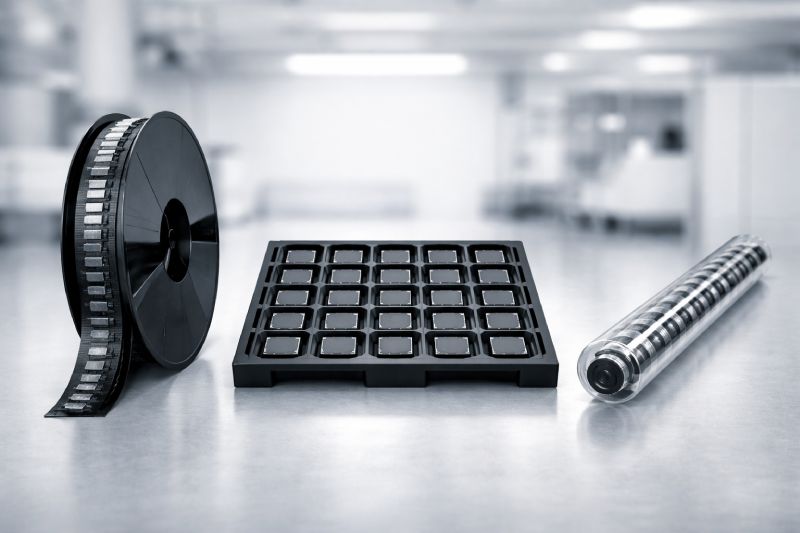
Among the most widely used methods, tape and reel packaging, tray packaging, and tube packaging dominate the industry. Each serves a different purpose, and selecting the wrong format can lead to serious issues such as misfeeds, reduced placement speed, and even component damage.
In high-speed SMT environments, packaging decisions can influence throughput by more than 30%, making it essential for engineers and procurement teams to understand the trade-offs.
This guide provides a clear, engineering-focused comparison of these three packaging methods, helping you choose the most suitable solution based on your component type, production scale, and automation level.
What Are the Three Main Electronic Component Packaging Methods?
Before comparing performance and cost, it’s important to understand how each packaging method works at a high level.
Tape and Reel Packaging
Tape and reel packaging consists of embossed or punched carrier tape sealed with cover tape and wound onto a reel. Components are placed in individual pockets and fed continuously into SMT machines.
This format is specifically designed for automated pick-and-place systems and is widely used for passive components, ICs, and small electronic parts.
Tray Packaging
Tray packaging uses rigid plastic trays (often JEDEC standard) with precisely molded cavities to hold components in fixed positions.
It is commonly used for sensitive or high-value components such as BGAs, QFNs, and large IC packages where mechanical protection is critical.
Tube Packaging
Tube packaging (also known as stick packaging) consists of elongated plastic tubes that hold components in a linear arrangement.
Components slide through the tube and are typically fed manually or with semi-automatic feeders. This method is commonly used for connectors, through-hole components, and certain ICs.
Visual Comparison: Tape vs Tray vs Tube
To understand the practical differences, the table below compares the three packaging methods across key engineering criteria:
| Factor | Tape & Reel | Tray | Tube |
|---|---|---|---|
| Automation Compatibility | ⭐⭐⭐⭐⭐ | ⭐⭐⭐⭐ | ⭐⭐ |
| Feeding Speed | High | Medium | Low |
| Component Protection | Medium | High | Medium |
| Cost Efficiency | High (mass production) | Low–Medium | Medium |
| Space Efficiency | Excellent | Poor | Good |
| Best For | Passive, small ICs | BGA, QFN, fragile ICs | Connectors, through-hole |
Key takeaway:
-
Tape and reel dominates high-speed SMT production
-
Tray excels in protection for sensitive components
-
Tube remains relevant for simpler or lower-volume applications

How Tape and Reel Packaging Performs in SMT Production
Tape and reel packaging is the industry standard for automated assembly, and its advantages are closely tied to production efficiency.
Continuous Feeding and High Throughput
Because components are arranged in a continuous strip, SMT machines can operate without interruption. This enables high placement speeds, often exceeding 30,000 components per hour (CPH).
There is minimal need for operator intervention, reducing labor dependency and improving consistency.
Stable Pick-and-Place Performance
Well-designed carrier tape pockets ensure consistent component orientation and positioning. Combined with optimized cover tape peel force, this results in:
-
Low misfeed rates
-
Stable vacuum pickup
-
Reduced placement errors
Reel Capacity and Line Efficiency
Large reel diameters allow thousands of components to be loaded at once. This reduces changeover frequency and minimizes downtime, which is critical in high-volume production.
When Tape and Reel Is Ideal
Tape and reel is the best choice when:
-
Production is high-volume
-
Full automation is required
-
Components are small to medium in size
-
SMT line speed is a priority
When Tray Packaging Becomes the Better Choice
While tape and reel dominates automation, tray packaging is essential for specific applications where protection and precision outweigh speed.
Superior Mechanical Protection
Trays provide rigid support and prevent component movement during transport and handling. This is especially important for:
-
Ball Grid Arrays (BGAs)
-
Fine-pitch ICs
-
Large or fragile packages
High Dimensional Stability
Each cavity is precisely molded to fit the component, ensuring consistent positioning and reducing the risk of deformation.
ESD Safety and Reusability
Most trays are made from ESD-safe materials, protecting sensitive components from electrostatic discharge. In many cases, trays can also be reused, partially offsetting their higher upfront cost.
Limitations of Tray Packaging
However, trays introduce trade-offs:
-
Requires dedicated tray feeders
-
Slower than tape-based feeding
-
Higher storage and transportation volume
When Tray Packaging Is Ideal
Tray packaging is preferred when:
-
Components are high-value or fragile
-
Protection is more critical than speed
-
Production volume is moderate
-
Precision handling is required
Tube Packaging: Where It Still Fits in Modern Electronics
Tube packaging is a simpler and more traditional method, but it still plays a role in certain manufacturing scenarios.
Simple and Cost-Effective Structure
Tubes are easy to manufacture and offer a relatively low-cost solution compared to trays. They are particularly suitable for:
-
Connectors
-
Through-hole components
-
Standard IC packages
Flexible for Manual and Semi-Automatic Feeding
Tube packaging works well in environments where:
-
Automation is limited
-
Production volumes are low
-
Manual handling is acceptable
Limitations of Tube Packaging
Despite its simplicity, tube packaging has several drawbacks:
-
Poor compatibility with high-speed SMT lines
-
Orientation inconsistencies during feeding
-
Increased labor requirements
When Tube Packaging Is Suitable
Tube packaging is best used when:
-
Production volume is low
-
Automation is not required
-
Cost needs to be minimized
-
Component geometry allows easy sliding
Cost Comparison: Which Packaging Method Is Most Economical?
Cost analysis must consider not only material price but also handling and operational efficiency.
Material Cost
-
Tray: Highest due to rigid structure and precision molding
-
Tube: Moderate cost
-
Tape and Reel: Lowest per unit at scale
Handling and Labor Cost
-
Tape and Reel: Lowest labor due to automation
-
Tray: Moderate handling effort
-
Tube: Higher labor due to manual processes
Total Cost Perspective
While trays may seem expensive upfront, they are justified for sensitive components. However, for high-volume production, tape and reel becomes the most economical solution due to:
-
Reduced labor
-
Higher throughput
-
Lower downtime
Decision Guide: How to Choose the Right Packaging Format
Selecting the right packaging method requires balancing multiple factors. The following framework simplifies the decision-making process.
Quick Decision Matrix
| Scenario | Recommended Packaging |
|---|---|
| High-speed SMT production | Tape & Reel |
| Fragile or high-value ICs | Tray |
| Low-volume or manual assembly | Tube |
Key Selection Factors
1. Component Size and Geometry
-
Small components → Tape and reel
-
Large or delicate → Tray
2. Production Volume
-
High volume → Tape and reel
-
Low volume → Tube or tray
3. Automation Level
-
Fully automated → Tape and reel
-
Semi/manual → Tube or tray
4. Sensitivity Requirements
-
ESD or mechanical sensitivity → Tray
Engineering Insight
In most modern SMT factories, tape and reel is the default choice. Alternative methods are typically selected only when specific constraints require them.
Common Mistakes When Selecting Packaging
Choosing the wrong packaging format can create hidden inefficiencies.
Using Tray Packaging in High-Speed Lines
This often leads to bottlenecks due to slower feeding and increased handling time.
Poor Carrier Tape Design
Improper pocket dimensions or material selection can cause:
-
Misfeeds
-
Component flipping
-
Placement errors
Ignoring ESD Requirements
Using non-ESD-safe materials can damage sensitive components, leading to yield loss.
Overlooking Total Cost
Focusing only on material cost without considering labor and efficiency often results in higher overall expenses.
Future Trends in Electronic Packaging
The industry is evolving toward greater automation and efficiency.
Increased Adoption of Tape and Reel
As SMT speeds continue to increase, tape and reel packaging is becoming even more dominant.
Smart Packaging Integration
Technologies such as RFID-enabled reels are being introduced to improve traceability and inventory management.
Sustainable Materials
Manufacturers are exploring recyclable and eco-friendly materials to reduce environmental impact.
Conclusion: Tape vs Tray vs Tube — Final Recommendation
Each packaging method serves a specific purpose:
-
Tape and Reel: Best for high-speed, automated, large-scale production
-
Tray Packaging: Ideal for fragile, high-value, or precision components
-
Tube Packaging: Suitable for low-volume or manual processes
In most cases, tape and reel is the preferred solution for modern SMT manufacturing due to its unmatched efficiency and scalability.
However, selecting the right method ultimately depends on your component characteristics and production requirements.
Get the Right Packaging Solution for Your Components
Choosing the correct packaging format is not just a technical decision—it directly affects your production efficiency, cost structure, and product quality.
If you are working with:
-
Custom component geometries
-
High-speed SMT lines
-
Specialized IC packages
Our engineering team can help you determine the most suitable packaging solution.
Send us your component drawings or specifications, and we will recommend:
-
Optimized carrier tape design
-
Compatible cover tape solutions
-
Appropriate reel configurations
-
Alternative packaging options if needed
The right packaging choice starts with the right engineering support.



 Emial
Emial John Mr