


How Reel Size Affects SMT Feeding Performance: 7-Inch vs 13-Inch Reel Guide
Many SMT feeding problems are blamed on the feeder, carrier tape, or component design. In reality, the reel itself is often the hidden cause. A reel that is too small, too large, or incompatible with the feeder can create excessive tape tension, unstable unwinding, misalignment, and frequent line stoppages.
In tape and reel packaging, the most common reel diameters are 7-inch and 13-inch. Each has advantages, but neither is correct for every SMT process. Reel size directly affects tape curvature, feeder resistance, reel change frequency, and production efficiency.

This guide explains how reel size influences SMT feeding performance, compares 7-inch and 13-inch reels, and shows how to select the right reel for your SMT line.
Why Reel Size Matters in SMT Feeding
Most SMT engineers focus on feeder settings, carrier tape quality, or machine speed when a line starts showing feeding problems. Reel size is often overlooked, even though it directly changes the way the tape behaves before it reaches the feeder.
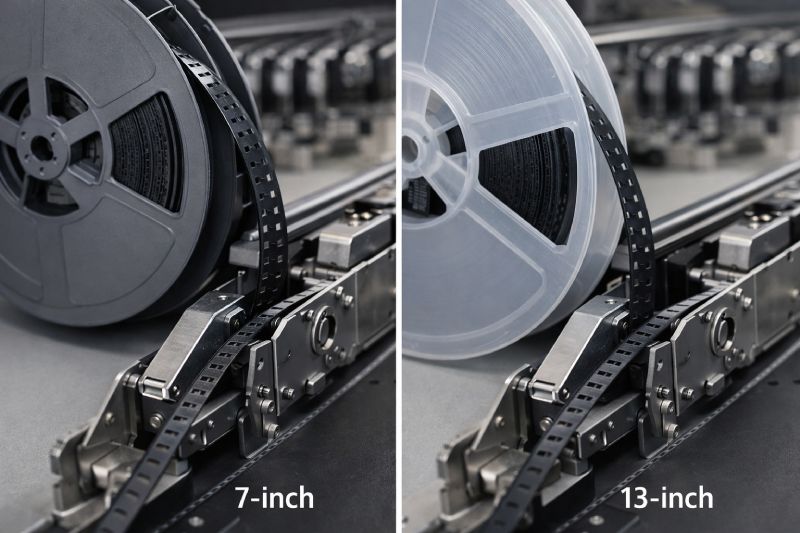
When carrier tape is wound onto a 7-inch reel, the tape is wrapped more tightly. After the tape leaves the reel, it still wants to keep that curved shape. This makes the tape harder to guide smoothly into the feeder, especially on wider tapes or deeper pockets.
Most SMT engineers focus on feeder settings, carrier tape quality, or machine speed when a line starts showing feeding problems. Reel size is often overlooked, even though it directly changes the way the tape behaves before it reaches the feeder.
When carrier tape is wound onto a 7-inch reel, the tape is wrapped more tightly. After the tape leaves the reel, it still wants to keep that curved shape. This makes the tape harder to guide smoothly into the feeder, especially on wider tapes or deeper pockets.
A 13-inch reel works differently. Because the reel diameter is larger, the tape is wound more gradually. The tape comes off the reel flatter and with less pull force. As a result, the feeder does not need to work as hard to keep the tape moving at a constant pitch.
In practice, the effect of reel size depends on the production environment. During prototype builds or short production runs, a 7-inch reel is often sufficient because the line speed is lower and reel changes are less important. In these situations, the smaller reel is easier to handle and reduces material cost.
The situation changes in longer SMT runs. Because a 7-inch reel holds less tape, the operator may need to stop the line several times during one shift to replace reels. Each reel change adds downtime and increases the possibility of setup variation.
A 13-inch reel is often preferred for higher-volume production because it can run for a longer period before replacement. The larger diameter also helps the tape unwind more gradually, which may improve feeding consistency on some high-speed lines.
Even so, a larger reel is only useful when the feeder is designed to support it. Some compact feeders are intended for 7-inch reels only. Installing a heavy 13-inch reel on the wrong feeder can create extra resistance and reduce feeding stability.
For this reason, reel size should be selected according to the feeder specification, tape width, and expected production volume rather than choosing the largest reel by default.
Common SMT Reel Sizes and Where They Are Used
The two most common reel diameters in SMT packaging are 7-inch and 13-inch. Some manufacturers also provide custom reel sizes for unusual parts or special feeder requirements.
| Reel Size | Typical Components | Typical Tape Width | Best For |
|---|---|---|---|
| 7-inch reel | LEDs, resistors, capacitors, small ICs | 8–16 mm | Prototype and low-volume production |
| 13-inch reel | High-volume ICs, connectors, large production runs | 8–56 mm | Mass production and high-speed SMT |
| Custom reel | Large, heavy, or unusual parts | Custom widths | Special applications |
7-Inch Reels: Flexible but Limited
A 7-inch reel is often used for low-volume production, prototypes, engineering samples, and multiple-SKU projects.
Its smaller size offers several advantages:
-
Lower packaging cost
-
Easier handling and storage
-
Faster reel changes for short production runs
-
Better suited for small quantities
For example, if a customer needs only a few thousand pieces of a component, using a 13-inch reel may be unnecessary. A 7-inch reel provides enough capacity while keeping inventory and packaging costs lower.
However, smaller reels also create tighter tape curvature and require more frequent replacement during production. This can increase downtime on larger SMT lines.
13-Inch Reels: Stable for High-Speed Production
A 13-inch reel is the standard choice for large-scale SMT production. Because it holds more carrier tape, it reduces the number of reel changes required during a production run.
This provides several benefits:
-
Longer continuous feeding
-
Less downtime
-
More stable tape unwinding
-
Lower tension fluctuation
-
Better performance in high-speed lines
A 13-inch reel is especially useful for EMS factories running long production shifts or high-speed pick-and-place machines.
For example, a high-volume assembly line placing 0201 resistors may consume several 7-inch reels in a short period. Replacing them repeatedly interrupts production. A 13-inch reel can reduce these interruptions significantly.
When Custom Reel Dimensions Are Necessary
Some components do not fit standard 7-inch or 13-inch reel configurations. This is common for:
-
Large connectors
-
Automotive parts
-
Deep-pocket carrier tape
-
Wide tape above 56 mm
-
Unusual feeder systems
In these cases, a custom reel may be required. The reel diameter, hub size, flange width, and material must be matched to both the carrier tape and the feeder.
7-Inch vs 13-Inch Reels: Which Performs Better?
Neither reel size is universally better. The correct choice depends on the production environment.
| Factor | 7-Inch Reel | 13-Inch Reel |
|---|---|---|
| Feeding stability | Moderate | High |
| Reel change frequency | High | Low |
| Suitable line speed | Low to medium | Medium to high |
| Storage efficiency | Better for small lots | Better for large-volume inventory |
| Feeder compatibility | Works with most compact feeders | Requires larger feeder capacity |
| Shipping cost | Lower | Higher |
In terms of feeding performance, a 13-inch reel usually provides better stability. The tape unwinds with less curvature, lower tension, and fewer interruptions.
A 7-inch reel, however, is often more practical when:
-
Production volume is low
-
Many different part numbers are used
-
The factory runs short jobs
-
Feeder space is limited
Which Reel Size Produces Fewer Feeding Errors?
A 13-inch reel generally creates fewer feeding errors because the tape path is smoother and more consistent.
Typical problems that are more common with 7-inch reels include:
-
Tape lifting at the feeder entrance
-
Inconsistent pocket position
-
Increased cover tape peel variation
-
Greater chance of tape jumping
For wider carrier tapes or fragile components, the difference is even more noticeable.
Which Reel Size Is More Cost Effective?
At first glance, a 7-inch reel may seem cheaper. The reel itself costs less and shipping is more compact.
However, in high-volume production, the cost of repeated reel changes, machine downtime, and feeding errors may be much greater than the cost difference between reel sizes.
For large SMT lines, a 13-inch reel is often more cost effective overall because it reduces interruptions and improves productivity.
Which Reel Size Is Better for Flexible Manufacturing?
Factories that produce many different assemblies in small quantities often prefer 7-inch reels. Smaller reels are easier to manage when there are multiple part numbers and frequent setup changes.
A contract manufacturer producing many low-volume orders may choose 7-inch reels even if the feeding stability is slightly lower.
Common Feeding Problems Caused by the Wrong Reel Size
Many feeding failures are caused by reel mismatch rather than by the feeder itself.
| Problem | Likely Reel Cause | Recommended Fix |
|---|---|---|
| Tape jumping | Reel too small, excessive tape memory | Use a larger reel diameter |
| Pocket misalignment | Incorrect reel width or hub size | Match reel to tape specification |
| Unstable cover tape peeling | Excessive feeding tension | Reduce reel resistance |
| Feeder jams | Reel too heavy for feeder | Use smaller reel or stronger feeder |
| Frequent line stoppages | Reel capacity too small | Switch to larger reel |
Why Small Reels Cause Excessive Tape Memory
Carrier tape wound on a small reel keeps a stronger curved shape. When the tape enters the feeder, it may resist straightening.
This can create tape memory problems such as:
-
Curved tape path
-
Lifted carrier tape edges
-
Inconsistent sprocket hole position
The effect is stronger with thicker carrier tape materials such as PC or PET used for deeper pockets.
How Incorrect Hub Size Creates Feeder Problems
The center hub of the reel must match the feeder spindle. If the hub is too small or too large, the reel may wobble during feeding.
A wobbling reel can cause:
-
Uneven tape movement
-
Misalignment between sprocket holes and feeder pins
-
Inconsistent feeder indexing
Even when the reel diameter is correct, the hub specification must also be compatible.
Why Large Reels Can Also Cause Problems
A 13-inch reel is not always the best solution. If the feeder is designed only for smaller reels, the additional weight may create drag.
In some cases, the feeder motor cannot rotate the reel smoothly. This may result in:
-
Delayed indexing
-
Tape slipping
-
Excessive wear on the feeder
Before changing to a larger reel, always confirm that the feeder supports it.
How Reel Size Influences High-Speed SMT Lines
High-speed SMT lines magnify every feeding problem. A small amount of reel resistance that seems acceptable at low speed may become a major issue when the feeder is cycling rapidly.
For this reason, most high-speed SMT lines prefer 13-inch reels.
The main reasons are:
-
More stable tape unwinding
-
Fewer reel changes during long runs
-
Lower tension fluctuation
-
Reduced risk of missed feeding
This is especially important for very small components such as 0201 and 01005 devices. These components require precise pocket positioning. Even a slight tape movement error can cause pickup failure.
When feeding these components at high speed, a larger reel often improves placement accuracy and reduces machine stoppages.
How to Choose the Right Reel Size for Your SMT Process
There is no single reel size that works best for every SMT project. The right choice depends on how the parts will be produced, which feeder is being used, and how the components are packaged.
A simple way to make the decision is to answer three questions before ordering the reel.
How Many Parts Will Run on One SMT Line?
If the production quantity is small, a 7-inch reel is usually enough. It is commonly used for engineering samples, pilot runs, and small orders because it is easier to handle and does not leave a large amount of unused material.
When the same part will run continuously for many hours or across multiple shifts, a 13-inch reel is often more suitable. The larger reel holds more tape, so the machine can continue running without frequent reel changes.
What Reel Sizes Does the Feeder Accept?
The feeder should always be checked before choosing the reel. Some SMT feeders are designed for 7-inch reels only, while others can support both 7-inch and 13-inch formats.
The reel diameter is not the only thing that matters. The center hub and overall reel width must also fit the feeder correctly. If the reel does not sit properly on the feeder spindle, the tape may not advance smoothly.
What Type of Component Is Being Packaged?
Small components on narrow 8 mm tape can usually use either reel size. Larger parts often need a different approach.
For example, wide carrier tape, deep pockets, or heavier components are usually easier to manage on a larger reel because the tape is wound less tightly. In some cases, a custom reel may be required when the component shape or tape width is outside a standard format.
| Typical Situation | Common Reel Choice |
| Samples, pilot runs, low-volume orders | 7-inch reel |
| Long production runs | 13-inch reel |
| Wide tape or large components | 13-inch or custom reel |
| Non-standard feeder or tape design | Custom reel |
In practice, most SMT manufacturers use 7-inch reels when flexibility is more important and 13-inch reels when production efficiency is the priority.
Reel Size Is Only One Part of Feeding Performance
Although reel size is important, it is not the only factor that affects SMT feeding.
Other important variables include:
-
Carrier tape pocket accuracy
-
Cover tape peel force
-
Plastic reel rigidity
-
Feeder calibration
-
Storage temperature and humidity
A well-designed 7-inch reel may perform better than a poorly designed 13-inch reel. Likewise, even the correct reel size cannot solve feeding problems caused by inaccurate pocket dimensions or unstable cover tape.
To achieve the best feeding performance, the reel, carrier tape, cover tape, and feeder must work together as a complete system.
FAQs About SMT Reel Size
Is a 13-inch reel always better than a 7-inch reel?
No. A 13-inch reel usually provides better feeding stability, but a 7-inch reel is often more practical for prototypes, low-volume orders, and multiple-SKU production.
Can I use a 13-inch reel in a feeder designed for 7-inch reels?
Usually not. Most feeders have a maximum supported reel size. Using a larger reel than recommended may cause drag, poor indexing, or feeder damage.
What reel size is best for prototype SMT assembly?
A 7-inch reel is usually the best choice for prototype or engineering builds because it supports smaller quantities and easier handling.
Does reel size affect cover tape peeling?
Yes. Smaller reels create more tape curvature and tension, which can make cover tape peel force less stable.
How do I know whether I need a custom reel?
You may need a custom reel if your component is large, the carrier tape is unusually wide, or the feeder requires a non-standard hub or reel diameter.
Conclusion
Reel size has a direct effect on SMT feeding performance. The wrong reel can increase tape tension, cause feeding errors, create line stoppages, and reduce production efficiency.
In general, 7-inch reels are best for small production runs, prototypes, and flexible manufacturing. 13-inch reels are better for high-speed, high-volume SMT lines where feeding stability and reduced downtime are critical.
The best solution depends on your component size, feeder type, tape width, and production volume. By selecting the correct reel size and matching it to the feeder, you can reduce feeding problems and improve SMT line performance.
If your application uses unusual components or feeder systems, a custom reel design may provide the most reliable result.



 Emial
Emial John Mr