


Common Tape and Reel Packaging Defects: Causes, Prevention & Solutions
Tape and reel packaging is designed to protect electronic components and ensure smooth feeding during SMT assembly. However, even a small defect in the carrier tape, cover tape, or reel winding can create major production problems. A poorly designed pocket may allow components to rotate. A weak cover tape seal can cause parts to spill during transport. Excessive reel tension may lead to feeder jams.
These issues often remain unnoticed until the reel reaches the SMT line, where they cause downtime, reject parts, and extra labor costs. In many cases, the problem is not the component itself, but the packaging around it.
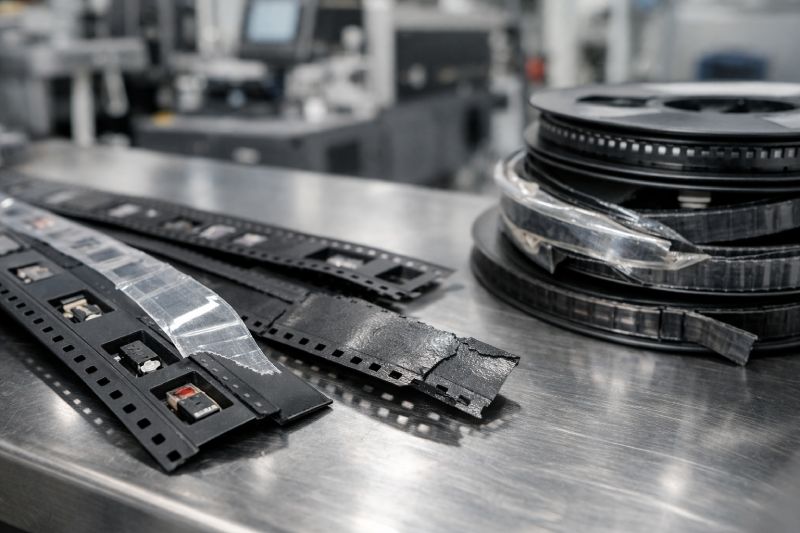
If you want to understand the complete packaging process before troubleshooting defects, you can first read your guide to tape and reel packaging solutions and how components are loaded into carrier tape. This article focuses on the most common tape and reel packaging defects, what causes them, and how to prevent them before they affect production.
Why Tape and Reel Packaging Defects Matter
Many manufacturers underestimate the impact of packaging quality. A single defective reel can stop an SMT line, especially when high-speed pick-and-place machines are running continuously.
Common consequences of packaging defects include:
- Components missing from the feeder
- Incorrect component orientation
- Mis-picks and placement errors
- Increased reject rates
- SMT line downtime
- Higher labor and inspection costs
For example, if the cover tape begins peeling during shipping, hundreds of components may shift out of position before the reel reaches the production floor. Even if the parts themselves are not damaged, the entire reel may need to be reworked or discarded.
Defects are also difficult to detect during incoming inspection because many problems only appear when the reel is running inside the feeder. A pocket that is slightly oversized may look acceptable visually, but once the reel moves through the machine, the component can flip or rotate and become unusable.
That is why reliable tape and reel packaging must meet ANSI/EIA-481 dimensional and peel-force requirements.
The Most Common Tape and Reel Packaging Defects
Below are the defects most often found in carrier tape, cover tape, and reel packaging systems.
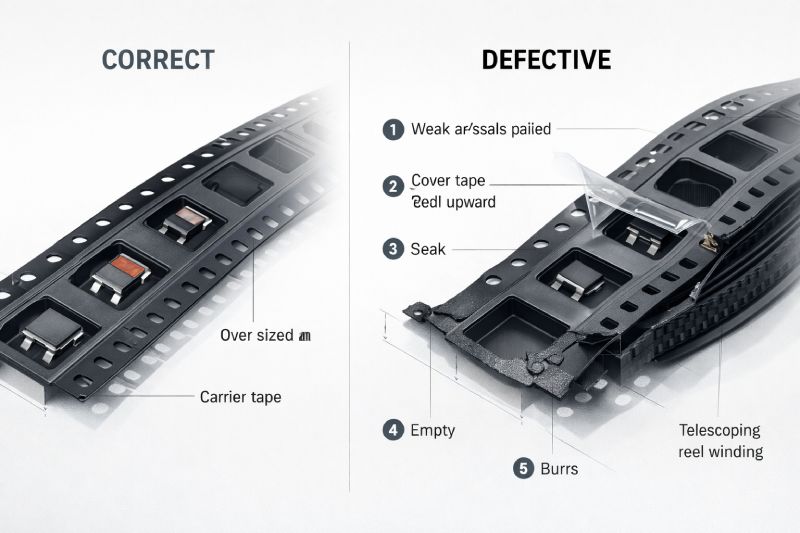
Incorrect Pocket Dimensions
Pocket size is one of the most important factors in tape and reel performance. If the pocket is too large, the component may rotate, tilt, or move during transport. If the pocket is too small, the component may become stuck or difficult to remove during pick-and-place.
Incorrect pocket dimensions usually happen because:
- The original component drawing is inaccurate
- Tolerances are not considered correctly
- The embossing tool is not designed for the exact part
- A standard tape is used instead of a custom pocket design
Small differences matter. A pocket that is only 0.2 mm wider than necessary may allow polarized components or ICs to rotate. This can lead to incorrect placement on the PCB.
For irregular, tall, or fragile components, custom embossed carrier tape is often necessary to keep the part stable and correctly oriented.
Component Flipping or Rotation Inside the Pocket
Component rotation is one of the most common causes of pick-and-place errors. During transportation and reel winding, vibration causes components to move inside oversized or poorly shaped pockets.
This problem is especially serious for:
- Polarized capacitors
- Diodes
- Connectors
- ICs with a defined pin-1 orientation
If a component rotates 90° or 180° inside the pocket, the SMT machine may place it incorrectly. In some cases, the feeder detects the error and stops the line. In other cases, the component is assembled incorrectly and the defect is discovered only after testing.
To prevent flipping and rotation:
- Reduce unnecessary pocket clearance
- Add support ribs or retention features
- Use a pocket depth matched to the component height
- Test the design under shipping vibration conditions
Cover Tape Peeling or Weak Seal Strength
A weak cover tape seal is one of the most obvious and damaging packaging defects. When the seal strength is too low, the cover tape may lift before the reel reaches the SMT line. Components can then spill, shift, or become contaminated.
Weak sealing is usually caused by:
- Incorrect sealing temperature
- Incorrect sealing pressure
- Poor sealing time control
- Incompatible carrier tape and cover tape materials
- Using the wrong type of cover tape
For example, heat-activated cover tape requires precise temperature control. If the temperature is too low, the adhesive does not bond properly. Pressure-sensitive cover tape can also fail if the adhesive is not compatible with the carrier tape material.
Weak seals are often seen after long-distance shipping, especially when reels experience vibration, humidity, or temperature changes.
A proper sealing process should produce a consistent peel force across the entire reel.
Excessive Cover Tape Adhesion
The opposite problem also occurs. Sometimes the cover tape adheres too strongly to the carrier tape. In this case, the feeder has difficulty removing the tape, and the component may jump out of the pocket when the cover tape is peeled away.
Excessive adhesion can lead to:
- Components popping out of the pocket
- Damage to fragile components
- Interrupted feeder operation
- Irregular peel force during SMT assembly
This defect is usually caused by:
- Excessive sealing temperature
- Excessive sealing pressure
- Incorrect adhesive selection
- Long storage time in high-temperature environments
According to ANSI/EIA-481, peel force must remain within a specific range. If the force is too high or too low, the reel may not run reliably.
H2: Cracked, Deformed, or Warped Carrier Tape
Carrier tape must remain dimensionally stable during storage, shipping, and feeding. Poor-quality tape may crack, bend, shrink, or warp, especially in difficult environments.
Common causes include:
- Brittle raw materials
- Exposure to low temperatures
- Excessive reel winding tension
- Poor moisture resistance
- Weak tape thickness
Warped or cracked carrier tape can cause sprocket misalignment and feeder jams. If the tape bends, the component pockets may no longer align with the pickup position.
This problem is especially common when low-cost materials are used for export shipments exposed to cold weather or long transport times.
Using high-strength and anti-static carrier tape materials improves resistance to cracking and deformation.
Pocket Burrs or Poor Forming Quality
Carrier tape pockets are usually created through thermoforming or embossing. If the forming tool is worn or poorly maintained, the pocket may contain burrs, rough edges, or incomplete shapes.
Pocket burrs create several problems:
- Components do not sit flat
- Parts become scratched or damaged
- The pickup nozzle cannot remove the component smoothly
- Components stick inside the pocket
This defect often occurs after long production runs when tooling begins to wear. Regular tool inspection is necessary to maintain pocket quality.
A well-formed pocket should have:
- Smooth inner walls
- Clean edges
- Uniform pocket depth
- No sharp corners or flash
Reel Winding Problems
Even when the carrier tape and cover tape are correct, poor reel winding can still cause defects.
The most common reel winding problems are:
- Loose winding
- Over-tight winding
- Uneven tape layers
- Telescoping, where the reel shifts sideways
Loose winding allows the tape to move during transport, increasing the risk of component rotation. Over-tight winding can deform the tape or increase seal stress.
Telescoping is particularly dangerous because the tape may jam in the feeder or unwind incorrectly.
To prevent reel winding defects:
- Maintain consistent winding tension
- Use the correct reel size
- Avoid overfilling the reel
- Verify that the tape layers remain even and aligned
Missing Components or Empty Pockets
Missing parts are usually caused by loading errors during packaging. Empty pockets may appear randomly throughout the reel or in larger sections.
This defect leads to:
- Incorrect part counts
- Unexpected feeder stops
- Production interruptions
- Extra inspection time
Automated vision systems are commonly used to detect missing components before the reel is shipped. These systems inspect every pocket and compare the actual loading pattern with the expected one.
For high-value components, many manufacturers also use counting sensors and final reel verification.
Static Electricity Damage (ESD)
Electrostatic discharge is a serious risk for semiconductors, ICs, and sensitive electronic parts. If the carrier tape is not ESD-safe, static charge can build up during handling and shipping.
Even when no visible damage appears, ESD can reduce component reliability or create hidden failures.
Typical causes include:
- Using non-conductive carrier tape
- Dry storage conditions
- Improper grounding during loading
- Lack of anti-static packaging materials
Anti-static carrier tape and conductive cover tape help prevent charge accumulation. For sensitive devices, ESD-safe packaging should be used throughout the entire tape and reel process.
Root Causes of Tape and Reel Packaging Defects
Most defects are not random. They usually result from one of a few root causes.
| Root Cause | Typical Defect Produced |
|---|---|
| Wrong pocket design | Component rotation, tilting |
| Incorrect sealing temperature | Weak or excessive cover tape adhesion |
| Poor carrier tape material | Cracking, warping, deformation |
| Worn forming tools | Burrs, poor pocket shape |
| Incorrect reel winding tension | Loose winding, telescoping |
| Lack of ESD protection | Static damage to components |
| Poor loading control | Missing components, empty pockets |
In many cases, the real problem begins during package design rather than during production. If the pocket design is wrong, no amount of sealing adjustment or inspection can fully solve the issue.
That is why it is important to validate the design before mass production begins.
How to Inspect Tape and Reel Packaging for Defects
Proper inspection can identify most packaging problems before the reel reaches the customer.
Visual Inspection
The first step is to visually examine the reel for obvious defects, including:
- Cracked or warped carrier tape
- Missing components
- Poor pocket forming
- Uneven cover tape sealing
- Reel winding problems
Visual inspection should be performed both during production and before shipment.
Peel Force Testing
Peel force testing measures how much force is required to remove the cover tape. This is one of the most important quality checks because it directly affects feeder performance.
The measured peel force should remain within the ANSI/EIA-481 range. If the force changes across the reel, the sealing process may be inconsistent.
Dimensional Measurement
Pocket width, depth, pitch, and sprocket position should all be measured and compared with the original drawing.
Important dimensions include:
- Pocket width and length
- Pocket depth
- Tape pitch
- Hole pitch
- Distance between pocket and sprocket holes
Even small dimensional errors can create feeding problems.
Functional Feeder Testing
The most reliable test is to run the reel through an actual SMT feeder. This confirms whether the reel feeds smoothly under real production conditions.
A feeder test can reveal:
- Component flipping
- Excessive peel force
- Reel winding problems
- Pocket design issues
Many manufacturers perform feeder testing on sample reels before approving mass production.
How to Prevent Tape and Reel Packaging Defects
Most defects can be prevented by following a few best practices.
- Use a pocket design specifically matched to the component. Avoid generic pocket sizes when the part has unusual dimensions.
- Select the correct carrier tape material. Fragile or sensitive components often require stronger or anti-static tape.
- Match the correct cover tape to the carrier tape. Heat-activated and pressure-sensitive cover tapes must be chosen carefully.
- Control sealing temperature, pressure, and time. Even small changes can affect peel force.
- Use ESD-safe materials when packaging semiconductors and ICs.
- Perform peel-force testing and feeder testing before full production.
- Inspect embossing tools regularly and replace worn molds before they create burrs or poor pocket shapes.
- Work with an experienced tape and reel packaging supplier that can provide engineering support, sample reels, and design validation.
When manufacturers invest time in design and testing early in the process, they can eliminate many packaging problems before they become expensive production failures.
When Standard Tape and Reel Packaging Is Not Enough
Standard carrier tape works well for many common components. However, some parts require a custom packaging solution.
Examples include:
- Irregular-shaped connectors
- Very small components
- Tall or fragile parts
- Components with strict orientation requirements
- High-value electronic devices
For these parts, custom embossed carrier tape is often the only reliable option. A custom pocket can hold the component securely, prevent rotation, and maintain correct orientation during shipping and feeding.
Custom sealing conditions may also be required to ensure proper peel force and long-term stability.
If you experience repeated packaging defects with a standard tape design, it is usually more cost-effective to redesign the packaging than to continue dealing with rejects and line stoppages.
Conclusion
Tape and reel packaging defects can lead to feeder jams, component damage, reject parts, and costly SMT downtime. The most common problems include incorrect pocket dimensions, weak or excessive cover tape adhesion, warped carrier tape, reel winding issues, and ESD damage.
The good news is that most of these defects are preventable. With the correct pocket design, proper material selection, accurate sealing control, and thorough inspection, manufacturers can greatly improve packaging reliability.
When standard tape does not provide enough protection or stability, a custom tape and reel solution is often the best answer. Early testing and engineering support can prevent recurring problems and keep production running smoothly.



 Emial
Emial John Mr