



Tape and Reel Packaging for LED Components: Complete Guide for SMT Assembly
LED components are among the most delicate parts used in SMT assembly. Unlike standard resistors or capacitors, LEDs often include exposed lenses, strict polarity requirements, and higher sensitivity to static electricity and physical damage. Because of this, manufacturers rely on tape and reel packaging for LED components to protect the parts during shipping and ensure stable, accurate feeding during automated assembly.
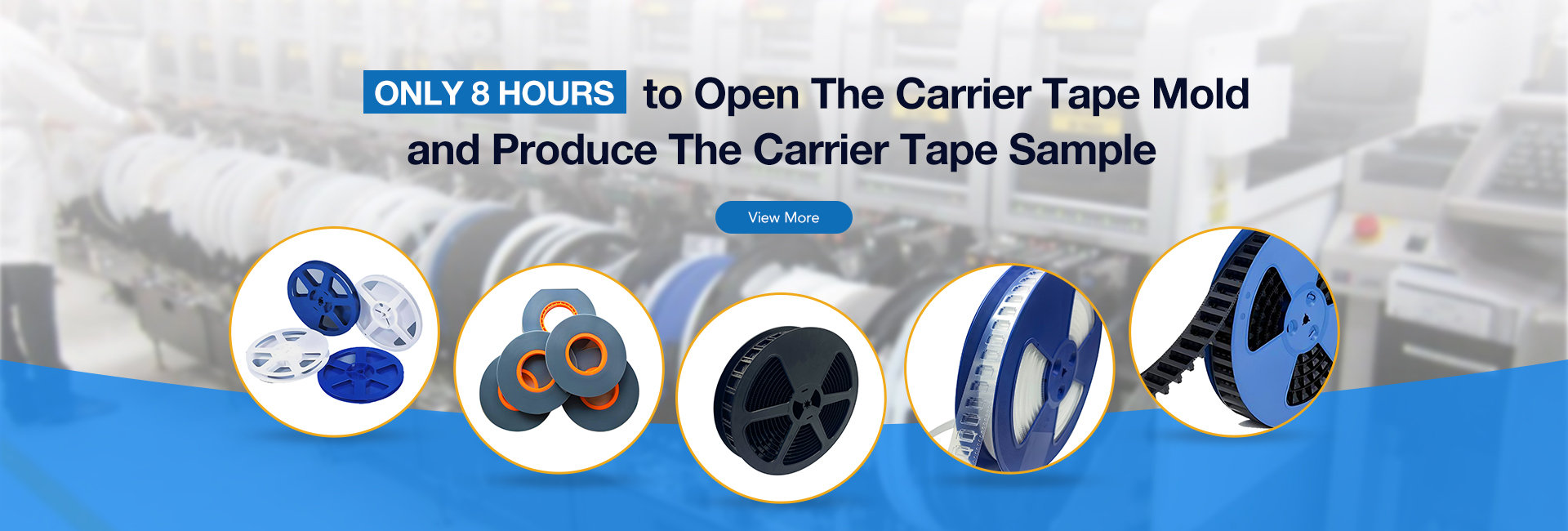
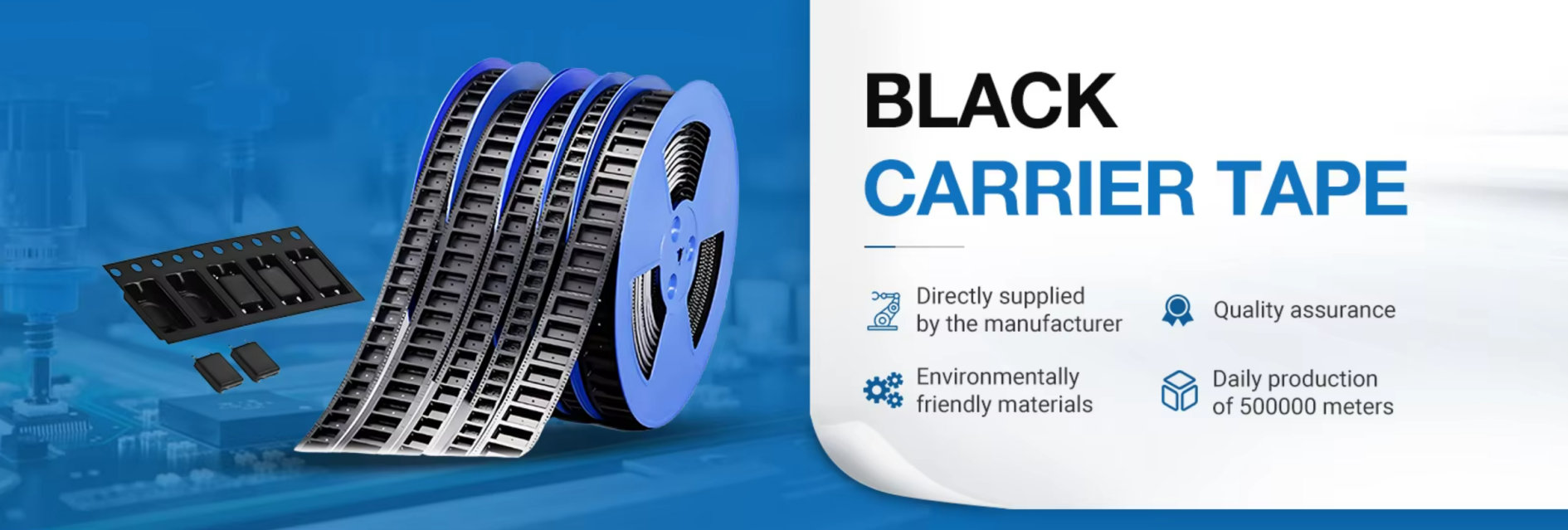
Tape and reel packaging places LED components into custom carrier tape pockets, seals them with cover tape, and winds the tape onto a plastic reel. The finished reel can then be loaded directly into an SMT pick-and-place machine.
When designed correctly, LED tape and reel packaging reduces component loss, prevents polarity errors, improves feeding speed, and supports high-volume production. In this guide, you will learn how LED tape and reel packaging works, which design factors matter most, and how to choose the right packaging solution for your LED products.

What Is Tape and Reel Packaging for LED Components?
Tape and reel packaging is a standardized method used to package LED components for automated SMT assembly.
In a typical system, LED parts are placed into pockets formed in a carrier tape. A cover tape is then sealed over the pockets to hold the components in place. Finally, the tape is wound onto a plastic reel with empty leader and trailer sections at the beginning and end.
LED tape and reel packaging is a standardized packaging method that places LED components into carrier tape pockets, seals them with cover tape, and winds them onto reels for automated SMT assembly.
The complete package normally includes:
-
Carrier tape with custom pockets
-
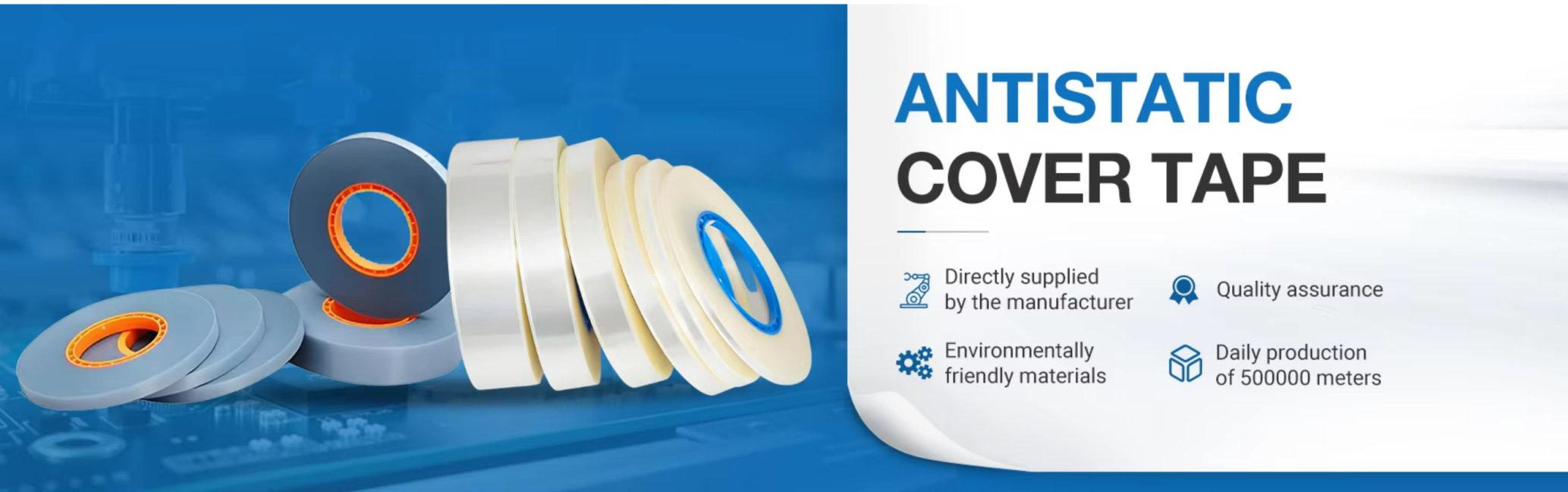
Cover tape to secure the components
-
Plastic reel for storage and feeding
-
Leader and trailer tape for feeder loading
This packaging format is widely used for:
-
0402 and 0603 chip LEDs
-
SMD LEDs
-
PLCC LEDs
-
RGB LEDs
-
High-power LEDs
-
Automotive LED components
During production, the reel is loaded into an SMT feeder. As the carrier tape advances, the pick-and-place machine removes each LED from the pocket and places it onto the PCB in the correct position and orientation.
Why LED Components Require Specialized Tape and Reel Packaging
LED components are more fragile and more sensitive than many standard electronic components. A tape design that works well for a resistor or capacitor may not provide enough protection for an LED.
The main reason is that many LEDs include a transparent lens or dome. If the component moves too much inside the pocket, the lens may become scratched, cracked, or contaminated. Even small marks on the surface can affect light output or product appearance.
LEDs also require strict orientation control. Unlike some passive components, LEDs have polarity. If the LED rotates inside the pocket or enters the SMT machine in the wrong direction, it may be placed incorrectly on the PCB.
Another challenge is ESD sensitivity. Many LED products are vulnerable to electrostatic discharge, especially high-brightness and automotive LEDs. For this reason, anti-static or conductive carrier tape materials are often required.
In addition, some LEDs are moisture-sensitive. Excessive exposure to humidity before assembly may damage the component during reflow soldering. Proper sealing and packaging help reduce this risk.
| Packaging Factor | Standard Passive Components | LED Components |
|---|---|---|
| Sensitivity to ESD | Usually low | Often high |
| Orientation Requirement | Less critical | Very important |
| Surface Protection | Basic protection is enough | Lens and light surface must be protected |
| Pocket Depth | Standard depth | Often requires custom depth |
| Feeding Accuracy | Moderate | High precision required |
Because of these requirements, LED components usually need custom carrier tape pockets, lower vibration during transport, and tighter dimensional control.
Main Components of LED Tape and Reel Packaging
Carrier Tape
Carrier tape is the main part of the package. It contains the pockets that hold each LED component.
For LED applications, embossed carrier tape is used more often than punched carrier tape. Embossed tape can create deeper, more complex pocket shapes that match the size and geometry of the LED package.
Black anti-static carrier tape is common for LED packaging because it reduces ESD risk and improves machine vision recognition. Transparent carrier tape may be used for certain small LEDs when visual inspection is important.
The most common materials include:
-
PS (Polystyrene)
-
PET (Polyethylene Terephthalate)
-
PC (Polycarbonate)
-
Conductive or anti-static compounds
Cover Tape
Cover tape seals the LED inside the pocket and prevents the component from falling out during transportation.
There are two common types of cover tape:
-
Heat-activated cover tape
-
Pressure-sensitive cover tape
For delicate LED products, peel force is especially important. If the cover tape peels too aggressively, the LED may jump out of the pocket or stick to the tape. If the peel force is too low, the parts may move or escape during shipping.
Plastic Reel
The finished carrier tape is wound onto a plastic reel. The two most common reel sizes are:
-
7-inch reel
-
13-inch reel
A 7-inch reel is typically used for smaller production volumes or compact LED packages. A 13-inch reel can hold a larger quantity of components and is preferred for mass production.
Larger reels reduce the number of reel changes during SMT assembly, which improves line efficiency.
Leader and Trailer Tape
Before the first LED component and after the last one, empty sections of tape are required. These sections are called leader tape and trailer tape.
Leader and trailer sections make it easier to load the reel into the feeder and ensure that the SMT machine can start and stop correctly.
Common LED Component Types Packaged in Tape and Reel
Different LED package sizes require different carrier tape widths and reel formats.
| LED Type | Typical Size | Preferred Tape Width | Typical Reel Size | Special Requirement |
|---|---|---|---|---|
| 0402 Chip LED | 1.0 × 0.5 mm | 8 mm | 7 inch | Precise orientation control |
| 0603 / 0805 LED | 1.6 × 0.8 mm | 8 mm | 7 inch | Stable pocket depth |
| PLCC LED | Larger molded package | 12–16 mm | 13 inch | Lens protection |
| RGB LED | Multi-chip package | 12–16 mm | 13 inch | Correct polarity orientation |
| High-Power LED | Large package | 16–24 mm | 13 inch | Deep custom pocket |
| Automotive LED | Various | 12–24 mm | 13 inch | ESD-safe material and strict quality control |
Pocket design depends on the shape, height, and pick-up area of the LED. A custom tooling solution is often required to ensure the component remains stable during transport and feeding.
How Carrier Tape Design Is Customized for LED Components
Pocket Dimensions
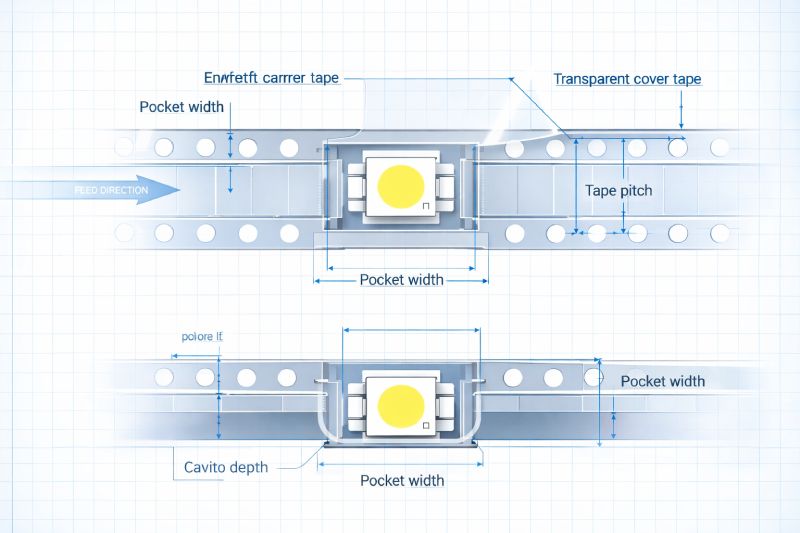
Pocket dimensions are one of the most important design factors in LED tape and reel packaging.
A carrier tape pocket must match the LED size closely enough to keep the part stable, but not so tightly that it damages the component.
The key dimensions include:
-
Pocket width
-
Pocket length
-
Pocket depth
-
Pocket pitch
-
Corner shape and cavity geometry
If the pocket is too large, the LED may tilt, rotate, or flip during shipping. If the pocket is too small, the lens may be scratched or the component may become difficult to remove.
Common problems caused by poor pocket design include:
-
Tilted LEDs
-
Upside-down feeding
-
Cracked or scratched lenses
-
Pick-and-place failures
-
Missing components during transport
Orientation and Polarity
LEDs must be fed into the SMT machine in a consistent direction. The carrier tape pocket is designed to position every LED with the same polarity and orientation.
This is especially important for:
-
RGB LEDs
-
Automotive LEDs
-
High-power LEDs
-
LEDs with asymmetrical shapes
A polarity mark or orientation arrow is often included on the tape design drawing. The feeder and SMT machine then use this orientation to place the LED correctly on the PCB.
Anti-Static and Material Selection
The material used for the carrier tape affects both protection and feeding performance.
PS material is often used for standard LED packaging because it is cost-effective and easy to form. PET and PC are more durable and may be preferred for larger or more fragile LED packages.
For ESD-sensitive LED components, conductive or anti-static materials are recommended. These materials help dissipate static electricity and reduce the risk of hidden electrical damage.
When selecting a material, manufacturers usually consider:
-
LED package size
-
Sensitivity to ESD
-
Required pocket depth
-
Transportation conditions
-
SMT feeder compatibility
Industry Standards for LED Tape and Reel Packaging
Most LED tape and reel packaging follows the EIA-481 standard.
EIA-481 defines the key dimensions and requirements for carrier tape and reel packaging, including:
-
Tape width
-
Pocket pitch
-
Sprocket hole spacing
-
Reel dimensions
-
Leader and trailer length
-
Component orientation
By following EIA-481, LED reels can run correctly in SMT feeders and pick-and-place equipment from different machine manufacturers.
Some moisture-sensitive LED products may also need to follow JEDEC or IEC requirements related to moisture barrier packaging.
An LED tape and reel package should meet the following checklist:
-
EIA-481 compliant tape dimensions
-
Stable and controlled cover tape peel force
-
Correct polarity and orientation marking
-
Anti-static or conductive material requirement
-
Compatibility with SMT feeders worldwide
Without these standards, even a well-made LED may fail during assembly because the reel cannot run smoothly in the feeder.
How Tape and Reel Packaging Improves SMT Assembly Efficiency for LEDs
The quality of tape and reel packaging has a direct impact on SMT production efficiency.
When LED components are packaged correctly, the SMT line runs faster and with fewer interruptions. The feeder loads smoothly, the machine can pick each LED accurately, and the placement process remains stable.
Poor packaging often creates problems such as:
-
Feeder jams
-
Components flipping in the pocket
-
Missing parts
-
Incorrect placement orientation
-
Increased machine downtime
Consistent pocket spacing and stable cover tape peel force are especially important in high-speed production lines.
| SMT Metric | Poor Packaging | Optimized LED Tape and Reel Packaging |
|---|---|---|
| Placement Accuracy | Frequent errors | Stable and precise |
| Downtime | High | Reduced |
| Component Waste | More damaged or lost parts | Minimal loss |
| Feeding Speed | Slower | Faster and more consistent |
| Yield Rate | Lower | Higher |
A high-quality LED reel package can reduce waste, improve throughput, and lower the overall manufacturing cost.
Common Problems in LED Tape and Reel Packaging
Even small packaging problems can create major issues during SMT assembly.
The most common problems include:
| Problem | Possible Cause | Recommended Solution |
|---|---|---|
| LED flips in pocket | Pocket too large | Redesign cavity dimensions |
| Lens scratched | Pocket too shallow or rough surface | Increase depth and improve material finish |
| SMT feeder jam | Incorrect tape width or sprocket hole error | Follow EIA-481 dimensions |
| Missing LEDs | Cover tape peel force too low | Use more stable sealing process |
| Components stick to cover tape | Peel force too high or static charge | Adjust cover tape and use anti-static material |
Other common issues include:
-
Reel deformation during transportation
-
Wrong polarity orientation
-
Static discharge damage
-
Pocket pitch mismatch
To avoid these problems, manufacturers should perform:
-
Dimensional inspection
-
Peel force testing
-
ESD testing
-
Transportation simulation
-
SMT feeding tests
Testing before mass production is one of the best ways to avoid expensive assembly failures later.
How to Choose the Right Tape and Reel Packaging Supplier for LED Components
Choosing the right packaging supplier is just as important as choosing the LED itself.
An experienced supplier should understand the unique requirements of LED components and be able to create custom packaging that protects the product and performs reliably in SMT assembly.
When comparing suppliers, ask the following questions:
-
Do they have experience with LED component packaging?
-
Can they create custom carrier tape drawings?
-
Do they understand EIA-481 requirements?
-
Can they provide anti-static material options?
-
Do they perform SMT feeding tests?
-
Can they support both low-volume and mass production?
A good supplier should also be able to provide:
-
Sample reels
-
Pocket design drawings
-
Peel force test reports
-
Feeding test videos
-
Fast tooling lead time
Use this supplier checklist before making a decision:
-
Supports multiple LED package sizes
-
Offers anti-static and conductive carrier tape
-
Can control polarity orientation accurately
-
Provides EIA-481 compliant packaging
-
Has strong quality inspection capability
The best supplier will not only manufacture the carrier tape, but also help optimize the design for better feeding performance and lower defect rates.
If you are developing a new LED product, it is a good idea to request a sample reel and run a feeder test before full production.
Frequently Asked Questions About LED Tape and Reel Packaging
What is the standard tape width for LED components?
Most small LED components use 8 mm carrier tape. Larger LEDs such as PLCC, RGB, or high-power packages may require 12 mm, 16 mm, or wider tape depending on the component size.
Can high-power LEDs be packaged in tape and reel?
Yes. High-power LEDs can be packaged in tape and reel, but they usually require deeper custom pockets, stronger carrier tape materials, and wider reels to protect the component during shipping and feeding.
What material is best for anti-static LED carrier tape?
Conductive PS, PET, and PC materials are commonly used for anti-static LED carrier tape. The best choice depends on the LED size, sensitivity, and required pocket depth.
How do you keep LED polarity consistent in carrier tape?
The carrier tape pocket is designed so that every LED sits in the same direction. Orientation marks and polarity arrows are then used during SMT assembly to ensure correct placement.
What standard applies to LED tape and reel packaging?
The most common standard is EIA-481. It defines tape width, pocket spacing, reel size, sprocket holes, and orientation requirements for SMT-compatible packaging.
Conclusion
LED components require more specialized packaging than ordinary electronic parts. Fragile lenses, polarity requirements, ESD sensitivity, and high-speed SMT production all make proper tape and reel packaging essential.
A successful LED packaging solution depends on custom carrier tape design, stable cover tape peel force, EIA-481 compliance, and reliable orientation control. When these factors are optimized, manufacturers can improve feeding performance, reduce waste, and achieve higher production efficiency.
If you need tape and reel packaging for LED components, choose a supplier that can provide custom carrier tape design, anti-static material options, sample reels, and SMT feeding support.
Need a custom tape and reel packaging solution for your LED components? Contact our engineering team to receive a carrier tape design proposal, free sample reel, and SMT feeding test support.



 Emial
Emial John Mr