


Tape and Reel Packaging for IC Chips: Standards, Dimensions, and Best Practices
Integrated circuits are among the most sensitive and valuable components used in electronics manufacturing. Whether the package is a tiny QFN, a large BGA, or a standard SOIC, even minor movement during transportation or feeding can cause bent leads, wrong orientation, ESD damage, or production downtime.
That is why tape and reel packaging for IC chips has become the standard method used by semiconductor manufacturers, distributors, and SMT assembly companies. Proper carrier tape design keeps every chip in the correct position, protects it from static and contamination, and ensures reliable feeding into pick-and-place equipment.
For IC chips, tape and reel packaging is not simply a way to ship parts. It is an important part of SMT production efficiency, feeder compatibility, and product quality.
Why IC Chips Need Tape and Reel Packaging
IC chips are more difficult to handle than passive components such as resistors or capacitors. Most IC packages have delicate leads, precise orientation requirements, and a high sensitivity to electrostatic discharge.
Loose handling creates several risks:
-
Bent or damaged pins on SOIC, QFP, or DIP packages
-
Rotated components that cannot be picked correctly
-
Static damage that reduces chip reliability
-
Contamination from dust or manual handling
-
Production delays caused by feeder jams
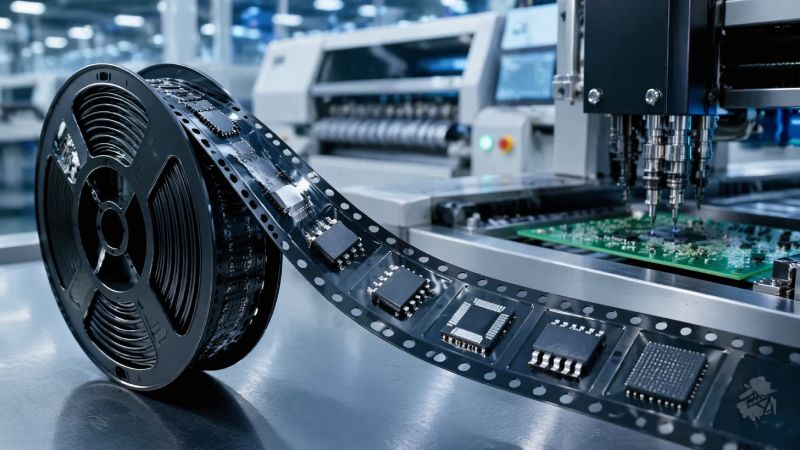
Tape and reel packaging solves these issues by placing each IC chip inside an individual pocket in embossed carrier tape. The pocket holds the chip securely while maintaining the correct orientation required by the SMT machine.
Because every component is positioned consistently, automatic pick-and-place systems can run at high speed with fewer feeding errors. Manufacturers also reduce labor costs because operators do not need to manually load or align the IC chips.
For high-volume SMT production, proper tape and reel packaging improves:
-
Feeding stability
-
Assembly speed
-
Product consistency
-
Lower defect rates
-
Reduced material waste
Which IC Chip Types Commonly Use Tape and Reel Packaging?
Many different IC package styles can be packed in tape and reel. The carrier tape design changes depending on the body size, lead shape, and orientation requirement of the chip.
The most common surface-mount IC packages include:
-
QFN (Quad Flat No-Lead)
-
SOIC / SOP
-
TSSOP
-
MSOP
-
QFP
-
BGA
-
CSP
-
SOT packages
These components are usually loaded into embossed anti-static carrier tape and supplied on either a 7-inch or 13-inch reel.
Through-hole IC packages such as DIP can also use tape and reel packaging, although they often require deeper pockets and custom reel configurations.
| IC Package Type | Typical Carrier Tape Width | Typical Reel Size | Main Packaging Concern |
|---|---|---|---|
| QFN | 8–12 mm | 7-inch | Tight pocket fit and orientation |
| SOIC / SOP | 12–16 mm | 7-inch or 13-inch | Protecting leads from bending |
| QFP | 24–32 mm | 13-inch | Larger body and pin clearance |
| BGA | 16–24 mm | 13-inch | ESD protection and alignment |
| DIP | Custom | Custom reel | Deep pocket and stable positioning |
Smaller ICs generally use narrow carrier tape widths, while larger packages such as QFP or BGA require wider tape and larger reels. Choosing the correct carrier tape width is essential because too much empty space inside the pocket can allow the chip to rotate or shift during transportation.
Main Components of Tape and Reel Packaging for IC Chips
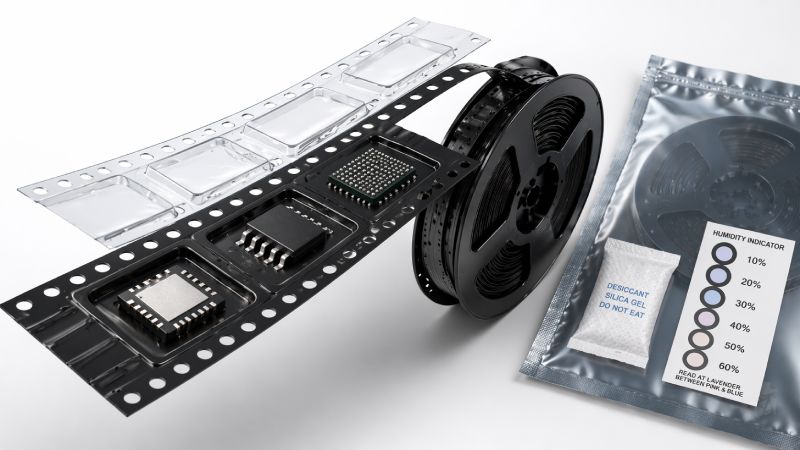
A complete IC chip tape and reel package usually includes four main parts: carrier tape, cover tape, plastic reel, and protective ESD packaging.
Carrier Tape
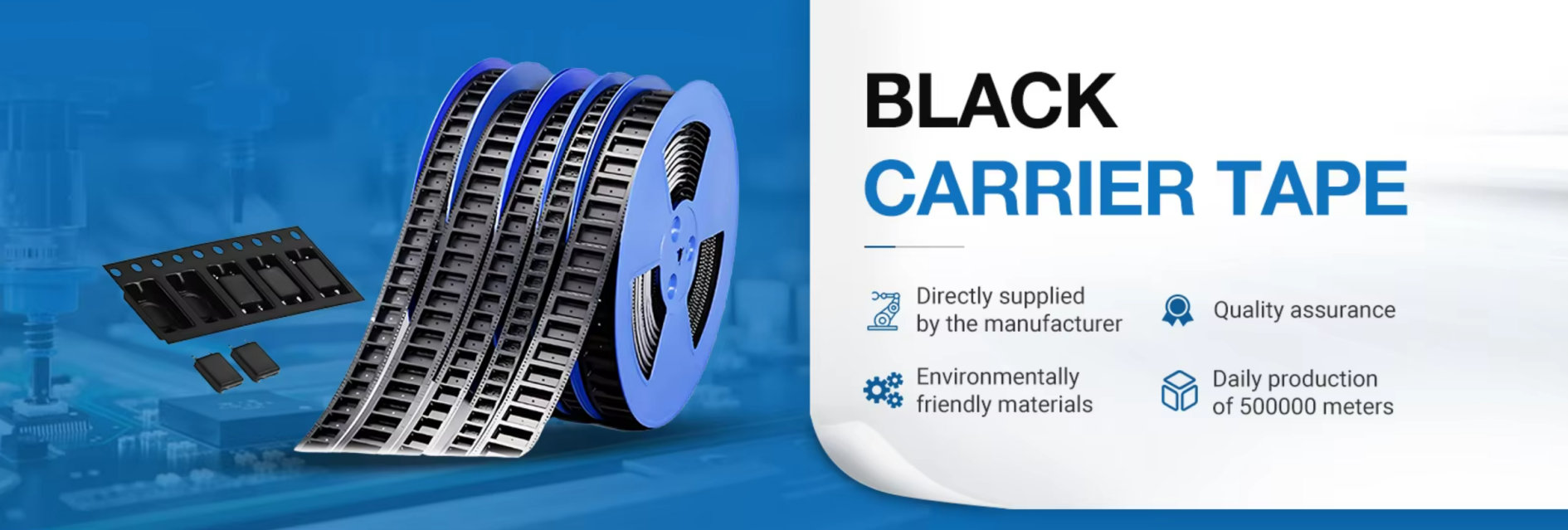
Embossed carrier tape is the most common option for IC chips. The pocket is thermoformed into the tape so that each chip fits inside its own cavity.
For semiconductor applications, carrier tape is often made from:
-
Polystyrene (PS)
-
Polycarbonate (PC)
-
PET
-
Conductive or anti-static materials
The pocket dimensions must match the IC body closely. Designers need to consider:
-
Body length and width
-
Pin or lead clearance
-
Pocket depth
-
Required orientation inside the tape
If the pocket is too large, the IC chip may rotate. If it is too small, the leads may be damaged during loading or sealing.
Cover Tape
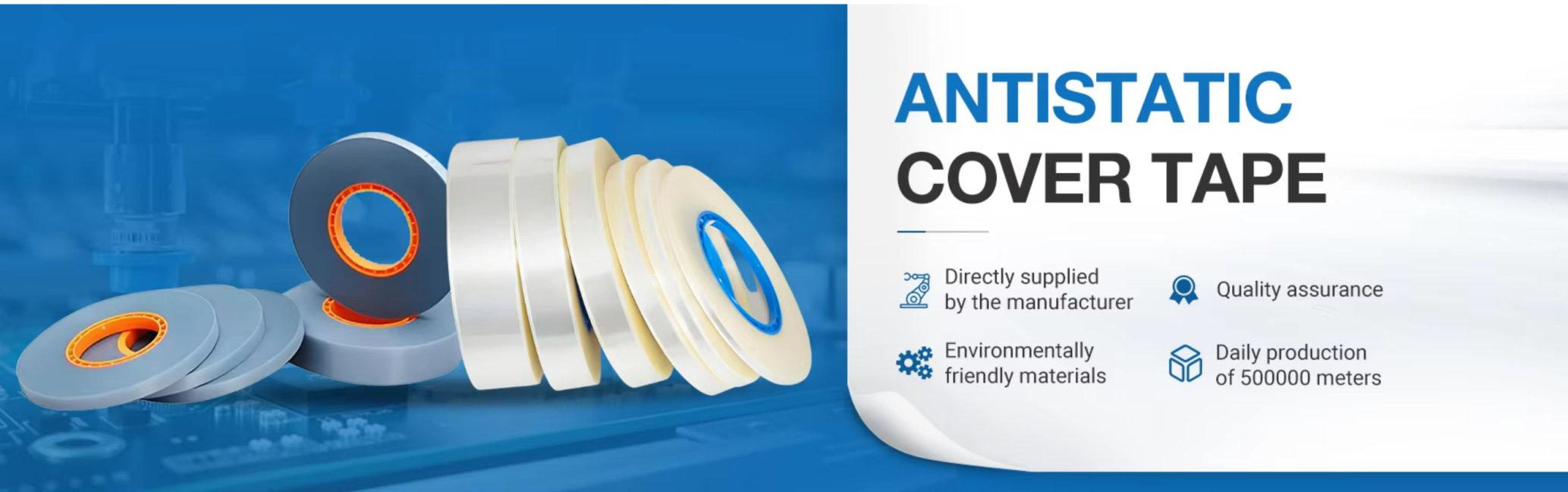
Cover tape seals the carrier tape after the chips are loaded. It protects the IC chips from falling out, contamination, and vibration during transportation.
There are two common types:
-
Heat-activated cover tape
-
Pressure-sensitive cover tape
For IC chips, stable peel force is extremely important. If the cover tape is too difficult to remove, the SMT feeder may jam. If the peel force is too low, the cover tape may lift during shipping.
Plastic Reel
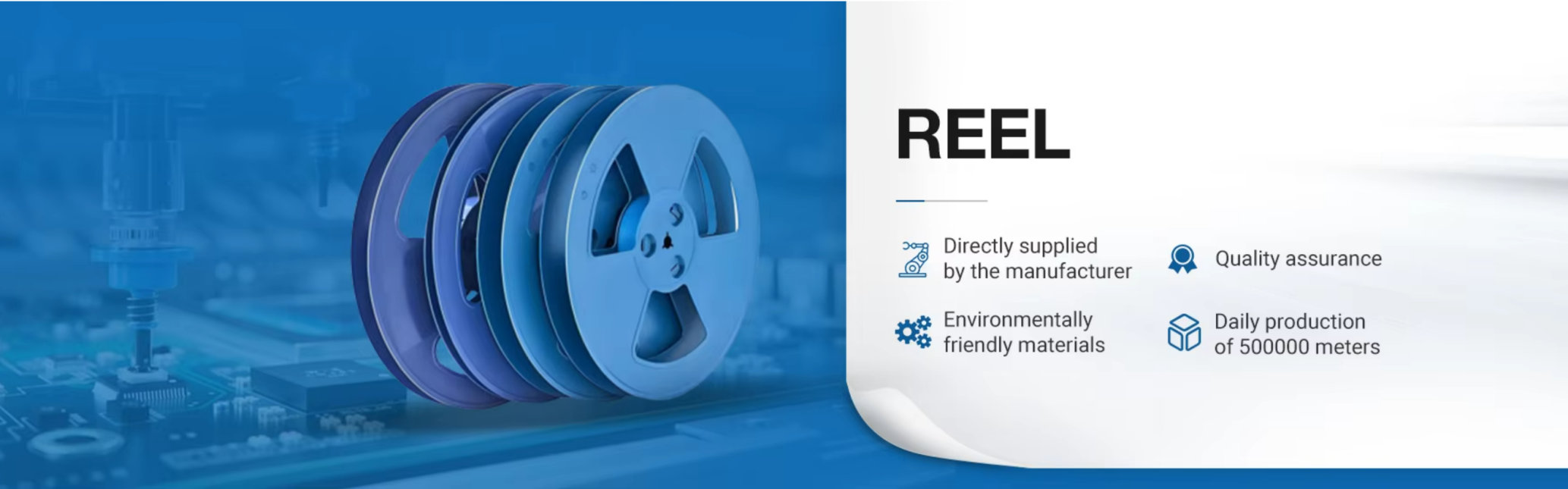
The carrier tape is wound onto a plastic reel after sealing. The most common reel sizes are:
-
7-inch reel for lower quantities or smaller tape widths
-
13-inch reel for higher quantities and wider carrier tape
A larger reel can reduce reel changes during SMT production, which helps improve efficiency.
ESD and Moisture Protection
Many IC chips are highly sensitive to static electricity and moisture. In addition to anti-static carrier tape, manufacturers often use:
-
Moisture barrier bags
-
Desiccant packs
-
Humidity indicator cards
These protective materials are especially important for moisture-sensitive ICs such as BGA and fine-pitch semiconductor packages.
How Carrier Tape Dimensions Are Designed for IC Chips
Carrier tape design is one of the most important steps in successful IC packaging. Every IC chip package has different body dimensions, lead geometry, and orientation requirements.
The main dimensions that must be defined include:
-
Pocket length
-
Pocket width
-
Pocket depth
-
Pocket pitch
-
Tape width
-
Sprocket hole position
-
Orientation mark or notch direction
A good pocket design provides enough clearance for the IC body without allowing the component to move excessively.
In most cases, the pocket should be slightly larger than the chip body. The extra space allows easy loading and reliable pick-up by the SMT nozzle. However, the clearance must remain small enough to prevent rotation.
Typical design process:
-
Measure the exact IC package dimensions
-
Add the required clearance for leads and body tolerance
-
Define the pocket depth based on component height
-
Confirm the required orientation for the feeder
-
Produce a sample carrier tape
-
Test the sample on the actual SMT line
For example, a QFN package may require only a shallow pocket with very tight dimensional tolerance, while a QFP package requires more space around the leads to prevent damage.
Testing is essential before mass production. Even when the design appears correct on paper, the real SMT feeder may reveal problems such as misfeeding, sticking, or incorrect orientation.
What Standards Apply to IC Chip Tape and Reel Packaging?
IC chip tape and reel packaging normally follows several international standards. These standards ensure that the packaged components will work correctly with automated feeders and meet the requirements of OEM and EMS manufacturers.
The most important standard is EIA-481.
EIA-481 defines:
-
Carrier tape width
-
Pocket spacing
-
Sprocket hole dimensions
-
Reel diameter
-
Component orientation
-
Tape winding direction
By following EIA-481, semiconductor suppliers can make sure that their IC chips are compatible with standard SMT equipment.
In addition to EIA-481, IC chip packaging often follows JEDEC and ESD standards.
| Standard | Main Purpose |
|---|---|
| EIA-481 | Defines tape and reel dimensions and orientation |
| JEDEC J-STD-033 | Controls moisture-sensitive semiconductor handling |
| IEC 61340 | Defines ESD protection requirements |
JEDEC standards are especially important for moisture-sensitive IC chips. Some semiconductor devices can absorb moisture during storage. When these chips are exposed to the high temperatures of solder reflow, trapped moisture may damage the package.
To prevent this, suppliers often vacuum-seal the reel inside a moisture barrier bag together with desiccant and a humidity indicator card.
Using the correct standards reduces:
-
Feeder compatibility problems
-
Line downtime
-
Product rejects
-
Customer complaints
Common Problems in IC Chip Tape and Reel Packaging
Poor tape and reel design can create serious production issues. The most common problems include:
-
Incorrect pocket dimensions
-
IC chips rotating inside the pocket
-
Bent leads after sealing
-
Cover tape lifting during transportation
-
Reel winding that becomes too loose or too tight
-
Static damage during loading
For example, if a QFP package is loaded into a pocket that is too narrow, the outer leads may bend when the cover tape is applied. If the pocket is too wide, the IC may rotate, causing the pick-and-place machine to place the chip in the wrong orientation.
Another common problem is unstable cover tape peel force. Excessive peel force may cause feeder stoppage, while insufficient peel force may allow components to escape from the pocket.
Manufacturers can reduce these risks by:
-
Running sample tests before mass production
-
Checking pocket dimensions carefully
-
Using anti-static materials
-
Inspecting the cover tape seal
-
Verifying reel winding tension
-
Testing the finished reel on the customer’s SMT feeder
A small design improvement during the prototype stage can prevent expensive failures during production.
How to Choose the Right Tape and Reel Packaging Supplier for IC Chips
Not all tape and reel suppliers have the same level of experience with semiconductor products. IC chips require more precise engineering than many other components.
Before choosing a supplier, buyers should ask:
-
Can you design custom carrier tape for my IC package?
-
Do you follow EIA-481 and ESD requirements?
-
Can you provide engineering drawings and prototype samples?
-
Can you support both small and large production volumes?
-
Can you test the reel on actual SMT feeder equipment?
A strong supplier should provide more than standard tape widths. They should also offer:
-
Engineering support for pocket design
-
Fast sample development
-
Stable production quality
-
Experience with QFN, BGA, SOP, QFP, and other IC packages
-
Anti-static and moisture-protection solutions
It is also important to avoid suppliers that only provide generic carrier tape without reviewing the actual IC dimensions. Using the wrong pocket design may save money initially, but it often creates much higher costs later because of feeder problems, damaged chips, and rejected assemblies.
The best suppliers work closely with the customer’s engineering team, review the IC drawings, provide sample reels, and confirm compatibility before mass production begins.
Frequently Asked Questions About Tape and Reel Packaging for IC Chips
What is the most common carrier tape width for IC chips?
The most common carrier tape widths are 8 mm, 12 mm, 16 mm, and 24 mm. The correct width depends on the size of the IC package.
Are IC chips packed in embossed or punched carrier tape?
Most IC chips use embossed carrier tape because it provides better pocket depth, stronger positioning, and better protection for delicate leads.
What reel size is usually used for IC chips?
7-inch reels are commonly used for smaller production quantities, while 13-inch reels are preferred for high-volume SMT production.
Why do IC chips need anti-static carrier tape?
Many semiconductor devices are sensitive to electrostatic discharge. Anti-static carrier tape helps protect the chips from static damage during handling and transportation.
How can I prevent IC chips from rotating inside the pocket?
The pocket must closely match the chip dimensions and include the correct orientation feature. Sample testing is the best way to confirm the design.
Can tape and reel packaging be customized?
Yes. Custom tape and reel packaging is often required for unusual IC sizes, large QFP packages, BGA packages, DIP packages, and other specialty semiconductor products.
Conclusion
Tape and reel packaging for IC chips is a critical part of semiconductor handling and SMT production. The right carrier tape design protects the IC from ESD, moisture, rotation, and physical damage while ensuring reliable feeding into automated equipment.
Because every IC package has different dimensions and handling requirements, custom carrier tape design is often necessary. A well-designed tape and reel solution reduces assembly defects, improves line efficiency, and protects the value of the semiconductor product.
If you need tape and reel packaging for QFN, SOIC, BGA, QFP, DIP, or other IC chips, working with an experienced supplier can help you choose the right carrier tape dimensions, reel size, and ESD protection for your application.



 Emial
Emial John Mr