

Mini LED Carrier Tape Packaging Challenges: How to Prevent Damage, Misalignment and Yield Loss
Mini LED technology is transforming display backlights, automotive lighting, consumer electronics and high-end signage. Compared with conventional LEDs, Mini LED components are dramatically smaller, lighter and more sensitive to handling errors. That creates a new challenge for tape-and-reel packaging.
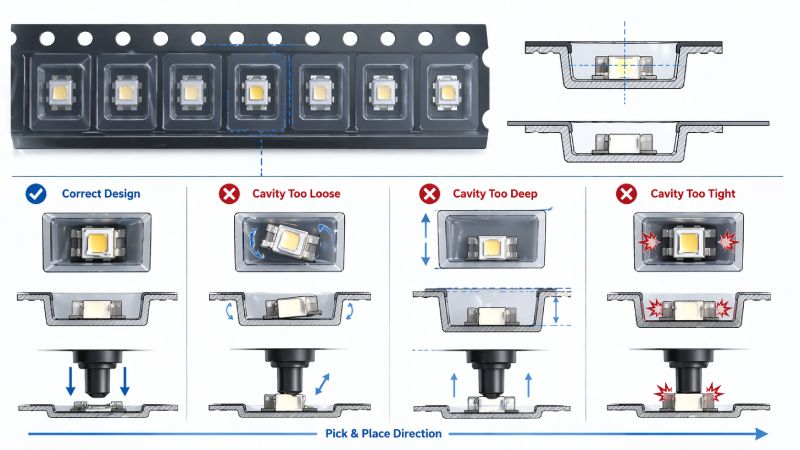
For Mini LED products, carrier tape is no longer just a transportation method. It directly affects SMT feeding stability, pick-and-place accuracy, ESD safety and final production yield. A cavity that is only slightly oversized can allow the component to rotate. A cavity that is too tight may damage the LED or prevent clean release during placement.
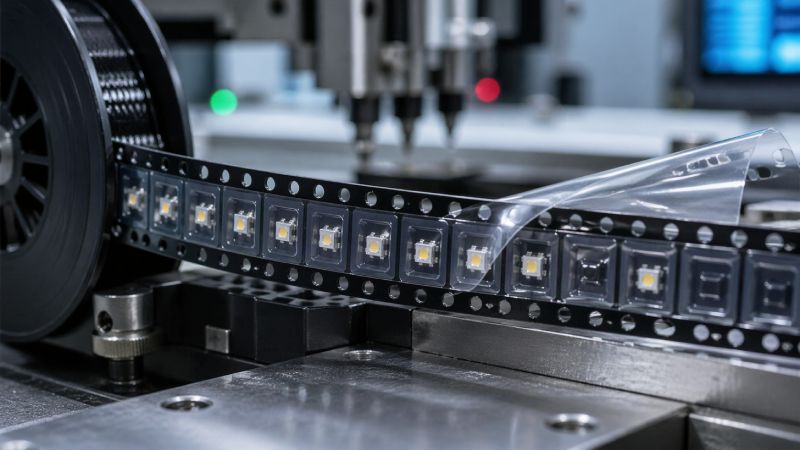
As Mini LED applications continue to move toward higher density and faster assembly speeds, manufacturers need carrier tape solutions with tighter tolerances, better ESD protection and more stable feeding performance.
This article explains the biggest Mini LED carrier tape packaging challenges, why they happen and how to solve them.
Why Mini LED Packaging Is More Difficult Than Standard LED Packaging
Standard SMD LEDs are usually large enough to remain stable inside a conventional carrier tape pocket. Mini LED devices are much smaller, often with dimensions below 0.2 mm to 0.4 mm. At this scale, even tiny dimensional differences in the cavity can create major problems during transportation and SMT assembly.
| Factor | Standard LED | Mini LED |
|---|---|---|
| Typical component size | 1.0–3.5 mm | 0.1–0.4 mm |
| Sensitivity to cavity movement | Moderate | Extremely high |
| Acceptable cavity tolerance | Relatively wide | Very tight |
| Risk of orientation shift | Low | High |
| Feeding difficulty | Standard | High-speed precision required |
Mini LED components are also commonly used in applications where thousands or even millions of LEDs must be mounted accurately. In display backlight modules, a single misplaced Mini LED can create brightness inconsistency or visible defects. In automotive lighting, incorrect placement can reduce product reliability.
Because of this, Mini LED packaging requires much tighter control over cavity design, cover tape performance, reel winding and feeder compatibility than traditional LED packaging.
Challenge #1 – Designing Ultra-Precise Carrier Tape Cavities
The most important challenge in Mini LED carrier tape packaging is cavity precision. The cavity must hold the Mini LED securely without allowing movement, while still enabling smooth pick-up by the SMT nozzle.
If the cavity is too large, the Mini LED may:
-
Rotate inside the pocket
-
Tilt during transportation
-
Shift to the wrong orientation
-
Stack or overlap with another part
These issues often cause pick-and-place failures, skipped pockets and higher reject rates.
If the cavity is too small, the opposite problem appears. The Mini LED may become stuck inside the cavity, making it difficult for the SMT nozzle to remove the part. Excessive friction can also scratch the package surface or damage the LED chip.
For Mini LED packaging, several cavity design factors must be optimized:
-
Pocket width and length
-
Pocket depth
-
Corner radius
-
Pocket pitch
-
Embossing consistency
-
Pocket bottom shape
Pocket depth is especially important. A cavity that is too shallow increases the risk of the component jumping out during transportation. A cavity that is too deep can reduce pick-up efficiency.
The corner radius also affects stability. Sharp corners may damage fragile components, while excessively rounded corners can increase movement.
Before mass production, manufacturers should confirm at least these five cavity parameters:
-
Pocket dimensions match the Mini LED size
-
Tolerance range is verified through sample testing
-
Pocket depth supports stable feeding
-
Embossing consistency remains uniform across the reel
-
Component orientation stays correct after reel winding
For companies new to tape-and-reel packaging, understanding the basics of carrier tape structure is essential. A detailed explanation can be found in the article “What Is Carrier Tape in Tape and Reel Packaging.”
Challenge #2 – Preventing Component Movement During Transportation and Feeding
Even when the cavity dimensions are correct, Mini LED components can still move during transportation, reel winding or SMT feeder vibration.
Because Mini LEDs are extremely light, they are more likely to shift inside the cavity than larger components. This movement can happen when:
-
The reel is wound too tightly
-
The shipping box experiences vibration or impact
-
The feeder advances at high speed
-
The cover tape peel force is unstable
Common results include:
-
Incorrect component orientation
-
Mispicks during SMT placement
-
Broken or chipped Mini LEDs
-
Increased reject rates on the SMT line
One of the most effective ways to reduce movement is to keep the cavity fit as close as possible to the component size. However, cavity fit alone is not enough.
The cover tape must also provide stable holding force. If the cover tape peel force is too low, the Mini LED may move during transportation. If the peel force is too high, the part may jump or shift when the cover tape is removed.
Manufacturers should also pay close attention to reel winding tension. Over-tight winding can place pressure on the cavities and deform the carrier tape. Over-loose winding can increase vibration and movement.
How to Reduce Mini LED Movement Inside Carrier Tape
-
Optimize cavity fit for the exact Mini LED dimensions
-
Use cover tape with controlled and consistent peel force
-
Avoid excessive reel winding tension
-
Add protective packaging during shipping
-
Perform drop tests and vibration tests before approval
Many manufacturers also use special shipping trays or anti-vibration cartons for Mini LED reels during long-distance transportation.
The relationship between cavity design and cover tape is critical. A stable sealing process is often the difference between a high-yield Mini LED line and repeated feeding problems. Manufacturers can learn more in the article “How Cover Tape Sealing Works.”
Challenge #3 – ESD Protection for Sensitive Mini LED Components
Mini LED devices are highly sensitive to electrostatic discharge. Even a small static event can damage the LED chip, reduce brightness or shorten the service life of the final product.
In many cases, ESD damage is not immediately visible. The Mini LED may still appear normal during inspection, but fail later during product use. This hidden damage can create serious reliability problems, especially in automotive, medical and high-end display applications.
Ordinary plastic carrier tape may generate static electricity during:
-
Embossing
-
Reel winding
-
Transportation
-
Cover tape peeling
-
High-speed feeder operation
Because of this, Mini LED packaging usually requires anti-static or conductive carrier tape materials.
| Material | ESD Performance | Transparency | Typical Application |
|---|---|---|---|
| PS anti-static carrier tape | Good | Semi-transparent | Standard Mini LED packaging |
| PC anti-static carrier tape | Very good | High transparency | High-precision Mini LED inspection |
| Carbon-filled conductive tape | Excellent | Opaque | Extremely ESD-sensitive Mini LED products |
| Coated anti-static tape | Moderate | Depends on coating | Cost-sensitive applications |
The ideal material depends on the Mini LED size, SMT process and inspection requirements. Transparent PC carrier tape is often preferred when manufacturers need to inspect Mini LED orientation visually before placement.
For most Mini LED projects, the carrier tape should meet EIA-481 requirements and maintain stable surface resistance. Typical target values are within the anti-static range required for electronic components.
In addition to carrier tape, the cover tape and plastic reel should also provide ESD-safe performance. A single conductive material is not enough if the rest of the packaging system still generates static.
Manufacturers looking for ESD-safe materials can refer to Jiushuo’s anti-static carrier tape solutions designed specifically for sensitive semiconductor and Mini LED applications.
Challenge #4 – Achieving Reliable Pick-and-Place Performance on SMT Lines
Mini LED production lines often run at extremely high speed. In many factories, the SMT line places thousands of components every minute. At these speeds, even a very small packaging issue can quickly create large-scale production losses.
Common Mini LED feeding problems include:
-
Skipped pockets
-
Inconsistent part presentation
-
Cover tape peeling instability
-
Pick nozzle failure
-
Pocket indexing errors
When the feeder indexes the carrier tape, every pocket must align perfectly with the pick-up position. If the cavity pitch is inconsistent, the nozzle may miss the component or pick it incorrectly.
Cover tape behavior is equally important. The cover tape must peel smoothly and consistently without jerking or pulling the Mini LED out of the cavity. Unstable peel force is one of the most common reasons for Mini LED placement failure.
Carrier tape design also affects nozzle access. If the cavity depth or opening is incorrect, the nozzle may not be able to reach the Mini LED properly.
For this reason, Mini LED carrier tape should never be approved based only on dimensional drawings. Real SMT testing is essential.
Recommended Validation Tests Before Approval
Before mass production, manufacturers should complete:
-
SMT feeding trial
-
Pick-and-place repeatability test
-
Cover tape peel force test
-
High-speed feeder compatibility test
-
Multiple reel validation across different SMT machines
The best carrier tape suppliers can provide sample reels and work directly with the customer’s SMT team to optimize feeding performance.
For example, companies using Jiushuo’s Mini LED tape and reel packaging service can request custom cavity development, sample testing and feeder validation before full-scale production.
Challenge #5 – Maintaining Consistency in Mass Production
Mini LED projects often involve millions of components per month. In mass production, even small differences between one reel and the next can create serious yield problems.
A cavity variation of only a few microns may seem insignificant, but when the component itself is extremely small, that variation can change the feeding result.
The most common mass-production consistency problems include:
-
Variation in cavity dimensions between production lots
-
Inconsistent embossing depth
-
Different cover tape peel force from reel to reel
-
Changes in material shrinkage
-
Uneven reel winding quality
To maintain stable Mini LED packaging quality, manufacturers need strong process control throughout production.
Important quality-control measures include:
-
100% dimensional inspection during tool development
-
Automated vision inspection for cavity shape and pitch
-
Statistical process control during embossing
-
Regular peel-force testing for cover tape
-
Incoming and outgoing inspection of every reel batch
Many Mini LED manufacturers also require first-article approval before every new production run.
Key QC Checkpoints for Mini LED Carrier Tape
-
Pocket width and depth
-
Pocket pitch accuracy
-
Component orientation
-
Cover tape sealing quality
-
Surface resistance and ESD performance
-
Reel winding stability
Without strong quality control, a Mini LED packaging problem may only become visible after the reel reaches the SMT line, where the cost of failure is much higher.
Manufacturers interested in broader inspection methods can also refer to the article “Quality Control in Tape and Reel Packaging.”
How to Choose the Right Carrier Tape Supplier for Mini LED Projects
Selecting the right carrier tape supplier is one of the most important decisions in a Mini LED project. Many suppliers can produce standard carrier tape, but far fewer can support the extreme precision required for Mini LED packaging.
When evaluating a supplier, buyers should ask these questions:
-
Can the supplier maintain micron-level cavity tolerance?
-
Do they offer anti-static and conductive material options?
-
Can they provide transparent materials for visual inspection?
-
Do they support custom cavity design?
-
Can they provide sample reels quickly?
-
Do they offer SMT feeding validation?
-
Do they have experience with Mini LED or semiconductor packaging?
Price is important, but choosing the lowest-cost supplier often creates higher downstream costs. A cheaper carrier tape that causes mispicks, placement errors or low yield will ultimately cost more than a properly engineered solution.
The ideal supplier should work as a technical partner rather than only a material vendor. They should help optimize cavity design, recommend the correct ESD-safe material and support testing throughout the development process.
Jiushuo specializes in SMT packaging materials, including carrier tape, cover tape, plastic reels and custom tape-and-reel solutions. With experience in Mini LED and semiconductor packaging, Jiushuo can support cavity development, sample validation and stable mass production.
FAQs About Mini LED Carrier Tape Packaging
Why do Mini LED components move inside carrier tape?
Mini LED parts move because they are extremely small and lightweight. If the cavity is too large, the cover tape peel force is unstable or the reel winding is incorrect, the component can shift during transportation or feeding.
What material is best for Mini LED carrier tape?
Anti-static PS and transparent PC carrier tape are the most common choices. Transparent PC tape is often preferred when manufacturers need better visual inspection and higher precision.
How much cavity tolerance is acceptable for Mini LED packaging?
The acceptable tolerance depends on the Mini LED size and shape. In most cases, the cavity must match the component dimensions very closely and should always be verified through sample testing.
Can standard LED carrier tape be used for Mini LED parts?
Usually not. Standard LED carrier tape is often too loose and does not provide the precision, ESD protection or feeding stability required for Mini LED applications.
How do you test Mini LED carrier tape before mass production?
Manufacturers should perform cavity inspection, vibration testing, peel-force testing and real SMT feeding trials. Testing with the actual feeder and pick-and-place machine is the most reliable method.
Conclusion
Mini LED carrier tape packaging is far more demanding than standard LED packaging. Because Mini LED devices are smaller and more fragile, manufacturers must solve several critical challenges: ultra-precise cavity design, stable component retention, effective ESD protection, reliable SMT feeding and strict mass-production consistency.
A successful Mini LED project depends on more than simply choosing a carrier tape material. The entire tape-and-reel system must be optimized for the component, SMT line and final application.
If you are developing a new Mini LED product, now is the right time to evaluate your packaging process. Jiushuo can help you design custom Mini LED carrier tape, provide ESD-safe materials and supply sample reels for testing before mass production.



 Emial
Emial John Mr