
How to Choose a Tape and Reel Packaging Supplier: 10 Factors That Matter
Choosing the right tape and reel packaging supplier can have a direct impact on SMT efficiency, product quality, and manufacturing cost. A good supplier helps ensure that components feed smoothly into pick-and-place machines, while a poor supplier can create production delays, feeder jams, damaged parts, and rejected shipments.
Many tape and reel packaging companies look similar at first glance. They may offer similar pricing, lead times, and product descriptions. However, their engineering capability, quality control process, and experience with specific component types can vary significantly.
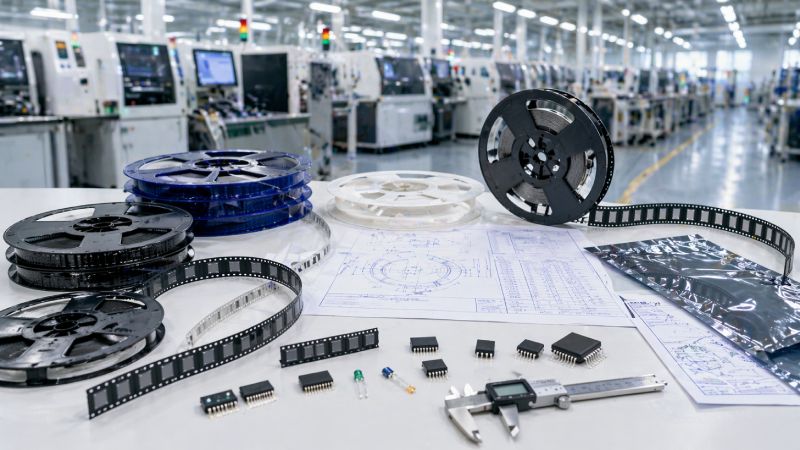
If you are sourcing carrier tape, cover tape, or full tape and reel packaging services, this guide will help you compare suppliers and avoid costly mistakes.
Before you send RFQs to several vendors, use the criteria below to evaluate them side by side.
Why Choosing the Right Tape and Reel Packaging Supplier Matters
Tape and reel packaging is not just a simple packaging step. It directly affects how components move through your SMT production line. If the carrier tape is poorly designed or the cover tape seal is inconsistent, components may flip, jam, or fail to feed correctly.
These problems often lead to:
-
Higher machine downtime
-
More operator intervention
-
Increased component waste
-
Production delays
-
Customer complaints
For example, a supplier that uses incorrect pocket dimensions may save a few cents per reel, but that small saving can create thousands of dollars in downtime later. Similarly, poor ESD protection can damage sensitive semiconductor devices before they ever reach the production line.
The cheapest supplier is not always the lowest-cost option. A more reliable supplier may reduce defects, improve feeding performance, and lower your total manufacturing cost.
If you want to understand how poor packaging affects production, see our guide on common tape and reel packaging defects.
Factor #1 — Does the Supplier Understand Your Component Type?
Not every tape and reel packaging supplier is suitable for every component. Different parts require different cavity designs, materials, and handling methods.
A supplier that specializes in tiny IC chips may not be the best choice for large connectors or irregularly shaped automotive components. Before choosing a supplier, ask whether they have experience with your specific product category.
| Component Type | Supplier Capability Needed |
|---|---|
| IC Chips | Precision cavity design, anti-static material |
| LEDs | Orientation control, light-sensitive handling |
| Passive Components | High-speed, accurate pocket spacing |
| Connectors | Deep-pocket carrier tape and strong retention |
| Automotive Parts | High durability and full traceability |
For example, LED components often require strict orientation control to prevent feeding errors. Connectors may need deep pockets and wider tape widths. Semiconductor devices may require conductive or anti-static carrier tape to prevent electrostatic discharge.
An experienced supplier should be able to show previous examples, engineering drawings, or case studies related to your component type. They should also understand how your parts behave during transport and SMT feeding.
Factor #2 — Can the Supplier Meet EIA-481 and Industry Standards?
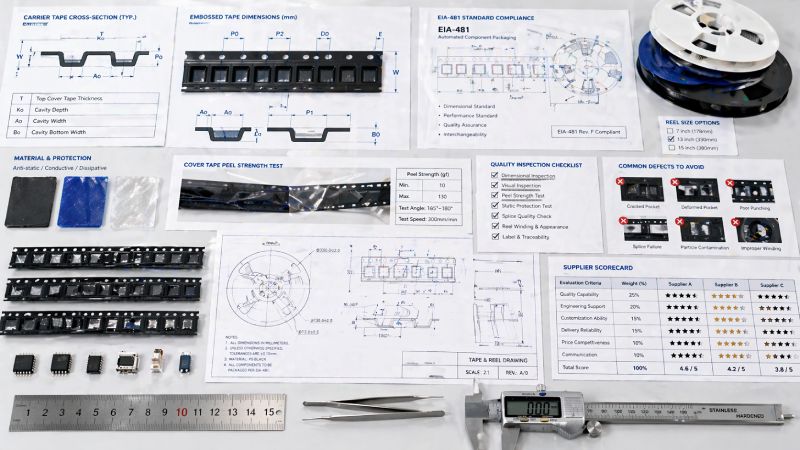
One of the first things you should ask a supplier is whether their tape and reel packaging follows EIA-481 standards. EIA-481 is the industry standard that defines key dimensions and tolerances for carrier tape and reel packaging.
It covers:
-
Pocket dimensions
-
Tape width
-
Sprocket hole spacing
-
Reel size
-
Cover tape peel strength
-
Component orientation
If a supplier does not follow EIA-481, there is a much higher risk that the tape will not work correctly with automated SMT equipment.
In addition to EIA-481, a reliable supplier should also provide supporting certifications such as:
-
ISO 9001
-
RoHS compliance
-
REACH compliance
-
Automotive certifications such as IATF 16949, if required
Ask the supplier to provide:
-
Engineering drawings
-
Material specifications
-
Quality inspection reports
-
Peel test data
-
Compliance certificates
A trustworthy supplier should be willing to share this information before production begins.
You can learn more about the standard in our article on understanding EIA-481 for carrier tape.
Factor #3 — What Customization Options Are Available?
Many components do not fit into standard carrier tape sizes. If your part has a unique shape, height, or orientation requirement, you may need a custom tape and reel solution.
The best suppliers offer a wide range of customization options, including:
-
Custom carrier tape width
-
Pocket length, width, and depth
-
Embossed or punched tape
-
Conductive, anti-static, or transparent material
-
Custom reel sizes
-
Barcode labels and custom packaging
A good supplier should also provide engineering support during the design stage. They should review your component dimensions, recommend suitable tape material, and create a custom cavity that protects the part during shipping and feeding.
Before choosing a supplier, ask these questions:
-
How long does new tooling take?
-
Is there a minimum order quantity for custom tape?
-
Can you provide sample reels before mass production?
-
Is the tooling fee one-time or charged again for repeat orders?
The supplier should be able to produce sample tape quickly so you can test it on your SMT line before full production.
If you need a fully customized solution, our tape and reel packaging service supports custom cavity design, anti-static materials, and sample validation.
Factor #4 — How Strong Is the Supplier’s Quality Control Process?
Quality control is one of the biggest differences between an average supplier and an excellent one. Even if the carrier tape design is correct, poor manufacturing quality can still create problems.
A reliable supplier should inspect every stage of production, including:
-
Incoming raw material inspection
-
Cavity dimension inspection
-
Cover tape sealing quality
-
Component orientation verification
-
Reel count accuracy
-
Final visual inspection
The supplier should also test important performance factors such as:
-
Cover tape peel strength
-
Pocket consistency
-
ESD performance
-
Feeding performance on SMT equipment
Ask whether the supplier can provide:
-
First article inspection reports
-
QC photos
-
Peel test results
-
Production records
-
Lot traceability
Strong traceability is especially important for automotive, medical, and industrial electronics. If a problem occurs later, you should be able to trace the reel back to a specific production lot.
Suppliers with a mature QC process are also more likely to catch issues before shipment. This reduces the risk of receiving unusable reels and helps avoid urgent rework.
For more detail, read our article about quality control in tape and reel packaging.
Factor #5 — Can the Supplier Support Your Required Production Volume?
Some suppliers are excellent at prototype projects but struggle with larger orders. Others are built for high-volume production but are not flexible enough for small custom runs.
Before selecting a supplier, think about both your current demand and your future growth.
| Supplier Type | Best For |
|---|---|
| Small Specialist Supplier | Prototype and low-volume orders |
| Medium Supplier | Flexible custom projects |
| Large Supplier | High-volume production and stable supply |
Ask the supplier about:
-
Minimum order quantity
-
Monthly production capacity
-
Maximum output per month
-
Ability to scale quickly
-
Backup production lines
For example, if you expect your annual demand to increase rapidly, you need a supplier that can grow with you. Otherwise, you may have to switch suppliers later, which can create delays and require new tooling.
It is also useful to ask whether the supplier keeps standard raw materials in stock. This can help reduce lead time during periods of high demand.
Factor #6 — How Fast Are Lead Times and Sample Turnaround?
Fast lead times are often more important than low pricing. If you are waiting weeks for samples or tooling, your project launch may be delayed.
Typical lead times in the tape and reel industry are:
| Project Stage | Typical Lead Time |
|---|---|
| Standard Tape Order | 3–7 days |
| Custom Tooling | 7–15 days |
| Sample Production | 3–5 days |
| Mass Production | 2–4 weeks |
However, actual timing depends on the supplier’s engineering team, raw material inventory, and production capacity.
When comparing suppliers, ask:
-
How quickly can you respond to engineering questions?
-
How long does it take to make a new tool?
-
Can you ship samples within one week?
-
What happens if we need urgent production?
A supplier with fast communication and quick sampling is often more valuable than a supplier that only offers a lower price.
Suppliers that keep raw materials, standard reels, and cover tape in stock are usually able to deliver faster and more consistently.
Factor #7 — What Level of Engineering and Technical Support Is Provided?
A strong tape and reel packaging supplier should do more than simply manufacture tape. They should act as a technical partner.
Good suppliers help optimize:
-
Cavity design
-
Tape pitch
-
Reel size
-
Cover tape type
-
Feeding performance
-
ESD protection
For example, if your component is unstable in the pocket, an experienced supplier may recommend changing the cavity depth or switching to a different cover tape. If your reel is too large or too small for your SMT line, they may recommend another reel size.
These changes may seem small, but they can improve feeding performance and reduce defects.
Before you approve tooling, ask the supplier to review your part drawings and provide recommendations. This early engineering review can save significant time and cost later.
You may also want to review our related articles on tape pitch in carrier tape packaging and how reel size affects SMT feeding performance.
Factor #8 — Should You Choose a Local or Overseas Supplier?
Many buyers compare local suppliers with overseas manufacturers. Both options have advantages and disadvantages.
| Factor | Local Supplier | Overseas Supplier |
|---|---|---|
| Price | Usually higher | Usually lower |
| Communication | Easier and faster | May require more coordination |
| Shipping Time | Faster delivery | Longer transit time |
| Customization | More limited | Often more flexible |
| Production Capacity | Smaller | Larger |
Local suppliers may provide easier communication and faster delivery. This can be useful for urgent projects or small orders.
However, overseas suppliers often offer more competitive pricing, stronger customization capability, and higher production capacity. Many experienced tape and reel manufacturers in Asia support international customers and can provide fast sample production even if shipping takes longer.
If you choose an overseas supplier, make sure they have:
-
Clear English communication
-
Fast response time
-
Export experience
-
Reliable shipping support
A supplier that communicates well and provides clear technical documentation can often be easier to work with than a local supplier that lacks engineering capability.
10 Questions to Ask Before Choosing a Tape and Reel Packaging Supplier
Before making your final decision, ask every supplier the same questions. This makes it easier to compare them fairly.
-
What types of components do you specialize in?
-
Are your products EIA-481 compliant?
-
Can you provide custom carrier tape samples?
-
What certifications do you have?
-
What is your minimum order quantity?
-
How long do tooling and samples take?
-
What quality inspections do you perform?
-
Can you provide recent case studies or references?
-
What happens if a defect is found after shipment?
-
How quickly can you increase production volume?
You can copy this list into a spreadsheet and use it when speaking with different suppliers. The answers will quickly show which supplier is the best fit for your project.
Red Flags That Indicate a Poor Tape and Reel Packaging Supplier
Some warning signs should make you reconsider working with a supplier.
Common red flags include:
-
They have no experience with your component type.
-
They cannot provide drawings or test reports.
-
Their pricing is much lower than every other supplier, but they cannot explain why.
-
They take several days to answer simple technical questions.
-
They do not offer samples before mass production.
-
They have no quality documentation or traceability system.
-
Their lead times are unclear or change frequently.
If a supplier shows several of these warning signs, there is a high risk of problems later. In most cases, it is better to pay slightly more for a supplier that is reliable and technically capable.
How to Compare Suppliers Side by Side
The easiest way to compare suppliers is to create a simple scorecard. Rate each supplier based on the factors that matter most to your project.
| Criteria | Weight |
|---|---|
| Quality | 35% |
| Technical Support | 20% |
| Lead Time | 15% |
| Customization | 15% |
| Price | 15% |
You can then score each supplier from 1 to 10 in every category. Multiply the score by the weight to find the total result.
Most companies focus too much on price. In reality, quality and technical support are usually more important. A supplier that prevents production problems will often save much more money over time.
Conclusion
Choosing a tape and reel packaging supplier is about much more than finding the lowest price. The right supplier should understand your component type, follow EIA-481 standards, provide strong quality control, and offer reliable engineering support.
You should also compare customization capability, lead time, production capacity, and communication quality. Taking the time to evaluate suppliers carefully can help you avoid costly packaging problems and improve SMT performance.
Before placing a large order, always request samples and test them on your production line.
If you are looking for a supplier that offers custom carrier tape, anti-static materials, fast sample turnaround, and full engineering support, contact our team today to discuss your project and receive a custom recommendation.



 Emial
Emial John Mr