
Paper Carrier Tape Manufacturing Process: From Raw Material to SMT-Ready Packaging
Paper carrier tape plays a critical role in modern SMT (Surface Mount Technology) packaging. While many buyers focus on dimensions, pricing, and lead times, the manufacturing process behind the carrier tape often determines whether components feed smoothly on automated assembly lines or cause costly production interruptions.
A well-manufactured paper carrier tape protects electronic components during transportation, storage, and automated placement. In contrast, poor manufacturing quality can lead to feeding errors, pocket deformation, component loss, and increased assembly costs.
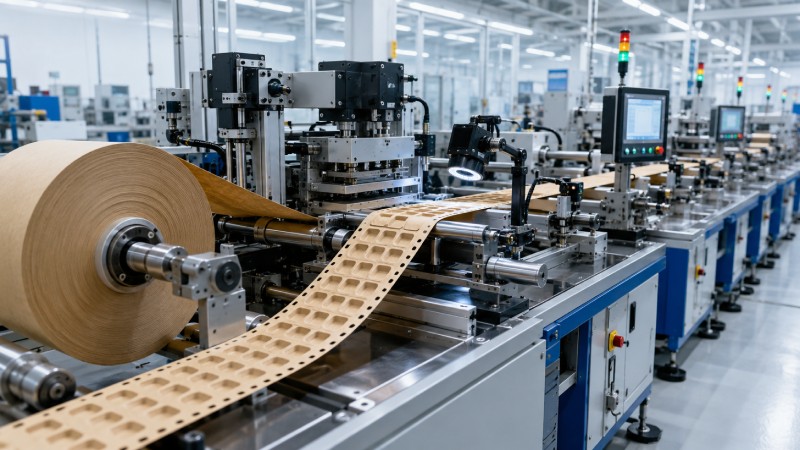
In this guide, we‘ll walk through the complete paper carrier tape manufacturing process—from raw material selection to final inspection—so you can better evaluate suppliers and choose the right packaging solution for your components.
Why the Manufacturing Process Matters More Than Most Buyers Realize
Many procurement teams view carrier tape as a simple packaging material. However, experienced SMT engineers understand that tape quality directly affects assembly performance.
When pocket dimensions vary or sprocket holes are misaligned, pick-and-place machines may struggle to feed components accurately. Even a small dimensional inconsistency can create thousands of placement errors during high-volume production.
Manufacturing quality also impacts:
-
Component retention during shipping
-
Feeding stability on SMT equipment
-
Cover tape sealing performance
-
Storage durability
-
Production yield rates
Ultimately, a lower-cost carrier tape that causes production downtime often becomes more expensive than a higher-quality alternative.
Raw Materials Used in Paper Carrier Tape Production
The manufacturing process begins with selecting the appropriate paper material.
Base Paper Materials
Most paper carrier tapes are produced using industrial-grade kraft paper or specially engineered fiber-based materials designed for packaging applications.
These materials must provide:
-
Consistent thickness
-
High tensile strength
-
Dimensional stability
-
Excellent formability
Unlike ordinary paper products, carrier tape materials must withstand continuous feeding through automated equipment without tearing or deforming.
Functional Coatings
Depending on the application, manufacturers may apply specialized coatings to enhance performance.
Common options include:
-
Anti-static (ESD) coatings
-
Moisture-resistant coatings
-
Surface strengthening treatments
-
Enhanced sealing surfaces
These coatings improve both production reliability and long-term storage performance.
Material Selection Factors
Manufacturers evaluate raw materials based on several key criteria:
| Factor | Importance |
|---|---|
| Thickness consistency | Accurate pocket formation |
| Tensile strength | Reliable feeding |
| Surface smoothness | Better cover tape sealing |
| Humidity resistance | Storage stability |
| Dimensional stability | Process consistency |
Poor-quality paper materials frequently lead to pocket deformation and feeding issues later in production.
Step 1: Paper Preparation and Material Conditioning
Before production begins, raw paper rolls undergo a preparation process.
Incoming Material Inspection
Quality control teams inspect incoming materials for:
-
Thickness tolerance
-
Roll width accuracy
-
Surface defects
-
Moisture content
-
Fiber consistency
Any material that fails specifications is rejected before entering production.
Environmental Conditioning
Paper is naturally affected by humidity and temperature.
To minimize dimensional changes, manufacturers often condition materials in controlled environments before processing. Maintaining stable temperature and humidity levels helps ensure consistent pocket formation later in production.
Roll Preparation
The paper rolls are then mounted onto unwinding systems equipped with tension control mechanisms.
Proper tension management is essential because excessive tension can stretch the material, while insufficient tension may create alignment problems during manufacturing.
Step 2: Pocket Forming and Embossing Process
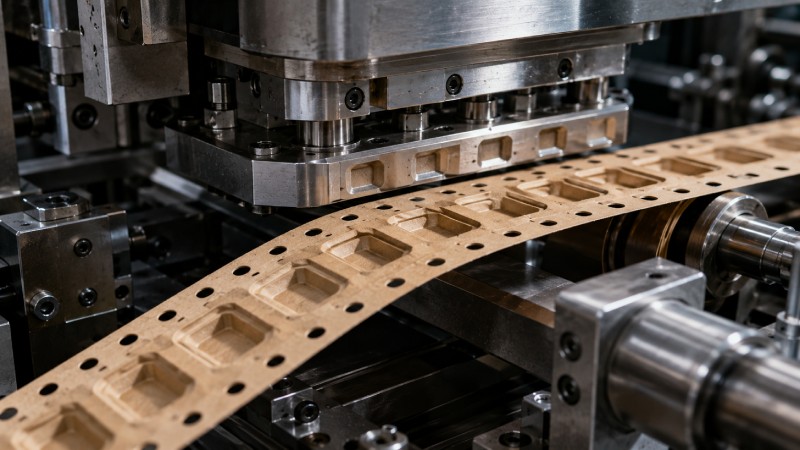
Pocket forming is the most critical stage in the paper carrier tape manufacturing process.
This step determines whether components will fit securely and feed properly during automated assembly.
How Pockets Are Created
Manufacturers use precision mechanical forming systems and specially designed tooling to create pockets in the paper tape.
The tooling is engineered according to component dimensions, ensuring each pocket provides adequate support and protection.
Critical Pocket Dimensions
Several dimensions must be tightly controlled:
-
Pocket width
-
Pocket length
-
Pocket depth
-
Pocket pitch
-
Corner geometry
Even minor variations can affect component positioning.
Common Forming Challenges
During pocket formation, manufacturers must prevent:
-
Pocket collapse
-
Edge cracking
-
Inconsistent depth
-
Surface damage
-
Dimensional drift
These issues become more likely when using poor-quality raw materials or worn tooling.
Maintaining Pocket Consistency
Leading manufacturers maintain consistency through:
-
Regular tool calibration
-
Preventive maintenance programs
-
Process monitoring systems
-
Statistical quality control
Consistent pockets help ensure stable feeding performance throughout the SMT assembly process.
Step 3: Sprocket Hole Punching and Alignment Control
After pocket formation, sprocket holes are punched along the carrier tape.
Why Sprocket Holes Matter
Sprocket holes allow SMT feeders to advance the tape precisely through pick-and-place machines.
Without accurate hole positioning, components cannot be presented correctly to placement equipment.
Precision Requirements
Critical specifications include:
-
Hole diameter
-
Hole pitch
-
Hole location accuracy
-
Edge distance
Manufacturers must maintain tight tolerances throughout production.
Impact on SMT Performance
Poor sprocket hole quality can result in:
-
Feeding interruptions
-
Component misalignment
-
Machine stoppages
-
Increased production downtime
Interestingly, a tape with visually perfect pockets may still perform poorly if sprocket hole accuracy is compromised.
Step 4: Surface Treatment and Functional Coating Application
Many paper carrier tapes receive additional treatments after forming.
Anti-Static Protection
Electronic components are often sensitive to electrostatic discharge.
Anti-static treatments help reduce static buildup during:
-
Manufacturing
-
Transportation
-
Storage
-
Automated feeding
This is particularly important for semiconductor and precision electronic components.
Moisture Protection
Paper naturally absorbs moisture from the environment.
Special coatings help improve:
-
Humidity resistance
-
Dimensional stability
-
Storage performance
These benefits become especially valuable during international shipping.
Surface Enhancement
Additional treatments may improve:
-
Mechanical strength
-
Surface durability
-
Cover tape adhesion
-
Wear resistance
The goal is to ensure the carrier tape maintains consistent performance throughout its entire lifecycle.
Step 5: Quality Inspection Throughout Production
Modern carrier tape manufacturing relies heavily on continuous quality inspection.
Rather than waiting until production is complete, leading manufacturers inspect products throughout every stage of manufacturing.
Dimensional Inspection
Operators routinely verify:
-
Pocket dimensions
-
Pocket pitch
-
Tape width
-
Hole position
-
Overall geometry
Measurements are compared against engineering specifications and customer requirements.
Automated Vision Inspection
Advanced production lines often incorporate machine vision systems capable of detecting:
-
Pocket defects
-
Surface damage
-
Hole misalignment
-
Contamination
-
Material inconsistencies
Automated inspection significantly improves defect detection compared to manual methods.
Mechanical Performance Testing
Manufacturers also evaluate physical performance characteristics such as:
-
Tensile strength
-
Tear resistance
-
Feeding performance
-
Cover tape peel behavior
These tests help confirm that the finished product will perform reliably during SMT assembly.
Common Defects Identified During Inspection
| Defect | Potential Impact |
|---|---|
| Pocket deformation | Component movement |
| Hole misalignment | Feeding failures |
| Surface damage | Seal integrity issues |
| Dimension variation | Placement errors |
| Material defects | Reduced reliability |
Effective inspection systems are often the difference between premium manufacturers and low-cost suppliers.
Step 6: Slitting, Rewinding, and Final Packaging
Once inspection is complete, the tape enters finishing operations.
Precision Slitting
Large master rolls are slit into customer-specified widths.
High-precision slitting equipment ensures:
-
Clean edges
-
Accurate widths
-
Consistent reel quality
Poor slitting can introduce feeding problems even when earlier manufacturing stages were successful.
Controlled Rewinding
The finished tape is wound onto reels using carefully controlled tension.
Proper rewinding helps prevent:
-
Reel deformation
-
Tape telescoping
-
Feeding instability
Final Packaging
Before shipment, products are packaged using protective materials designed to minimize:
-
Moisture exposure
-
Physical damage
-
Contamination
Each reel is labeled with production information for traceability purposes.
Quality Standards in Paper Carrier Tape Manufacturing
High-quality manufacturers follow recognized industry standards throughout production.
One of the most widely referenced standards is EIA-481, which defines requirements for carrier tapes used in electronic component packaging.
Manufacturers typically maintain:
-
Process documentation
-
Inspection records
-
Material traceability
-
Production history
Traceability allows manufacturers to quickly investigate and resolve any quality concerns that arise after delivery.
For buyers, compliance with recognized standards often provides greater confidence in long-term performance.
What Separates a High-Quality Manufacturer from a Low-Cost Supplier?
Not all carrier tape manufacturers offer the same level of capability.
Advanced Production Equipment
Premium manufacturers invest heavily in:
-
Automated forming systems
-
Precision punching equipment
-
Vision inspection technology
-
Process monitoring systems
These investments improve consistency and reduce defect rates.
Strong Quality Systems
Look for suppliers that utilize:
-
In-process inspections
-
Statistical process control (SPC)
-
Preventive maintenance programs
-
Comprehensive testing procedures
Engineering Expertise
An experienced engineering team can help optimize:
-
Pocket design
-
Component fit
-
Feeding performance
-
Packaging efficiency
This support becomes particularly valuable for custom carrier tape projects.
Production Consistency
When evaluating suppliers, ask:
-
How are pocket dimensions controlled?
-
What inspection systems are used?
-
Is automated vision inspection available?
-
How is traceability maintained?
-
What testing is performed before shipment?
-
Can feeding performance be validated?
-
What experience exists with similar components?
The answers often reveal more than pricing alone.
Choosing the Right Manufacturing Partner for Custom Paper Carrier Tape
For custom applications, manufacturing capability becomes even more important.
An ideal supplier should provide:
-
Custom pocket design assistance
-
Engineering consultation
-
Sample development
-
Prototype validation
-
Production scalability
The best manufacturers work collaboratively with customers throughout the development process, helping optimize both packaging performance and production efficiency.
Whether you‘re packaging semiconductors, LEDs, passive components, sensors, or specialty electronic devices, selecting the right manufacturing partner can significantly reduce packaging risks and improve SMT line performance.
Frequently Asked Questions
How is paper carrier tape different from embossed plastic carrier tape?
Paper carrier tape is generally more cost-effective and environmentally friendly, while embossed plastic carrier tape may offer greater durability for certain component types.
Can paper carrier tape provide ESD protection?
Yes. Anti-static coatings and treatments can be applied to meet ESD-sensitive packaging requirements.
How is feeding performance verified?
Manufacturers often conduct feeder simulation tests and mechanical performance evaluations to confirm reliable operation.
What information is needed for a custom carrier tape design?
Typically:
-
Component dimensions
-
Weight
-
Orientation requirements
-
Packaging quantity
-
SMT feeder specifications
How long does custom development take?
Development timelines vary depending on tooling complexity, but sample development generally requires several weeks before mass production begins.
Conclusion
The paper carrier tape manufacturing process involves far more than simply forming pockets into paper. Every stage—from raw material selection and environmental conditioning to pocket forming, sprocket hole punching, surface treatment, inspection, and final packaging—directly impacts SMT assembly performance.
For buyers, understanding these manufacturing steps provides valuable insight when comparing suppliers. A manufacturer with advanced equipment, robust quality control systems, and strong engineering support is far more likely to deliver consistent, reliable carrier tape that performs smoothly on automated production lines.
When evaluating paper carrier tape suppliers, focus not only on price but also on process capability, inspection standards, and manufacturing expertise. In SMT packaging, quality manufacturing is often the key to lower total production costs and higher assembly efficiency.



 Emial
Emial John Mr