

Paper Carrier Tape Packaging Process: Complete Manufacturing & Quality Control Guide
In modern electronics manufacturing, even the smallest packaging detail can affect production efficiency. A poorly designed carrier tape may cause component misalignment, feeding interruptions, or costly downtime on high-speed SMT assembly lines.
Paper carrier tape remains one of the most widely used packaging solutions for passive electronic components such as resistors, capacitors, inductors, and diodes. Its lightweight structure, cost-effectiveness, and compatibility with automated tape-and-reel systems make it a preferred choice for manufacturers worldwide.
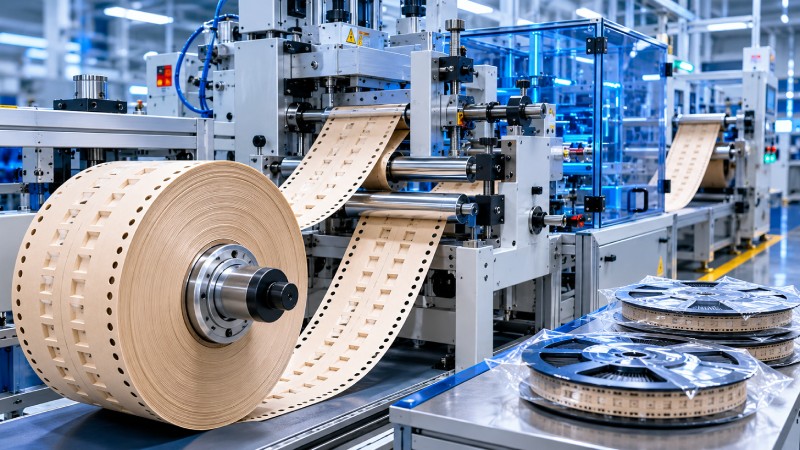
Understanding the paper carrier tape packaging process helps buyers evaluate supplier capabilities, identify quality risks, and ensure reliable component feeding during SMT production. This guide explains the complete process—from raw paper selection to final tape-and-reel packaging—and highlights the critical quality controls that ensure consistent performance.
What Is the Paper Carrier Tape Packaging Process?
The paper carrier tape packaging process refers to the series of manufacturing and quality-control operations used to produce carrier tapes that securely hold electronic components for automated placement machines.
The process typically includes:
-
Paper material selection
-
Surface treatment
-
Slitting
-
Pocket forming
-
Sprocket hole punching
-
Dimension inspection
-
Cover tape compatibility testing
-
Tape-and-reel packaging
-
Final shipment preparation
Each stage contributes to the overall reliability of the finished product. Even minor dimensional variations can affect feeding accuracy and lead to component loss during high-speed assembly.
Paper carrier tapes are commonly used for:
-
Chip resistors
-
Multilayer ceramic capacitors (MLCCs)
-
Inductors
-
Diodes
-
Small semiconductor packages
-
Other miniature electronic components
Because SMT production lines often operate at extremely high speeds, manufacturers must maintain tight process control throughout the entire packaging workflow.
Overview of the Complete Production Flow
The typical paper carrier tape manufacturing process follows a structured sequence:
Raw Paper Selection
↓
Surface Treatment & Material Preparation
↓
Slitting
↓
Pocket Forming
↓
Sprocket Hole Punching
↓
Dimension Inspection
↓
Cover Tape Compatibility Testing
↓
Tape & Reel Packaging
↓
Shipment
Every stage affects tape quality, dimensional consistency, and feeding reliability. A defect introduced early in production may eventually cause failures during SMT assembly, making process control essential from start to finish.
Step 1: Selecting the Right Paper Material
The foundation of a reliable carrier tape begins with high-quality paper.
Paper materials must provide sufficient strength while maintaining dimensional stability during forming and transportation. Manufacturers carefully evaluate several characteristics before selecting base materials.
Key Material Requirements
-
Consistent thickness
-
High tensile strength
-
Uniform fiber density
-
Good moisture resistance
-
Stable dimensional performance
Common Paper Types
Kraft Paper
Widely used for standard carrier tape applications due to its balance of strength and affordability.
Reinforced Paper
Designed for applications requiring additional durability during transportation and handling.
Anti-Static Treated Paper
Suitable for sensitive electronic components that require protection from electrostatic discharge.
Poor-quality paper can lead to curling, deformation, or pocket instability. These issues often result in feeding errors and reduced packaging reliability. Therefore, selecting the appropriate paper material is one of the most critical decisions in the entire manufacturing process.
Step 2: Surface Treatment and Material Preparation
Raw paper alone may not provide the performance required for modern SMT packaging. Surface treatment improves durability, cleanliness, and compatibility with automated equipment.
Why Surface Treatment Matters
Electronic components require a clean and stable packaging environment. Untreated paper can generate dust, absorb moisture, or create excessive friction during feeding.
Manufacturers often apply treatments to improve:
-
Surface smoothness
-
Dust resistance
-
Moisture protection
-
Static control
-
Wear resistance
Common Treatment Methods
Anti-Static Coating
Reduces static buildup that could damage sensitive electronic components.
Surface Sealing
Minimizes fiber shedding and dust generation.
Protective Lamination
Enhances mechanical strength and environmental resistance.
Proper surface treatment ensures the carrier tape maintains consistent performance throughout storage, transportation, and SMT assembly.
Step 3: Pocket Forming Process
Pocket forming is the most important stage of carrier tape production.
The pockets hold individual electronic components and must be manufactured with exceptional precision.
How Pockets Are Created
Manufacturers use specialized forming equipment and precision tooling to create cavities that match component dimensions.
The forming process typically involves:
-
Precision die cutting
-
Mechanical punching
-
Controlled shaping operations
Critical Design Factors
When designing pockets, engineers consider:
-
Component length
-
Component width
-
Component height
-
Orientation requirements
-
Pick-and-place compatibility
Quality Parameters
Several dimensions must remain within strict tolerances:
-
Pocket depth
-
Pocket width
-
Pocket length
-
Pocket pitch
-
Pocket positioning accuracy
If pockets are too large, components may rotate or shift during transportation.
If pockets are too small, components may become damaged or difficult to load.
Proper pocket design ensures components remain secure while still allowing efficient pickup by automated assembly equipment.
Step 4: Sprocket Hole Punching and Alignment
Sprocket holes are essential for automated feeding systems.
During SMT assembly, feeder mechanisms engage these holes to move the carrier tape accurately through the placement machine.
Functions of Sprocket Holes
-
Tape indexing
-
Position control
-
Feeding synchronization
-
Transport stability
Critical Specifications
Manufacturers closely monitor:
-
Hole diameter
-
Hole pitch
-
Hole position
-
Center alignment
Even slight deviations can cause feeding interruptions, skipped components, or machine stoppages.
Most manufacturers follow EIA-481 standards to ensure compatibility with industry-standard feeder systems.
Accurate sprocket hole punching is crucial for maintaining smooth operation on high-speed SMT production lines.
Step 5: Precision Dimension Inspection
After forming and punching, carrier tapes undergo comprehensive dimensional inspection.
The purpose is to verify that all critical dimensions meet design specifications before the tape enters the packaging stage.
Dimensions Commonly Inspected
-
Tape width
-
Pocket width
-
Pocket depth
-
Pocket pitch
-
Sprocket hole pitch
-
Hole diameter
-
Tape flatness
Inspection Equipment
Manufacturers often use:
-
Vision measurement systems
-
Optical inspection equipment
-
Digital precision gauges
-
Automated dimensional analysis tools
Statistical Process Control
Advanced manufacturers implement SPC systems to monitor production consistency and identify variations before defects occur.
This proactive approach reduces waste, improves quality, and ensures stable performance across large production batches.
Step 6: Cover Tape Compatibility Verification
A carrier tape system consists of both the carrier tape and the cover tape.
Even if the carrier tape is manufactured perfectly, poor cover tape compatibility can compromise packaging reliability.
Key Requirements
The cover tape must:
-
Seal securely
-
Protect components
-
Peel consistently
-
Support automated assembly
Common Testing Procedures
Peel Force Testing
Measures the force required to remove the cover tape.
Seal Strength Testing
Verifies adequate bonding between carrier tape and cover tape.
Transportation Simulation
Evaluates packaging performance under vibration and handling conditions.
Common failures include:
-
Excessive peel force
-
Weak seals
-
Component escape
-
Inconsistent peeling behavior
Compatibility testing ensures the complete packaging system functions reliably throughout the supply chain.
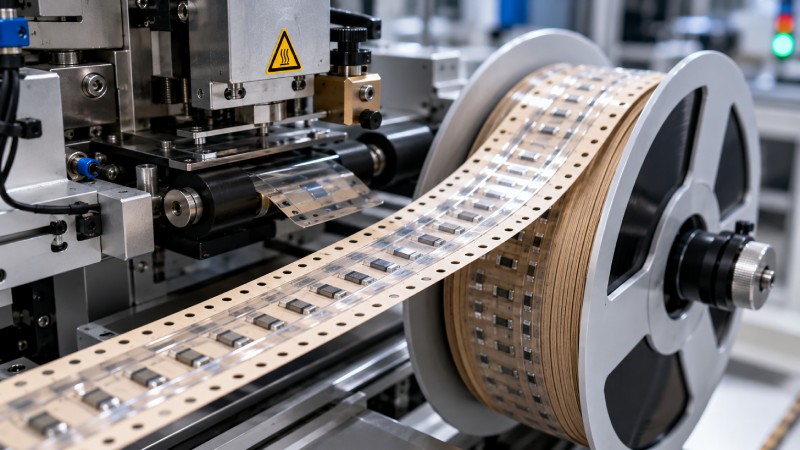
Step 7: Tape and Reel Packaging Process
Once carrier tape production is complete, components are loaded into the pockets and prepared for shipment.
Component Loading
Automated equipment places components into individual pockets according to predefined orientation requirements.
Vision systems often verify correct placement before sealing.
Cover Tape Sealing
The cover tape is applied using carefully controlled heat and pressure settings.
Proper sealing prevents component movement while maintaining acceptable peel characteristics.
Reel Winding
The sealed carrier tape is wound onto reels under controlled tension.
Excessive tension can deform the tape, while insufficient tension may cause loose winding.
Final Packaging
Completed reels are typically packaged with:
-
Moisture barrier materials
-
Protective bags
-
Labels
-
Traceability information
-
Lot identification codes
At this stage, the product is ready for storage, transportation, and SMT assembly operations.
Quality Control Throughout the Entire Process
Quality control is not limited to a single inspection step. Instead, it is integrated throughout the entire manufacturing workflow.
Incoming Material Inspection
Manufacturers verify paper quality before production begins.
In-Process Inspection
Critical dimensions and process parameters are monitored continuously during manufacturing.
Final Product Inspection
Finished carrier tapes undergo comprehensive verification before shipment.
Traceability Management
Production records, material batches, and inspection data are documented to support quality assurance and continuous improvement.
Manufacturers with strong quality systems often achieve higher consistency, lower defect rates, and better long-term reliability.
Common Problems During Paper Carrier Tape Packaging
Despite advances in manufacturing technology, several issues can still occur if process controls are inadequate.
| Problem | Common Cause | Solution |
|---|---|---|
| Pocket deformation | Poor paper quality | Upgrade material specifications |
| Feeding interruptions | Hole misalignment | Improve tooling accuracy |
| Component escape | Oversized pockets | Optimize pocket dimensions |
| Tape curling | Moisture imbalance | Environmental control |
| Cover tape failure | Incorrect sealing parameters | Adjust sealing conditions |
Early identification and correction of these issues can significantly improve packaging performance and reduce production costs.
How to Choose a Reliable Paper Carrier Tape Manufacturer
Selecting the right supplier is often more important than achieving the lowest purchase price.
Evaluate Manufacturing Capabilities
Look for manufacturers with:
-
In-house tooling development
-
Precision forming equipment
-
Custom design capabilities
-
Stable production capacity
Review Quality Systems
Reliable suppliers should demonstrate:
-
EIA-481 compliance
-
Comprehensive inspection procedures
-
Traceability systems
-
Continuous improvement programs
Assess Engineering Support
Strong engineering teams can help optimize:
-
Pocket design
-
Material selection
-
Cover tape matching
-
Packaging efficiency
Consider Supply Stability
Consistent lead times and dependable delivery performance are essential for maintaining uninterrupted production schedules.
A supplier that combines technical expertise with strong quality control often delivers greater long-term value than a low-cost alternative.
Why Process Consistency Matters More Than Low Cost
Many buyers focus heavily on unit price when sourcing carrier tape.
However, the true cost of packaging extends beyond material expenses.
Packaging failures can lead to:
-
SMT line stoppages
-
Component loss
-
Increased labor costs
-
Product quality issues
-
Delayed shipments
A carrier tape that costs slightly more but delivers consistent performance often reduces overall manufacturing costs.
For electronics manufacturers operating high-volume SMT lines, process stability is far more valuable than short-term cost savings.
Conclusion
The paper carrier tape packaging process involves much more than simply forming pockets in paper. From raw material selection and surface treatment to precision forming, inspection, cover tape testing, and tape-and-reel packaging, every stage influences the reliability of the final product.
High-quality paper carrier tape helps ensure smooth feeding, protects valuable electronic components, and minimizes disruptions on SMT assembly lines.
When evaluating suppliers, manufacturers should focus not only on pricing but also on process control, engineering capability, quality systems, and long-term consistency. A well-managed packaging process ultimately delivers better production efficiency, lower operational costs, and more reliable electronic manufacturing outcomes.



 Emial
Emial John Mr